
Show summary Hide summary
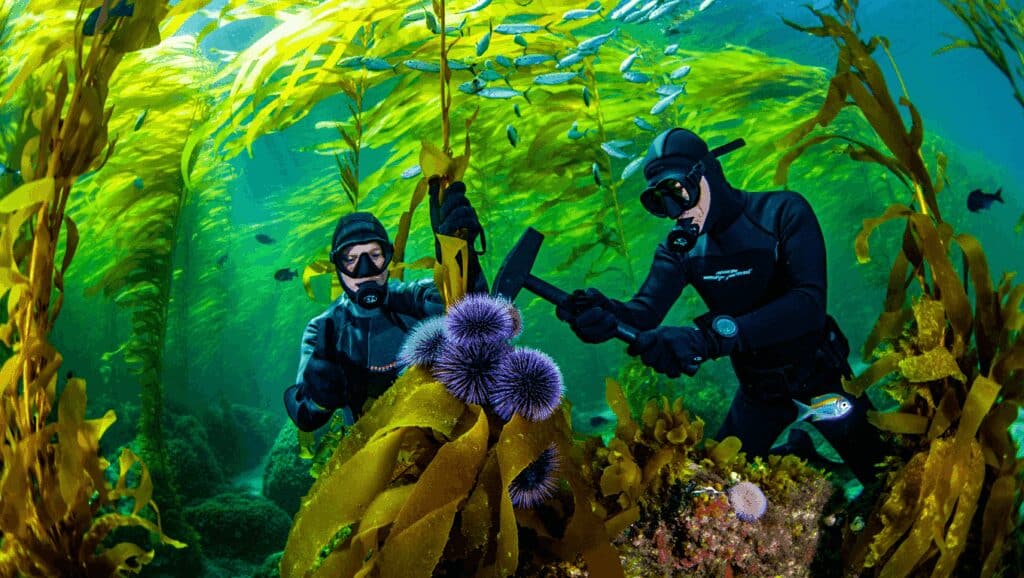
For more than a decade, volunteer divers have been quietly wielding hammers off the coast of Santa Monica, California — not to build reefs, but to knock apart an ecological problem that nearly erased the region’s kelp forests. What began as a small, persistent effort by the Bay Foundation has turned into one of the most unusual and effective local marine restorations in recent years, showing how targeted, hands-on work can spark dramatic returns in coastal ecosystems.
The scene below the waves is almost cinematic: wetsuits and tanks, steady hands, and the repetitive tap of tools on sea urchin shells. That steady rhythm has cleared vast swaths of seafloor, allowing kelp to reestablish itself and hundreds of species to return. The project blends science, sweat, and community action — and it’s producing fast, tangible results.
How a grassroots effort revived kelp forests near Santa Monica
The Bay Foundation organized and supported a team of volunteer divers who have, over the course of roughly 13 years, removed millions of purple sea urchins from reefs where kelp once flourished. These volunteers don’t use nets or explosives — they dive with hammers, working methodically to reduce urchin densities and give kelp spores a chance to take hold.
The Growing Demand for Data-Driven Decision Making in Silicon Valley
He quit, ran out of money, and begged to come back — here’s how his boss reacted
Key facts about the campaign:
- Time invested: Tens of thousands of volunteer hours logged on dives that sometimes lasted several hours each.
- Scale of removal: More than 5.8 million sea urchins removed, clearing seabed equivalent to dozens of football fields.
- Method: Manual removal using hammers and hand extraction; larger healthy urchins are often left for local fisheries.
- Outcome: Dense kelp forests reestablished within months in treated areas, bringing back associated marine life.
Why sea urchins multiplied and how that killed kelp
Kelp forests are dynamic marine ecosystems, but they’re vulnerable when natural predators decline. In this region, the collapse occurred in stages:
- Commercial hunting and other pressures sharply reduced sea otter populations, one of the kelp forest’s key urchin predators.
- Sea star populations then suffered from a widespread wasting disease, removing another important control on urchin numbers.
- With predators diminished, purple spiny sea urchins proliferated into dense aggregations that grind the seabed with their spines and consume kelp faster than it can regrow.
Scientists and divers have observed seabeds where dozens of urchins occupy each square meter, leaving the substrate scoured and unable to anchor kelp spores. In those “urchin barren” zones, little else can survive until urchin pressure is reduced.
Underwater labor: what the divers actually do and why it works
Divers train and coordinate to clear urchin-dominated areas using a simple but relentless technique: locate, tap, and remove. The work is physically demanding — divers haul tools and bags of urchins while dealing with currents, cold, and the constraints of breathing through scuba gear.
What a typical dive includes:
- Surveying the site to estimate urchin density and prioritize areas for removal.
- Using hand tools to break or collect small, starving urchins that prevent kelp spores from settling.
- Removing or relocating shells and debris, and leaving robust urchins that can be sold or sustain local fisheries.
Volunteer accounts emphasize how repetitive and tiring the work can be: long shifts, sore forearms, and the physical strain of reaching into crevices where urchins hide. Yet the payoff is rapid: in several zones, divers reported kelp return within three months of intensive removal. Kelp’s fast growth rate — in some cases up to two feet per day under ideal conditions — means recovery can be dramatic once the grazing pressure is eased.
What regrown kelp forests bring back to the coast
Kelp is more than seaweed. As it grows into towering strands and wide canopies, it creates a three-dimensional habitat that supports a huge variety of life and provides concrete ecosystem services:
- Biodiversity boost: Fish, invertebrates, and crustaceans like California spiny lobster return to the complex structure of a healthy kelp bed.
- Storm protection: Thick kelp canopies dampen wave energy, helping to reduce shoreline erosion and buffer coastal areas from storm surge.
- Carbon and nutrient cycling: Kelp forests sequester carbon and support food webs that extend into nearby habitats.
Volunteers describe the first dives through restored kelp as almost otherworldly: sunlight streaming through long swathes of kelp, fish weaving through fronds, and a sense that an underwater “forest” has come back to life.
Lessons for marine conservation and community-driven restoration
The Santa Monica example highlights several takeaways for coastal managers and community groups:
- Targeted, local intervention can reverse ecosystem collapse when larger-scale predator recovery is slow or uncertain.
- Volunteer networks, supported by nonprofit organizations, can carry out long-term, labor-intensive projects that would be costly for government agencies alone.
- Combining removal efforts with sustainable use — for example, allowing healthy urchins to be harvested — builds economic incentives that help maintain balance.
Scientists caution that removing vast numbers of an animal, even a native one, is not a universal solution. Successful restoration depends on monitoring, adaptive management, and, where possible, restoring predator populations and overall ecosystem resilience.
How the approach could be adapted elsewhere
Replicating this model requires local knowledge and partnerships. Potential steps include:
- Baseline surveys to identify hotspots and prioritize areas where kelp recovery is feasible.
- Engaging trained volunteers and local fishers to reduce urchin densities while creating market opportunities for harvested individuals.
- Ongoing monitoring to detect regrowth, biodiversity increases, and any unintended consequences.
The combination of hands-on labor, scientific oversight, and community buy-in offers a pathway for restoring kelp ecosystems where practical and appropriate.
You might also like:
- White abalone found alive after 5 years in Channel Islands survey sparks hope for recovery
- Oyster reef restoration off Portsmouth becomes England’s largest with 200+ volunteers
- New Zealand marine reserves: 5 new sites to protect dolphins and kelp forests off South Island
- Santa Monica coastline rewilding completed: 8 acres restored to native habitat
- Hyundai turns ghost nets into recycled car floor mats with Healthy Seas

Michael Thompson is an experienced journalist covering U.S. and global news. With ten years on the front lines, he breaks down political and economic stories that matter. His precise writing and keen attention to detail help you grasp the real‑world impact of every event.


I remember when all the kelp disappeared, it was like a ghost town down there. Props to those divers for putting in the work. Maybe they can teach those sea urchins some manners next.
Man, I feel ya! Kelp vanishing was like a plot twist in a bad movie. Divers deserve mad respect for diving into that kelp-less ghost town. But those sea urchins? Total party crashers, dude. Cant they chill a bit and learn some manners down there?
I remember diving off Santa Monica back in the day, kelp forests lush and vibrant. Glad volunteers stepped up to save em! Next time you swim, thank a sea urchin diver, dude.
Oh man, diving off Santa Monica sounds like a dream! Bet those kelp forests were like an underwater jungle. Its awesome volunteers are out there making sure those beauties stay lush. Sea urchin divers saving the day? Thats some superhero stuff right there. Gotta show some love to those underwater heroes next time I hit the waves!
Man, those divers are the real MVPs! Saving kelp forests like its no big deal. Talk about heroes of the sea! Makes you wonder what other underwater magic theyre pulling off down there. Hats off to em!
Man, those volunteer divers really put in work saving those sea urchins to help the kelp forest! Reminds me of that time I tried to save a goldfish stuck in a plastic bag. Kudos to them for making a difference!
Man, the oceans like a whole other world down there! Those volunteer divers are the real MVPs, saving the kelp forest. Imagine if sea urchins had a union… theyd be protesting their job cuts for sure!
Man, those volunteer divers are the real MVPs! Removing 6 million sea urchins to save the kelp forest? Thats some serious dedication. Mother Nature owes them a big one for reviving Santa Monicas underwater scene!
Man, those volunteer divers are like the unsung heroes of the ocean, huh? Removing 6 million sea urchins to save the kelp forest? Thats some serious dedication. Makes me wanna grab a wetsuit and join em!
Man, those volunteer divers are the real MVPs! Six million sea urchins removed? Thats some serious dedication. Saving the kelp forest near Santa Monica? Thats some superhero stuff right there. Respect!
Man, those divers are like real-life superheroes! Removing sea urchins by the millions to save the kelp forest? Thats some serious dedication. Maybe I should trade my day job for an underwater cape too!
Man, those divers are like the superheroes of the sea! Removing 6 million sea urchins to save the kelp forest? Thats some serious dedication. Respect to those volunteers making a real difference underwater.
Man, those volunteer divers are the real MVPs! Removing 6 million sea urchins to save the kelp forest? Thats some heroic underwater action. I bet Aquaman would approve!
Man, those volunteer divers really rock! Removing 6 million sea urchins to save the kelp forest? Thats like the Avengers of the ocean! Aquaman would totally fist bump these guys. Just missing a sea shanty soundtrack to their heroic deeds!
Man, those volunteer divers are like the unsung heroes of the ocean, huh? Removing sea urchins by the millions to save kelp forests? Thats some serious dedication. Its like an underwater superhero movie, but for real, ya know?
Man, those volunteer divers are the unsung heroes of the sea, huh? Removing all those sea urchins to save the kelp forest is like a real-life undersea Avengers mission. Nature owes them big time!
Man, those divers are like underwater superheroes or something! Saving kelp forests by getting rid of all those sea urchins, thats some serious dedication. Wonder if they wear capes underwater too?