
Show summary Hide summary
- How diplomacy unraveled and the forces that pushed both sides toward strikes
- What the strikes appear to aim for — beyond military targets to political change
- Tehran’s position: built resilience and the logic of retaliation
- Maritime and strategic vulnerabilities that raise the stakes
- Proxy networks and the danger of a wider regional conflagration
- Why outside intervention threatens the prospects for Iranian self-determination
- Immediate risks for US forces, Israel and global markets
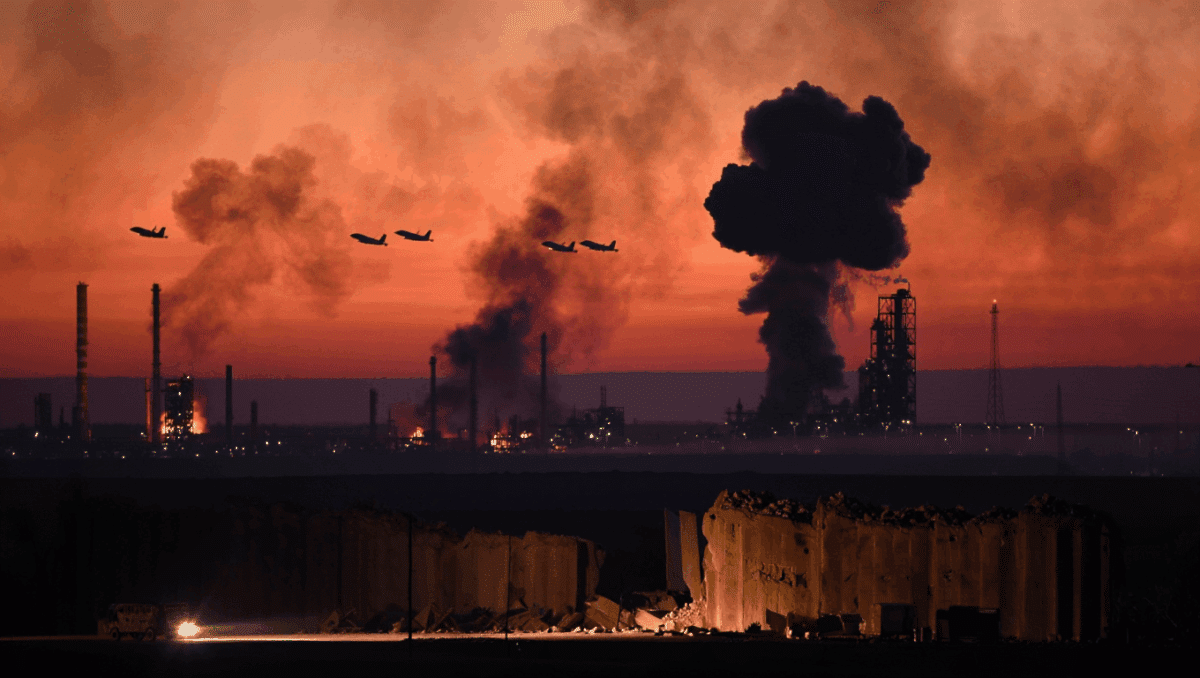
A sharp new chapter has opened in the long-running Israel–Iran confrontation, and the outcome is anything but certain. Early today, US and Israeli forces launched a coordinated aerial campaign against targets inside Iran — a step Tehran answered with strike missions not only toward Israel but also against American bases across the Middle East. The region now faces an acute risk of wider, lasting upheaval.
The move follows months of military repositioning, diplomatic shuttle missions and mounting public threats. What began as asymmetric exchanges and proxy clashes has escalated into direct strikes between states, raising the prospect of a sustained conflict that could reshape security and energy markets well beyond the Gulf.
How diplomacy unraveled and the forces that pushed both sides toward strikes
The Growing Demand for Data-Driven Decision Making in Silicon Valley
He quit, ran out of money, and begged to come back — here’s how his boss reacted
For weeks the international scene hinted at the possibility of a negotiated de-escalation. Back-channel talks mediated by Oman sought terms that might have averted open hostilities, but the gap between Washington and Tehran proved large. The United States pressed for sweeping concessions — not only curbs on Iran’s nuclear ambitions but also limits on ballistic missile development and an end to its backing for regional militias. Those demands were politically nonstarter for Tehran.
At the same time, Washington moved a substantial array of aircraft, carriers and warships into the region, signaling preparation for more than a single, isolated strike. Political rhetoric on both sides hardened public expectations: US leaders framed strong action as support for Iranians protesting at home, while Iranian authorities warned that any attack would meet a forceful response.
What the strikes appear to aim for — beyond military targets to political change
Initial strikes targeted a range of military and political facilities, a pattern that suggests objectives extending past disabling specific weapons programs. The scale and selection of targets indicate that the operation is at least partly driven by the prospect of changing Tehran’s strategic posture — and possibly its leadership calculus.
Removing or degrading the instruments of state coercion is now being treated by some as a pathway to political change inside Iran. That framing alters the mission from precision counter-proliferation to a broader attempt to reshape Iranian influence and capacity in the region.
Key goals likely guiding US and Israeli planners
- Disrupting ballistic missile production and storage sites
- Degrading command-and-control centers that coordinate proxy networks
- Reducing Iran’s ability to project naval and air power across the Gulf and Red Sea
Tehran’s position: built resilience and the logic of retaliation
Despite severe economic strains and political unrest at home, Iran retains a layered security apparatus that is deeply embedded in the state. The Islamic Revolutionary Guard Corps and allied paramilitary forces are organized to protect the regime’s core institutions and to strike back when threatened.
That defensive design makes a rapid collapse unlikely; instead it increases the chance of aggressive, asymmetric retaliation. Iran has already launched strikes against Israeli territory and a number of US military facilities in Bahrain, the United Arab Emirates, Qatar, Jordan and Kuwait. Those hits underline Tehran’s capacity to hit multiple kinds of targets over a broad geography.
Maritime and strategic vulnerabilities that raise the stakes
The Persian Gulf and Strait of Hormuz are central fault lines in any Iran–US confrontation. Tehran can leverage naval forces, fast-attack craft, mines and shore-to-ship missiles to threaten commercial shipping and military vessels.
- Blocking or disrupting traffic through the Strait of Hormuz could trigger a sharp rise in global oil prices, given that roughly one-fifth of the world’s seaborne oil transits that chokepoint.
- Anti-ship missiles such as those deployed in regional conflicts have demonstrated the ability to damage or sink large vessels — including, in a worst-case scenario, capital ships that would dramatically shift US operational calculations.
Military analysts warn that a single, successful strike on a major vessel could force a rapid reassessment of US force posture in the region, potentially reducing American options and emboldening Iranian proxies.
Proxy networks and the danger of a wider regional conflagration
Iran’s influence reaches beyond its borders through an array of allied groups — from Hezbollah in Lebanon to Palestinian factions in Gaza, Houthi forces in Yemen and assorted militias in Iraq and Syria. These networks provide Tehran with indirect ways to retaliate and complicate any attempt at a localized campaign.
Escalation risk isn’t just about state-on-state strikes; it’s about the cumulative effect of proxy attacks that can ignite multiple fronts simultaneously. Asymmetric strikes on shipping lanes, drone and missile barrages, and cross-border artillery could draw neighboring countries into the conflict, multiplying humanitarian and economic costs.
Why outside intervention threatens the prospects for Iranian self-determination
There is a persistent tension between external pressure aimed at weakening an authoritarian government and the agency of the people living under that regime. History shows that toppling a repressive government from the outside often creates a power vacuum that foreign actors then seek to fill.
Those dynamics can marginalize indigenous movements for change: when external powers intervene, the outcome of political transition becomes a negotiation among foreign capitals as much as a process led by domestic actors. In practice, that can undermine the very popular aspirations external actors claim to support.
Immediate risks for US forces, Israel and global markets
On the tactical level, Israel’s layered air-defense systems have proven effective in many past incidents, but no shield is perfect. Missile and drone strikes have occasionally penetrated defenses and caused damage; in a sustained campaign the probability of successful hits grows.
For US forces stationed in the region, the threats are both conventional and unconventional: missile and drone strikes, naval ambushes, and even cyberattacks on critical systems. Economically, disruptions to oil exports and shipping through the Gulf could reverberate worldwide.
The combination of military vulnerability, proxy escalation and economic leverage gives Iran multiple ways to raise costs for adversaries — and therefore multiple paths for the conflict to broaden rather than contain itself.
You might also like:
- Trump threatens Kharg Island invasion and nuclear option in Iran
- Terrorist state: leader says we can’t make peace
- “Probably F-15, F-16, F-22 and F-35” : Dozens of American Jets Are Now Heading to the Middle East
- Iran nuclear threat persists as Tehran expands uranium enrichment program
- Iran war began Oct. 7, triggering regional escalation

Robert Johnson is a dedicated columnist focusing on political and social debates. With twelve years in editorial writing, he provides nuanced, well‑argued perspectives. His commentaries invite you to form your own views and engage in critical issues.


Hey, folks! War drums are beating in the Middle East…again. Its like a never-ending cycle of conflict out there. Wonder if there will ever be a day when peace prevails over the region. Your thoughts on this mess?
Man, this whole situation in the Middle East is like a never-ending rollercoaster ride. One move leads to another, then another… Its like a giant chess game, but with real lives at stake. Hope cooler heads prevail.
Man, the tension in the Middle East be like a ticking time bomb, ready to explode any moment. Its like watching a high-stakes poker game, but with countries and lives at stake. Hope cooler heads prevail.
These strikes be like a game of chess where every move brings us closer to checkmate. Will anyone hit pause and realize the stakes before its too late? The Middle East aint a playground for power plays.
Man, its like watching a chess game with nukes. One wrong move and boom! The whole board goes up in flames. Cant they just sit down, have a cuppa, and chat it out?
Man, these strikes in Iran feel like the prelude to a wild ride. Its like watching a chess game where every move could set off a chain reaction. Wonder if theres any endgame in sight or if were just getting started…
Man, these strikes in Iran got me feeling like Im watching a never-ending game of chess, you know? Every move feels like its setting off a domino effect. Wonder if theres a grand plan at play or if were just at the tip of the iceberg. Its like waiting for that plot twist that either blows your mind or leaves you scratching your head.
Man, these strikes, theyre like a game of dominoes, you know? One falls, then another, and before you know it, the whole tables a mess. Its like watching a slow-motion disaster movie unfold in real life. Scary stuff.
Man, this whole situation is like watching a train wreck in slow motion. Cant help but wonder if theres any way out of this mess without things escalating even more. Its like a political thriller, but scarier cause its real life.
Man, its like a game of dominoes out there in the Middle East. One strike leads to another, and before you know it, were on the brink of a full-blown regional war. Diplomacy? Who needs that when youve got missiles flying left and right. Crazy times were living in.
Man, its like a game of dominoes out there in the Middle East. One strike leads to another, and before you know it, were on the brink of a full-blown regional war. Diplomacy? Who needs that when youve got missiles flying left and right. Crazy times were living in… But hey, maybe they can switch to playing Monopoly instead. At least then they might have a chance to roll for peace!
Man, this whole mess in the Middle East is like a real-life game of chess, but with way higher stakes. Feels like one wrong move could send everything spiraling outta control. Hope cooler heads prevail soon.