
Show summary Hide summary
- How the missing leaf was identified in Blois
- What the page contains and why it matters to mathematics
- The palimpsest story: how a manuscript became layered history
- Ownership, an auction, and museum conservation
- Plans to reveal the hidden writing beneath the Daniel illustration
- What scholars hope to learn next
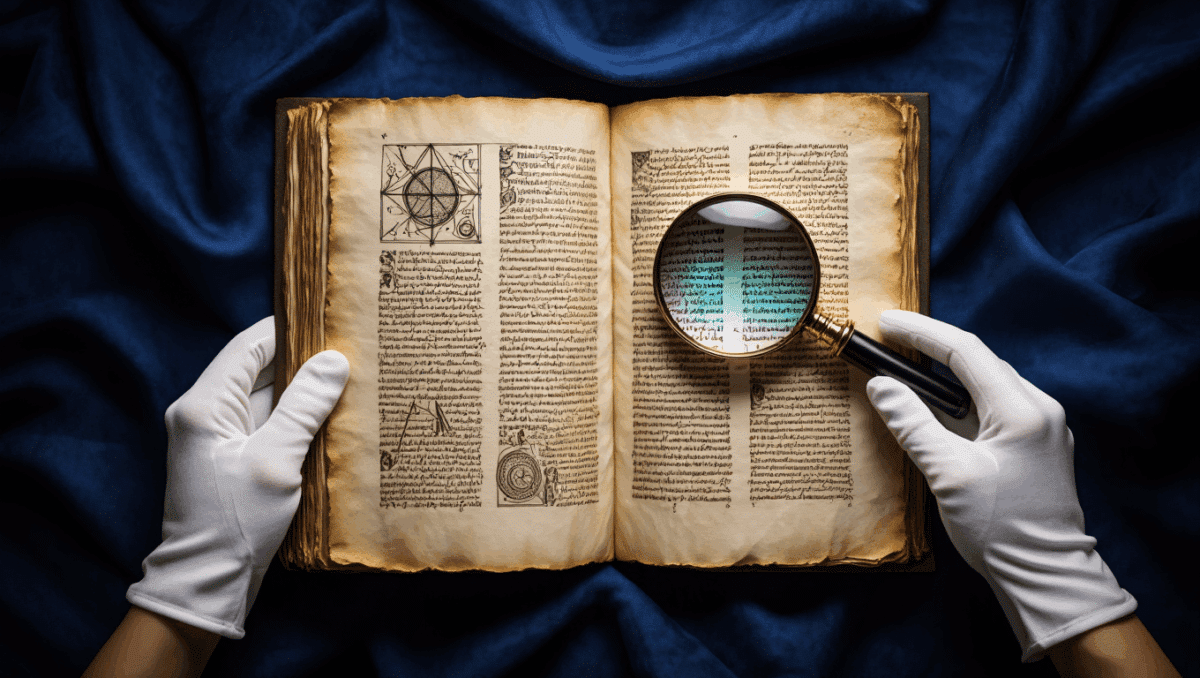
A single leaf from one of antiquity’s most celebrated scientific manuscripts has resurfaced in a French museum collection, reconnecting scholars to lost words of Archimedes. The discovery came when a French researcher recognized the page among holdings at the Musée des Beaux-Arts in Blois, potentially restoring a long-missing fragment of the Archimedes Palimpsest and opening the door to buried text hidden beneath a later illustration.
The fragment contains legible Greek writing from Book I of On the Sphere and the Cylinder and shows signs of extensive reuse and alteration over centuries. Researchers now plan advanced imaging to peel back layers of history and reveal what was deliberately obscured under a twentieth-century painting of the Prophet Daniel.
How the missing leaf was identified in Blois
Victor Gysembergh, a researcher affiliated with France’s CNRS and the Léon Robin Center for Research on Ancient Thought, noticed the manuscript leaf while cataloging the Blois museum’s holdings. He matched the fragment to early twentieth-century photographs kept at the Royal Danish Library, confirming it as the long-missing page from the Archimedes Palimpsest.
The Growing Demand for Data-Driven Decision Making in Silicon Valley
He quit, ran out of money, and begged to come back — here’s how his boss reacted
- Where it was found: Musée des Beaux-Arts, Blois, France.
- Who found it: Victor Gysembergh (CNRS).
- How it was matched: Comparison with century-old photographs in the Royal Danish Library.
On one face of the parchment, Greek prayers have been written directly over geometric diagrams. The reverse shows the overwritten ancient script still present beneath a later, twentieth-century depiction of Prophet Daniel flanked by lions — a painting that, until now, prevented direct access to the earlier text.
What the page contains and why it matters to mathematics
The leaf preserves a passage from Archimedes’ On the Sphere and the Cylinder (Book I, Propositions 39–41), material that contributes to our understanding of the mathematician’s work on volumes, areas, and the geometry of solids. The larger codex—commonly known as the Archimedes Palimpsest—also holds other texts that were once considered lost, including:
- The Ostomachion (a puzzle-like treatise on combinatorics and geometry)
- The Method of Mechanical Theorems (insights into Archimedes’ heuristic techniques)
- The only surviving original Greek text of On Floating Bodies
These writings illuminate Archimedes’ methods for approximating pi and his inventive geometric proofs. Recovering even a page can tweak scholarly reconstructions of his arguments and suggest fresh interpretations of classical mathematics.
The palimpsest story: how a manuscript became layered history
The codex itself was composed around 950 CE and later transported to a Greek Orthodox monastery in Palestine. Over time the original ink was washed or scraped away and the parchment was reused for religious texts — a process known as palimpsesting. This is why Archimedes’ treatises survived in a layered state: the underlying text is faded but often recoverable with modern imaging.
Key moments in the manuscript’s journey:
- Circa 950 CE: Original copying onto parchment.
- 1204 and later: Movement and safeguarding during upheavals in Constantinople and surrounding regions.
- Early 20th century: Photographs of the manuscript were made in Constantinople/Istanbul (documents from the 1900s–1910s are preserved in European libraries).
- Circa 1922: At least one leaf disappeared during the chaotic evacuation of church holdings and later entered a private French collection.
Ownership, an auction, and museum conservation
The palimpsest’s modern legal and conservation history is complex. In 1998, after approval from the French Ministry of Culture, the incomplete manuscript was exported to Christie’s in New York for sale by the daughter of the French collector who had owned it. The sale was contested by the Greek Orthodox Church, but a U.S. court allowed the auction to proceed.
- Auction outcome: Purchased by an anonymous buyer identified publicly only as “Mr. B.”
- Conservation home: Deposited for study and preservation at the Walters Art Museum in Baltimore.
- Media speculation: Press reports suggested the buyer might have been Jeff Bezos, though the identity was never officially confirmed.
The newly located leaf had previously slipped out of that chain—taken during the larger upheavals of the early twentieth century and ending up separated from the main palimpsest. Its rediscovery reconnects pieces of a fragmented provenance and raises questions about other dispersed folios.
Plans to reveal the hidden writing beneath the Daniel illustration
Because the ancient text lies underneath a later painted image, traditional visual inspection won’t expose it. Gysembergh and CNRS colleagues have secured authorization paths and aim to perform advanced imaging studies within the coming year. Their approach will combine several state-of-the-art methods:
- Multispectral imaging to capture inks and pigments that respond differently across wavelengths.
- Synchrotron-based X-ray fluorescence (XRF) mapping to identify elemental signatures of iron-gall inks and pigment layers.
- High-resolution X-ray imaging to see beneath the painted layer and reconstruct the underlying script.
These non-invasive techniques have recovered hidden writing in other palimpsests and are particularly effective when iron-rich inks or distinctive pigments remain. The research team expects the imaging to reveal not only the visible Greek prose but also any erased diagrams or marginalia that could alter interpretations of Archimedes’ propositions.
Why synchrotron XRF and multispectral imaging are useful
Synchrotron XRF maps chemical elements at very fine scales, making it possible to locate iron or copper traces from old inks even when the ink is invisible to the naked eye. Multispectral imaging complements that by exploiting how different materials reflect or absorb light across ultraviolet, visible, and near-infrared bands. Together, they can separate overlapping layers — pigment on top of ink — without touching the parchment.
What scholars hope to learn next
Beyond confirming the identity of the text, the research could:
- Clarify Archimedes’ original wording and proofs in the cited propositions.
- Reveal erased diagrams or annotations that shed light on transmission and use of the text.
- Improve the historical record about how and when pages were removed or repurposed.
The recovered leaf adds a tangible piece to the puzzle of the Archimedes Palimpsest’s journey across centuries, and the upcoming imaging work promises to translate concealed ink into renewed scholarship and public knowledge.
You might also like:
- King Arthur manuscript with 126 illustrations may soon enter public collection
- Acropolis relic identified as older after man returns dad’s Parthenon souvenir
- Earliest confirmed adult cremation identified by archaeologists
- Alleged first space crime: ex-wife pleads guilty
- Beachy Head woman mystery solved by DNA after a decade

Michael Thompson is an experienced journalist covering U.S. and global news. With ten years on the front lines, he breaks down political and economic stories that matter. His precise writing and keen attention to detail help you grasp the real‑world impact of every event.


As a history buff, finding hidden text in an old manuscript is like discovering buried treasure. It adds a layer of mystery and excitement to the story, making you wonder what other secrets are waiting to be uncovered.
Oh, mate, I hear ya! Its like stumbling upon a dusty old chest in an RPG game, innit? You crack it open, and boom! Ancient scrolls and cryptic messages, sending shivers down your spine. Makes you wonder what hidden quests await, right? Who knows what other juicy bits of history are lurking in the shadows, just waiting for someone like us to uncover em. Exciting stuff for sure!
Man, finding that lost page with hidden text under the illustration is like discovering a secret code in a video game level. Makes you wonder what other hidden gems are waiting to be uncovered in the world of history and mathematics!
Yo, imagine the look on the curators face when they uncovered that hidden text under the illustration! Its like a math mystery novel coming to life. Bet Archimedes himself would crack a smile on this one.
Man, imagine finding hidden math gems under drawings! Like a secret code from the past. Bet those old manuscripts got more tricks up their sleeves. Historys full of surprises, innit?
Man, finding that lost Archimedes page with hidden text feels like solving a riddle! Imagine the math mysteries waiting to be uncovered. History nerds, rejoice! Lets dive into these layers of knowledge like its a treasure hunt!
Man, finding that lost page with hidden text feels like a treasure hunt! Reminds me of digging through old stuff at grandmas. Wonder what secrets that math magic holds! Bet Archimedes wouldve loved a game of hide and seek in his own manuscript!
Yo, imagine finding this lost Archimedes page like a hidden treasure hunt! Math secrets under illustrations? That’s some Da Vinci Code vibe right there. Who knew ancient math could be this mysterious?
I swear, its like a treasure hunt in a museum! Finding that lost page with hidden math secrets is like cracking a code. Makes me wanna go on a history adventure myself!
Dang, I feel ya! Its like being Sherlock Holmes, but with dusty old books instead of a pipe. Who knew math could be this sneaky? Im half-expecting secret passages and hidden compartments next time I hit the library. Time to dust off that explorer hat!
Man, can you imagine the hype if we found more hidden gems like this Archimedes manuscript page? Its like a math mystery novel come to life! Makes you wonder what other secrets are hiding in plain sight, right?
Man, imagine hiding secret math gems under drawings, sneaky stuff. Wonder if ancient doodles hold secrets too. Math under art, art under math, layers like an onion. Mind-blown!
Man, this news bout Archimedes lost manuscript page found in the museum? Thats some Indiana Jones stuff right there! Uncoverin hidden math secrets like a real-life treasure hunt. Makes ya wonder what other ancient puzzles are still waitin to be cracked.
Man, imagine finding hidden gems like that under some old drawing! Makes you wonder what else is lurking under our noses, right? Like, what if my math notes had secret messages too? Mind-boggling stuff!