
Show summary Hide summary
- Why McCurdy switched gears from memoir to fiction
- What Half His Age is about and why it matters
- Female rage: the emotional engine of the novel
- Imagery and tone: the sensory language McCurdy wanted
- Between fact and invention: where Jennette ends and Waldo begins
- Who will connect with Half His Age — and who might not
- Visibility, vulnerability, and adapting the past
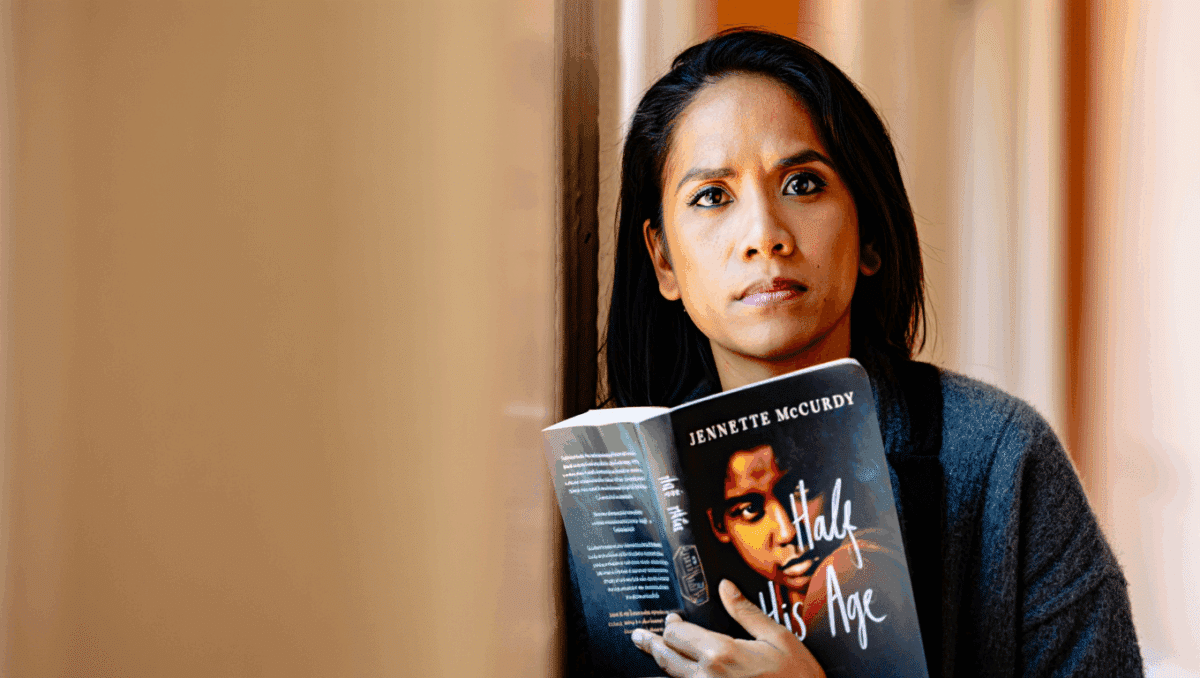
Jennette McCurdy’s leap from memoir to novel arrives with bite. Her new book, Half His Age, unspools a raw, uncomfortable story about a teenage girl entangled with an older teacher — a premise that forces readers to sit with power, shame, and desire rather than look away. In a recent Zoom conversation, McCurdy talked about why she needed to write this novel, how female anger fuels the narrative, and what she hopes readers take away.
The novel follows Waldo, a 17-year-old who becomes romantically involved with a man more than two decades her senior. While elements of the plot echo McCurdy’s own past, the book is a work of fiction that zooms in on longing, validation, and the fragile ways people try to seize power over their lives.
Why McCurdy switched gears from memoir to fiction
McCurdy says the novel didn’t feel optional — it insisted on being written. After the blunt honesty of her memoir, I’m Glad My Mom Died, she found herself pulled toward a different form of storytelling that let her explore truth through invention. The idea of Waldo arrived so insistently that a first draft followed quickly, then multiple rewrites until the story took its final shape.
The Growing Demand for Data-Driven Decision Making in Silicon Valley
He quit, ran out of money, and begged to come back — here’s how his boss reacted
She describes the process as driven less by plan and more by force: a character who wouldn’t let go. That compulsion, she says, is how she knows a project must be pursued — the work that pushes itself up gets finished.
What Half His Age is about and why it matters
At its center, the book is less a scandalous chronicle than a study of need. It lays bare a young person’s hunger for approval and affection, and how that hunger can be manipulated by someone older and more experienced.
- Protagonist: Waldo, 17 — energetic, bold, convinced she is in control.
- Antagonist/partner: A teacher in his 40s — positioned to know better, but exploiting the imbalance.
- Core themes: power dynamics, loneliness, shame, and the search for agency.
McCurdy intentionally shows the story entirely through Waldo’s perspective. By keeping the viewpoint rooted in the teenager’s interior life, the novel exposes how belief in control can coexist with profound vulnerability and limited self-awareness. Readers older than Waldo will recognize the naiveté — the illusions we had at 17 — and the book uses that disconnect to generate tension rather than moralizing.
Portraying a minor’s point of view without preaching
Rather than judging Waldo from an outside moral platform, McCurdy chose nuance. Waldo is aggressive and forward in ways that complicate how readers assign blame. The author wanted to resist a simple lecture and instead invite empathy, while still making the power imbalance unmistakable. The intention is to let readers feel the complexity: attraction, manipulation, and the small, quiet mechanics of control.
Female rage: the emotional engine of the novel
One of the clearest threads McCurdy emphasizes is anger — not sensationalized fury, but the slow build of rage that comes from repeated boundary violations. She frames “female rage” as the outcome of being dismissed, taught to be polite instead of assertive, and denied the vocabulary or permission to demand one’s needs. Over time that pent-up energy compounds and demands release.
McCurdy hopes the book opens space to talk about that feeling as legitimate and useful, a source that can be harnessed to create change rather than be stuffed down and disguised by “toxic positivity.”
How to work with rage — practical paths the book suggests
- Creative expression: writing, art, or any outlet that converts emotion into form.
- Honest conversation: naming what hurts instead of performing cheerfulness.
- Community with other women: shared testimony can make anger feel held and understood.
McCurdy argues that acknowledging anger — saying plainly, “I’m angry and here’s why” — is more likely to produce constructive outcomes than staying silent and polished.
Imagery and tone: the sensory language McCurdy wanted
Rather than romanticizing sex or nostalgia, McCurdy wanted Half His Age to feel immediate and bodily. She describes the sensory palette of the book in frank, sometimes uncomfortable terms: the stickiness of sweaty skin, the force of approaching trains, the sour tang of certain candies as a metaphor for taste, and visual close-ups that emphasize flesh, imperfections, and the mundane mechanics of bodies rather than idealized glamor.
- Sound: the looming impact of a train — inevitable, loud, and dangerous.
- Touch: sweaty, textured skin, not glossy or cinematic.
- Smell & taste: sharp, offbeat scents and flavors that call attention to the body’s rawness.
- Sight: intimate, unflattering close-ups — cellulite, makeup-free faces, small humiliations.
These choices reinforce the book’s refusal to prettify the story. McCurdy wants readers to feel the visceral, sometimes ugly reality of desire and shame.
Between fact and invention: where Jennette ends and Waldo begins
McCurdy is candid that aspects of the novel were inspired by her life — she had a significant age-gap relationship in her late teens — but she repeatedly stresses that Waldo is her own creation. The narrative is fiction first: a distinct plotline, its own cast, and the freedom to dramatize without being biographical.
She asks readers to meet the book on its own terms rather than retrofit it into a memoir. That separation gives the story room to explore emotional truths without being reduced to a confessional checklist.
Who will connect with Half His Age — and who might not
McCurdy frames the book as one that will resonate with readers who carry big feelings — especially those who have felt humiliated, lonely, or desperate for affection. Conversely, she suggests it may not land for readers who prefer muted emotional registers or avoid confronting discomfort.
Who this novel will likely speak to:
- People who have experienced unrequited attachment or emotional dependence.
- Readers drawn to character-driven, emotionally raw fiction.
- Anyone curious about the messy intersections of power, sex, and adolescence.
Who might struggle with it:
- Readers seeking tidy moral answers or a sanitized portrayal of relationships.
- Those averse to frank depictions of bodily reality or the coarse edges of desire.
Visibility, vulnerability, and adapting the past
McCurdy reflects on her public life with nuance: she appreciates years spent away from the spotlight, time when social media wasn’t a factor and she could write without audience pressure. Returning to public work, she says, has been both liberating and complicated, but honesty remains nonnegotiable for her. She prefers authenticity in interviews and in creative work over performative polish.
On the TV adaptation of I’m Glad My Mom Died, McCurdy is protective and deliberate. She has a clear vision for how the memoir should translate to the screen and is taking time to assemble a team that shares that understanding. The project matters to her, and she’s committed to getting it right rather than rushing it into production.
The conversation has been edited for clarity and length.
Half His Age is available now.
You might also like:
- Is God Is lets Black women feel their rage and find catharsis
- Off campus vs the deal: 8 key differences between the books
- People we meet on vacation movie vs book: key differences
- Abigail Cowen on Every Year After: bringing back yearning
- Carley Fortune stayed off social media when everyone else joined: why she avoided it

David Miller is an entertainment expert with a passion for film, music, and series. With eight years in cultural criticism, he takes you behind the scenes of productions and studios. His energetic style guides you to the next big releases and trending sensations.


Man, Jennette McCurdys new book is like a breath of fresh air – diving deep into female rage? Count me in! Cant wait to see how she tackles such a raw and real emotion. Sounds like a compelling read for sure!
Man, reading about Jennette McCurdys new book feels like diving deep into the complexities of female rage. Its like a rollercoaster of emotions, yknow? Gotta admire her for switching gears from memoir to fiction. Cant wait to see how she tackles this subject!
Man, Jennette McCurdy really delves into some deep stuff with Half His Age. Its like a rollercoaster of female rage and emotions. Cant wait to see how she portrays it through fiction this time!
Im a literature buff and let me tell ya, Jennette McCurdys pivot to fiction in Half His Age got me intrigued. Exploring female rage through a fresh lens? Count me in for that rollercoaster of emotions!
I remember when Jennette McCurdy ruled the screen, now shes diving into the literary world with female rage in Half His Age. A daring move, can she capture our hearts off-camera too?
Man, Jennette McCurdy be diving deep with Half His Age. Exploring female rage through fiction? Thats some bold move. Wonder how shes gonna tackle that emotional rollercoaster without preachin. Gotta admit, got me curious.
Man, female rage is a whole symphony of emotions, aint it? Jennette McCurdys diving into that with her new book Half His Age sounds like a wild ride. Cant wait to unravel those layers!
Man, Jennette McCurdy really delves into some deep stuff with Half His Age. Female rage as the driving force? Thats some raw honesty right there. Cant wait to see how she tackles such a powerful theme in a novel format.
Man, Jennette McCurdy really went all out with Half His Age, diving deep into female rage. Its like a rollercoaster of emotions, yknow? Switching from memoir to fiction was a bold move, but hey, sometimes you gotta shake things up, right?
You know, I always admired Jennette McCurdys honesty, so Im curious how she channels female rage in her new book. Switching from memoir to fiction mustve been quite a leap. Wonder if she can keep it real in a new light.
Man, McCurdy really delves deep with Half His Age. Explorin female rage is no easy feat, but she tackles it head-on. Cant wait to see how she navigates such a complex theme in a novel.
Oh man, McCurdy really nailed it in Half His Age, didnt she? Exploring female rage aint for the faint of heart, but she takes it on like a champ. Cant wait to see how she dives even deeper into that theme in her novel. Its gonna be a ride, thats for sure!
Dude, Jennette McCurdys delving into female rage? Thats like tapping into a volcano of feels! Cant wait to see how she spins it in Half His Age. A switch from memoir to fiction? Bold move, but Im curious!
Man, Jennette McCurdy really hits the nail on the head with Half His Age! Explorin female rage in a novel sounds like a wild ride. Cant wait to dive into the emotional rollercoaster of this book!
Man, Jennette McCurdys new book Half His Age dives deep into female rage. Cant wait to see how she navigates that emotional rollercoaster. Got me curious about her switch to fiction from memoirs, yknow?
Oh, I totally feel ya on that one! Jennette McCurdy taking a dive into female rage sounds like a wild ride, innit? Switching from memoirs to fiction can be a bold move, but who knows, maybe shes got some juicy stories to tell in a whole new light. Cant wait to see how she spins that emotional rollercoaster!
Man, Jennette McCurdy really delves into the female rage theme in her new book, huh? Its like tapping into a whole new level of raw emotions and power. Cant wait to see how she weaves it all together!