
Show summary Hide summary
- How tectonics lifted the limestone that became the Twelve Apostles
- How researchers reconstructed the Apostles’ history
- From cliffs to stacks: the erosion story that created the sea pillars
- How many Apostles were there — and how many remain?
- Why these cliffs are valuable to climate science and coastal research
- Where the study was published and the team behind the work
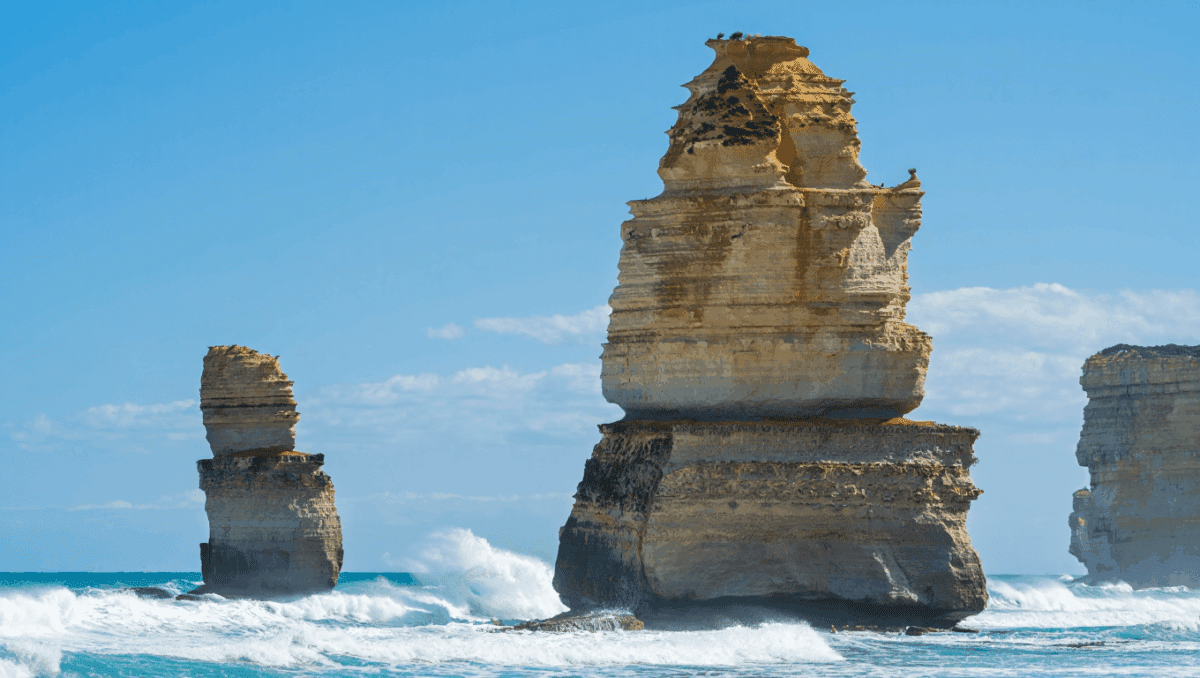
Towering limestone pillars along Victoria’s rugged coastline are more than a photo-op; they’re chapters of Earth’s deep history. New research by geoscientists at the University of Melbourne has for the first time pieced together the long geological story behind the famous Twelve Apostles sea stacks, showing how tectonic forces and millennia of coastal erosion combined to sculpt the formations visitors see today.
Scientists used fresh field mapping, microscopic fossil evidence and high-resolution imagery to redraw the timeline of these cliffs. Their findings not only refine the age of the limestone but also reveal structural twists and breaks left by ancient earthquakes — features that turn the Apostles into a natural archive of past climates and sea levels.
How tectonics lifted the limestone that became the Twelve Apostles
The Growing Demand for Data-Driven Decision Making in Silicon Valley
He quit, ran out of money, and begged to come back — here’s how his boss reacted
The team’s work confirms that the broad limestone platform along Victoria’s southern shore was not formed where it stands today. Instead, slow but relentless movements of the Earth’s crust gradually pushed the seabed upward over millions of years. That tectonic uplift exposed layers that had been laid down in shallow seas and set the stage for the coastline we recognize now.
Key geological takeaway: the rock layers that make up the cliffs were raised by tectonic activity and then shaped by surface processes — they were not simply carved in place by modern waves alone.
Refining the age of the cliffs with microfossils
Previous age estimates for the limestone spanned a broad window. The new study narrowed that range by identifying tiny fossilized remains within the rock layers. These microfossils allowed researchers to date the deposits more precisely to roughly 8.6 to 14 million years ago, a revision from earlier, less specific estimates.
Within those layers scientists also detected a warmer interval around 13.8 million years ago, preserved like a climatic snapshot. That ancient warmth is now being used as a baseline to understand how coastal environments respond when temperatures and sea levels change.
How researchers reconstructed the Apostles’ history
Rather than relying on a single technique, the study combined several complementary approaches to build a clearer picture of the coastline’s past.
- Field mapping: detailed surveys of cliff faces and rock exposures to record orientation and structural features.
- Photographic and digital imagery: high-resolution pictures and digital models to measure how layers tilt and where faults appear.
- Stratigraphic analysis: tracing the order and relationships of rock layers to understand deposition and deformation.
- Microfossil dating: identifying microscopic shells and remains that indicate specific geological ages and environmental conditions.
These methods together revealed subtle tilts in the limestone bedding and small fault lines — evidence that uplift did not occur as a simple, uniform raise but involved rotations and breaks tied to ancient seismic activity.
From cliffs to stacks: the erosion story that created the sea pillars
The dramatic stacks themselves are products of a two-stage process: tectonic uplift followed much later by coastal erosion. After the limestone rose above sea level, waves, wind and storms gradually exploited weaknesses in the rock to sculpt caves, arches and, eventually, isolated pillars.
Major flooding and sea-level changes that followed the Last Glacial Maximum (around 23,000–20,000 years ago) accelerated coastline reshaping. Over thousands of years the Southern Ocean’s powerful waves widened cracks and hollows until arches collapsed and left behind the free-standing sea stacks tourists now photograph.
- Stage 1: uplift of marine limestone by tectonic forces.
- Stage 2: wave-driven erosion forms caves in cliff faces.
- Stage 3: caves become arches as erosion continues.
- Stage 4: arch collapse leaves isolated sea stacks (the Apostles).
How many Apostles were there — and how many remain?
Although commonly called the “Twelve Apostles,” early mapping and the new study suggest there may never have been a full dozen visible at once. Evidence points to fewer original stacks, and natural collapses over recent decades have reduced their number further. Today, within the protected bounds of Port Campbell National Park, seven prominent stacks remain after two notable collapses — one in 2005 of a 50-meter tower and another in 2009 that removed more of the coastline’s vertical relief.
Why these cliffs are valuable to climate science and coastal research
Researchers describe the cliff sequences as a kind of geological archive. Each layer preserves information about ancient sea levels, temperatures and ecosystems, allowing scientists to reconstruct environmental conditions across millions of years. That long-term perspective is especially useful for understanding how coastlines might react to modern climate warming and rising seas.
By comparing fossil indicators, stratigraphy and signs of tectonic movement, scientists can connect past climate episodes with physical changes in the shore — insights that help model potential future scenarios for coastal erosion and sea-level rise.
Where the study was published and the team behind the work
The findings were published in the Australian Journal of Earth Sciences and led by Associate Professor Stephen Gallagher from the University of Melbourne’s School of Geography, Earth and Atmospheric Sciences. The research focused on approximately 40 kilometers (25 miles) of continuous sea-facing cliffs along Victoria’s southwest coast, combining lab-based microfossil work with on-site geological mapping.
You might also like:
- Rock climbers accidentally discover 80-million-year-old fossil
- Bermuda Triangle: scientists discover mysterious anomaly beneath the seafloor
- UK’s oldest cave painting reclassified from striped rock once dismissed as natural in 1928
- 2-million-year-old elephant ancestor tooth found on beach by boy
- In 2011, a collector bought a Moroccan meteorite—it turned out to be proof of thermal water on Mars

Michael Thompson is an experienced journalist covering U.S. and global news. With ten years on the front lines, he breaks down political and economic stories that matter. His precise writing and keen attention to detail help you grasp the real‑world impact of every event.


Man, those Twelve Apostles rock formations in Australia are a sight to behold! Can you believe how tectonics lifted those limestone beauties? Natures own masterpiece, I tell ya! Just makes you wonder about the forces at play, right?
Oh man, these Twelve Apostles rock formations are blowing my mind! Cant believe the science behind them. Nature is wild, yall. Makes me wanna go on a geology field trip ASAP!
Yo, I feel you, buddy! Those Twelve Apostles rock formations are straight-up mind-blowing. Its insane how nature can whip up such jaw-dropping sights, right? A geology field trip sounds like a plan! Who wouldnt wanna dive into some rock-solid knowledge, am I right? Natures got tricks up its sleeve that never fail to impress!
Man, the Twelve Apostles rock formations are like natures own masterpiece, you know? Its wild how scientists cracked the code on how these bad boys formed in Australia. Mother Nature sure knows how to keep us on our toes!
Man, those Twelve Apostles in Australia are like natures own art installation, right? Hearing about the science behind their formation just adds a whole new level of appreciation. Nature really outdoes itself sometimes, huh?
Totally, mate! Its like Mother Nature put on her best paintbrush and created a masterpiece down under. The Twelve Apostles are like her little art project, standing tall and proud. And when you hear about how they formed, its mind-blowing! Natures got some serious skills, huh? Just makes you wanna go out there and hug a tree or something.
I mean, those Twelve Apostles rock formations in Australia are like natures own art gallery, right? Its wild how scientists figure out all these theories about how they were formed. Makes you appreciate the Earths creative side a bit more, doesnt it?
Man, hearing about how those Twelve Apostles rocks formed in Australia is mind-blowing! Its like Natures own art show, with tectonics and erosion as the artists. Makes you appreciate the Earths makeover skills, huh?
Man, these Twelve Apostles rock formations in Australia are like natures skyscrapers! But I gotta know, how did those scientists figure out all this tectonic lifting and erosion stuff? Its like a geological soap opera out there!
Man, those Twelve Apostles rock formations in Australia are mind-blowing! It’s wild how nature works its magic. Can’t wait to hear more about the science behind those stunning sea stacks – bring on the geology lesson!
Yo, imagine being a rock, just chillin for thousands of years, then boom, youre famous as one of the Twelve Apostles! These formations got more history than my grandpas stories, for real.
Man, those Twelve Apostles rock formations in Australia are like natures own art installation. Its wild how scientists figured out their origin story. Makes you appreciate the forces that shaped our world, huh?