
Show summary Hide summary
- From kitchen experiment to patented recycling process — how used nets become new plastic
- Funding, scale and capacity — turning one metric ton a day into marketable material
- Deployable micro-factories — offering recycling to harbors worldwide
- Real-world impact and related innovations to fight ghost gear
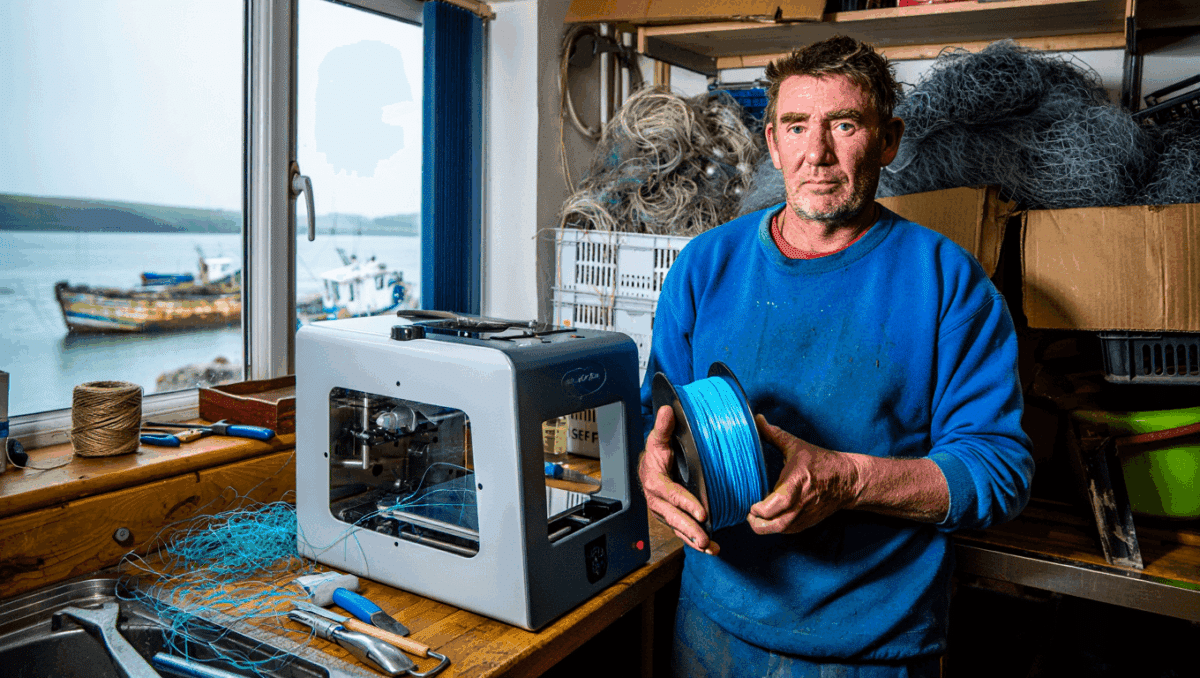
An English fisherman fed up with the steady stream of discarded nylon nets piling up on Cornwall’s piers stopped going out to sea and set about solving the problem. What began as a makeshift experiment in his kitchen has grown into an industrial answer to a global pollution headache: a way to turn worn-out fishing nets back into usable plastic for new products, including filament for 3D printers.
The inventor’s company has moved beyond grassroots tinkering to patented processes, outside investment, and a portable, harbor-ready system that promises to convert dangerous marine waste into valuable raw material right where it’s collected.
From kitchen experiment to patented recycling process — how used nets become new plastic
The project started when locals handed over old nets that would otherwise be burned, buried, or left to drift and entangle wildlife. Through a combination of mechanical cleaning and reprocessing, the company’s method breaks down contaminated nylon nets and extrudes them into small pellets suitable for standard manufacturing.
The Growing Demand for Data-Driven Decision Making in Silicon Valley
He quit, ran out of money, and begged to come back — here’s how his boss reacted
- Input: Used nylon fishing nets, often fouled with algae and marine residue.
- Processing: Cleaning, shredding, and converting fibers into molten polymer for pelletizing.
- Output: Nylon granules that can be used like virgin plastic for injection molding or spun into filaments for 3D printing.
These pellets have been fashioned into a surprising array of items, showing the material’s versatility:
- Household lamp shades
- Razor handles and small consumables
- Filament for desktop and industrial 3D printers
Funding, scale and capacity — turning one metric ton a day into marketable material
The venture has attracted corporate backers from unexpected corners, securing more than a million dollars in funding from major companies. With that support, the recycling operation now processes roughly one metric ton of net material per day, producing nylon pellets that meet manufacturing specifications.
The founder emphasizes the practicality of the system: it’s designed to fit inside a single shipping container and to be operated without highly specialized labor. That portability allows the technology to be transported to coastal towns and harbors rather than transporting bulky waste to distant facilities.
Why fishermen discard their nets — the hidden lifecycle of nylon gear
After several months at sea, nylon nets collect algae and other biofilms that cloud their color and alter their performance. Fish begin to avoid the faded, biofouled gear, and crews facing falling catches often replace nets quickly. Rather than undergo proper disposal, much of the material is buried, burned, or abandoned — contributing to the global problem of “ghost gear.”
Experts estimate that roughly one million tons of fishing nets are wasted each year, a fraction of which is collected and recycled in organized systems.
Deployable micro-factories — offering recycling to harbors worldwide
To scale the solution, the company offers the complete recycling micro-factory in a shipping container, delivered and ready to run. The containerized unit is pitched as an all-in-one answer for ports that want to convert a costly disposal issue into a potential revenue stream.
Key selling points:
- Compact footprint: containerized and transportable
- Ease of operation: designed for local harbor staff to manage
- Revenue potential: salvaged nets transformed into sellable plastic granules
The company’s price for a turnkey micro-factory has been positioned for municipalities and harbor authorities that want on-site processing capabilities.
Real-world impact and related innovations to fight ghost gear
This recycling approach is just one part of a broader movement to tackle abandoned fishing gear and marine plastics. Other initiatives focus on prevention, retrieval, and repurposing, including efforts that adapt washed-up buoys into wildlife protectors, pay crews to recover derelict traps, or apply advanced chemistry to break down carpets and nets at the molecular level.
Examples of complementary programs:
- Reusing recovered tracker buoys and technology to keep turtles and other animals safe from entanglement
- Payment schemes for shrimpers and crabbers who retrieve abandoned traps
- New catalysts and chemical recycling methods that reclaim polymers from mixed waste streams
By converting what was once a hazardous, low-value waste into durable feedstock for manufacturing, the harbor-based recycling approach aims to reduce ocean pollution while creating local jobs and supply chains.
You might also like:
- Hyundai turns ghost nets into recycled car floor mats with Healthy Seas
- Plastic to vinegar: sunlight-powered process converts multiple plastics with no emissions
- 100,000 new jobs to clean up the coastline and protect species from plastic, overdevelopment
- Teens set world record recycling 2,675 pounds of sports balls in one day
- Activated carbon from coffee and plastic waste captures CO2 in project by female-led Arab team

Michael Thompson is an experienced journalist covering U.S. and global news. With ten years on the front lines, he breaks down political and economic stories that matter. His precise writing and keen attention to detail help you grasp the real‑world impact of every event.


I remember the days when folks just tossed out old fishing nets without a care. Now were turning those babies into 3D printer filament? Talk about a glow-up for trash! Wonder whats next… recycled flip-flops as computer parts?
Man, talk about innovation! Turning old fishing nets into 3D printer filament? Thats like turning trash into treasure, literally. Wonder what else we could recycle into cool stuff. Skys the limit, I guess!
Dang, aint that the truth! Talk about turning trash into treasure, huh? Its wild to think about all the stuff we could recycle into cool new things. The possibilities are endless, man! Who knows what other hidden gems we could unearth if we put our minds to it. Skys the limit, indeed!
Man, I remember when we used to toss those old fishing nets like they were trash. Now theyre getting a second life as 3D printer filament? Thats some sci-fi level recycling, turning trash into tech. Wonder whats next!
I used to think fishing nets were just for catching fish, but now theyre making 3D printer filament? Thats some next-level recycling magic! Wonder if my old sneakers can transform into a spaceship next.
Dude, imagine turning old fishing nets into 3D printer filament. Thats like making trash into treasure, man! Its like nature giving us a high-five for being eco-friendly and innovative at the same time. So rad!
Man, thats wild! Turning old fishing nets into 3D printer filament? Who wouldve thought, right? Its like a whole new level of recycling. Wonder if they can recycle my old sneakers next!
Man, its wild how those old fishing nets are getting a new life as 3D printer filament. Like, one mans trash is another mans, uh, 3D-printed treasure? Wonder if this recycling magic could spread to other trash too.
Man, I remember when I tried melting random stuff in the kitchen just for fun. Now, folks are out here turning fishing nets into 3D printer filament. Talk about leveling up the recycling game!
Man, imagine turning old fishing nets into 3D printer filament? Thats some sci-fi stuff right there. Wonder how they cracked that code. Bet those fishermen never thought their nets could end up in a new form.
Man, I remember when I tried to fix my dads old fishing net with a soldering iron. Now theyre turning those nets into 3D printer filament? Thats some next-level recycling game right there. Way to save the planet, one filament spool at a time!
Man, talk about turning trash into treasure! Recycling fishing nets into 3D printer filament? Thats some next-level eco-friendly innovation. Its like giving those abandoned nets a second chance at life, all while reducing waste. Kudos to the brains behind this initiative!
Man, imagine turning old fishing nets into 3D printer filament? Thats like some next-level recycling game right there. Bet those fishermen will think twice before tossing those nets away now. Way to go with the eco-friendly tech hustle!