
Show summary Hide summary
- Bad Bunny’s halftime show: a record-setting, Spanish-led moment
- Stagecraft and symbolism: Puerto Rico, labor, and resistance
- The show as a diasporic homecoming: food, neighborhoods, and everyday life
- Music, movement, and cultural reclamation
- When performance meets politics: voices that objected and voices that answered
- Puerto Rico on a global stage: colonial history and sovereignty
- Moments of intimacy: weddings, children, and intergenerational care
- Language, faith, and public prayers: mixing English, Spanish, and plea
- How art builds alternative imaginaries of America
- Responses and ripples across communities
- Artistic solidarity and the ongoing work of visibility
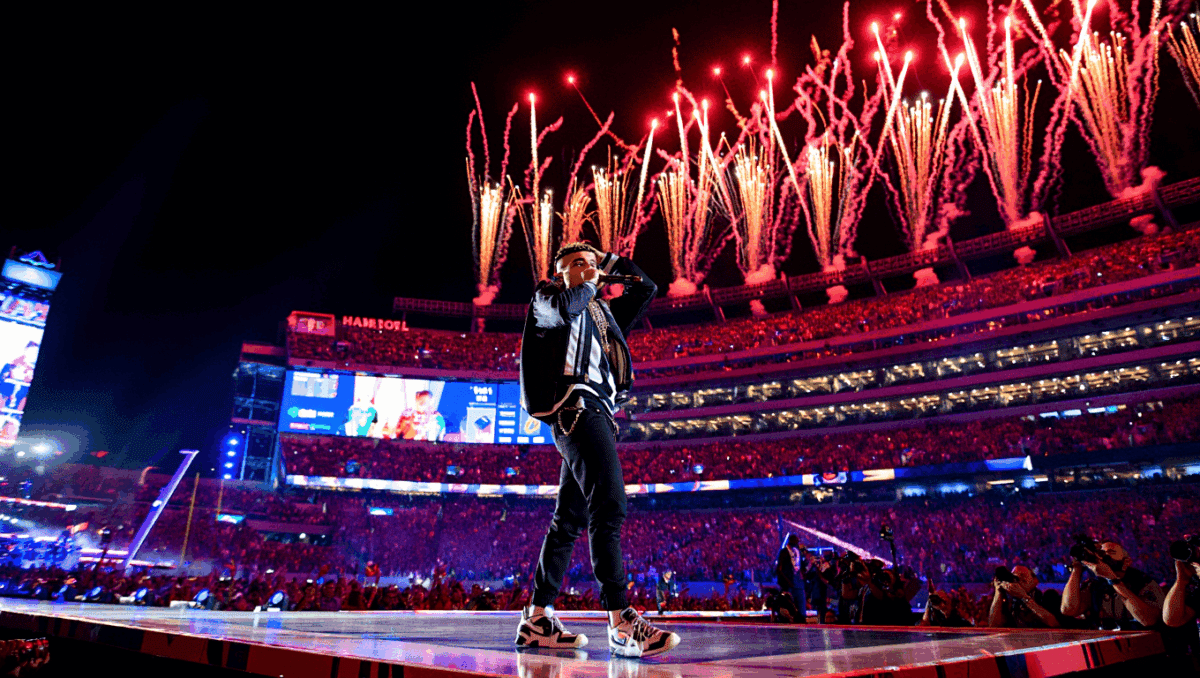
When fireworks cracked above Levi’s Stadium and echoed all the way to neighborhoods in Orlando, it felt like more than a finale to a pop set. For millions across the Americas, Bad Bunny’s Super Bowl halftime performance landed as a bold cultural claim: the label “American” belongs to an entire hemisphere, not a single nation. In living rooms, on street corners, and at packed watch parties, people who trace their roots across the continent celebrated a moment that stitched music, history, and politics into one electrifying spectacle.
Bad Bunny’s 13-minute set did what stadium spectacles rarely do — it made a mass audience feel seen, spoken to, and included. The performance threaded joy with resistance, Spanish with English, and island memory with continental solidarity, leaving a mark well beyond commercial records.
Bad Bunny’s halftime show: a record-setting, Spanish-led moment
Bad Bunny’s set drew a massive global audience — estimates placed viewership between roughly 135 and 142 million — and in doing so marked a milestone for NFL halftime programming. This was the first Super Bowl halftime show to be primarily in Spanish, and the staging, song choices, and closing message made the language a vehicle for a broader political and cultural argument.
The Growing Demand for Data-Driven Decision Making in Silicon Valley
He quit, ran out of money, and begged to come back — here’s how his boss reacted
- Historic viewership: numbers rivaling the most-watched halftime performances ever.
- A Spanish-first mainstream moment: songs, choreography, and spoken lines centered Latin American languages and experiences.
- Clear message: the closing football stamped “Together, We Are America” reframed American identity across borders.
Stagecraft and symbolism: Puerto Rico, labor, and resistance
Rather than opening with abstract spectacle, the set plunged viewers into a layered Puerto Rican landscape. The stage evoked sugarcane fields and jíbaro culture, a deliberate nod to the island’s history of colonial extraction and the resilient communities that emerged from that past. Performers wore pava hats and carried machetes — visual callbacks to agricultural labor and to the tools historically associated with resistance across the Caribbean.
Key visual elements
- Sugarcane backdrops and farmwear linking present-day Puerto Rico to its colonial past.
- Machetes and traditional hats that reference tools of labor and symbols of revolt.
- A life-size pink casita — a domestic stage element that echoes community, home, and Puerto Rican cultural spaces.
The show as a diasporic homecoming: food, neighborhoods, and everyday life
Bad Bunny threaded intimate, everyday scenes through the choreography: vendors selling piraguas and coco frío, friends playing dominoes, nail salons and street corner braids. These vignettes mapped Puerto Rican life across oceans — from island boardwalks to Brooklyn storefronts to roadside taco vendors in California — spotlighting how diaspora communities remake home in new places.
- Scenes of rebuilding after Hurricane María, nodding to ongoing recovery.
- References to U.S.-based street vendors and ICE-era targeting, linking cultural life to immigration policy.
- Interactions with children and elders that emphasized generational connection and care.
Music, movement, and cultural reclamation
The playlist was a tour through contemporary reggaeton, salsa, plena, and protest music. Bad Bunny moved fluidly from stadium-sized party anthems to sharply political tracks, honoring the island’s musical pioneers while centering female agency and community memory.
Highlights included:
- A medley of hits such as “Tití Me Preguntó,” “Yo Perreo Sola,” “Safaera,” and “Voy a Llevarte Pa PR.”
- Salsa and plena moments that pulled folk traditions into mainstream visibility.
- Performative tributes to reggaeton elders like Daddy Yankee and Tego Calderón.
In performance, the lyrics about bodily autonomy and joy — from “Yo Perreo Sola” to the explicit, crowd-sung lines of “Safaera” — became acts of empowerment. The choreography and vocal call-and-response reclaimed space: dancing was not just entertainment, it was a cultural refusal of marginalization.
When performance meets politics: voices that objected and voices that answered
Not everyone received the show as a unifying gesture. A handful of conservative groups and commentators framed the Spanish-forward set and Bad Bunny’s immigrant-friendly rhetoric as a challenge to certain visions of American identity. In response, conservative nonprofit Turning Point USA produced an alternate “All-American Halftime Show,” streaming country and rock acts for a much smaller online audience.
But the backlash underscored the very point Bad Bunny was making: his set reframed “America” as a geographic and cultural space that reaches far beyond U.S. political borders. By naming nations across the Caribbean, South, Central, and North America and waving flags from across the hemisphere, the performance insisted that American identity can be multilingual, multiracial, and cross-continental.
Puerto Rico on a global stage: colonial history and sovereignty
Throughout the show, references to Puerto Rico’s colonial status were unmistakable. Songs and staging called attention to U.S. territorial control, historic extraction, and contemporary displacement. A protest-tinged sequence — including a performance of “El Apagón” and imagery that invoked the island’s struggles with power outages and governmental neglect — turned the halftime slot into a platform for civic and cultural critique.
- Ricky Martin’s tribute tied to rural resistance and land preservation themes.
- Bad Bunny scaling a sparking utility pole served as a theatrical indictment of infrastructural failure.
- The repeated invocation of Puerto Rican sovereignty pushed the island’s struggles into a global conversation.
Moments of intimacy: weddings, children, and intergenerational care
Beyond spectacle, the show staged several tender scenes that felt rooted in real communal life: a couple exchanging vows during the performance, a band playing a salsa rendition while a cake was cut, and gestures of encouragement toward a child that mirrored family advice heard across many Latinx homes. When Bad Bunny knelt to gift a child his Grammy and whispered “Cree siempre en ti,” it read as both a personal and symbolic affirmation — a hand passed to younger generations.
Language, faith, and public prayers: mixing English, Spanish, and plea
Bad Bunny’s spoken moments were intentionally bilingual. He began and closed with words that signaled outreach across linguistic lines, and when he invoked “God bless America” and then switched to Spanish with “seguimos aquí” — “we are still here” — the shift functioned like a prayer for survival and presence. That line, familiar in Puerto Rican circles as a chant of endurance, landed on a stage watched around the world and carried centuries of resilience in three syllables.
How art builds alternative imaginaries of America
What made the halftime show resonate was not just spectacle but its insistence that cultural expression can reshape public imagination. Through music, history, food, and flags, the performance proposed a different map of belonging: one that centers shared experiences across the hemisphere rather than the narrow nationalisms of a single country.
Bad Bunny’s staging offered several invitations:
- To recognize the Americas as a plural set of identities and histories.
- To celebrate multilingual cultural practices as core, not peripheral.
- To see music and dance as forms of political knowledge and collective memory.
Responses and ripples across communities
Across cities with dense Puerto Rican and Latinx populations, the reaction was immediate and communal. Watch parties sold out, shops closed early for families to gather, and neighborhood streets turned into impromptu celebrations. These local responses weren’t just fandom — they reflected a collective recognition that the show had named and validated experiences often relegated to margins.
Ways communities showed up
- Block parties and watch events that doubled as cultural gatherings.
- Social media amplifications that translated Spanish lyrics, shared pride, and argued back against critics.
- Local businesses leveraging the moment to host inclusive space for celebration and discussion.
Artistic solidarity and the ongoing work of visibility
By centering Puerto Rican and broader Latin American soundscapes, Bad Bunny used a moment on the biggest live-broadcast stage to spotlight issues of colonialism, migration, and belonging. The show modeled how popular art can do more than entertain: it can invite audiences to rethink history, policy, and identity together. For many viewers — on islands, in cities, along coastlines, and in rural enclaves — the halftime performance was a rare mainstream recognition that their stories are part of the American story.
You might also like:
- Bad Bunny concert causes NYC toilets to flush simultaneously after fans held it in
- Bad Bunny live stream with Amazon Una Más signals push into livestream concerts
- Super Bowl halftime show needs a return to basics as NFL plans for next year
- Artists in crisis: what do we want from political art?
- MLB owners threaten World Baseball Classic’s future

David Miller is an entertainment expert with a passion for film, music, and series. With eight years in cultural criticism, he takes you behind the scenes of productions and studios. His energetic style guides you to the next big releases and trending sensations.


I mean, Bad Bunny really set the bar high with that halftime show! The Latin music scene needed that kind of spotlight, you know? Its like a fiesta for the ears and the eyes at the same time. So much energy, so much flavor!
Oh man, Bad Bunny really brought the fuego to that halftime show, didnt he? It was like a full-blown Latin music bash for the senses! The energy was off the charts, and the flavor? Dont even get me started! Its about time the spotlight shone on the Latin music scene like that. Who else you think could bring that level of fiesta vibes to the stage?
Man, that Bad Bunny halftime show was like a fiesta on steroids! The energy, the colors, the music – talk about a full-on sensory overload. Dudes definitely bringing some Latino spice to the mainstream.
Man, that Bad Bunny show was straight-up fuego! The way he had the crowd vibin with those beats and colors… it was like a party that never wanted to end. Latino spice on full blast, for real! Wasnt it just a wild ride from start to finish?
Man, Bad Bunny’s halftime show was like a sonic fiesta, man! He just owned that stage, bringing that Latin heat! It was pure fuego, Im still hyped up from it! Can we have an encore, pretty please?
Man, Bad Bunnys Super Bowl halftime show was like a shot of pure adrenaline straight to the heart! He really brought the heat and showed the world what Latin music is all about. It was a vibe that I didnt know I needed!
Man, Bad Bunny really brought the heat at that halftime show! His energy was off the charts, and the way he mixed in those Latin music vibes was fire. Definitely a groundbreaking performance thats gonna be remembered for a long time.
Oh, man, Bad Bunny really set the stage on fire with that halftime show! His energy was just contagious, right? Mixing those Latin vibes in was pure fuego! A groundbreaking performance for sure, gonna be on repeat for ages. Who else cant stop vibing to it?
Man, Bad Bunnys halftime show was like a wild ride through Latin music history! The energy, the beats, the visuals – everything was on point! He really brought some fresh vibes to that Super Bowl stage.
Man, that Bad Bunny halftime show was like a shot of pure Latinx energy straight to the soul! The visuals, the vibe, the beats – it was a whole experience. Reclaiming and reimagining Latin music on that stage? Absolute legend move!
Man, Bad Bunnys halftime show was like a shot of pure energy! He brought that Latin flavor in full force, reclaiming the stage and giving us a taste of something fresh and vibrant. Cant deny the power of his performance!
Man, Bad Bunnys halftime show was like a wild ride through Latinx culture! The energy, the vibes, the colors – all on point. It was like a party that just kept getting better. Mad respect!
Oh man, Bad Bunny really brought the heat with that halftime show, huh? It was like a full-on fiesta of Latinx culture! The energy was off the charts, the colors were poppin, and the vibes were just *chefs kiss*. It was definitely a party that made you wanna keep on dancing all night long. Mad respect for that performance!
Man, that halftime show was fire! Bad Bunny brought Latin vibes to the Super Bowl like a boss. It was like a party in my living room, got me dancing like nobodys watching. So good!