
Show summary Hide summary
- National recognition and the boost that followed
- Why flowers, and how a shift in strategy saved the project
- How Southside Blooms and Chicago Eco House operate
- Real impact on the ground in South Side neighborhoods
- Why locally grown flowers matter for cities
- The people driving the effort
- Scaling the model and next steps
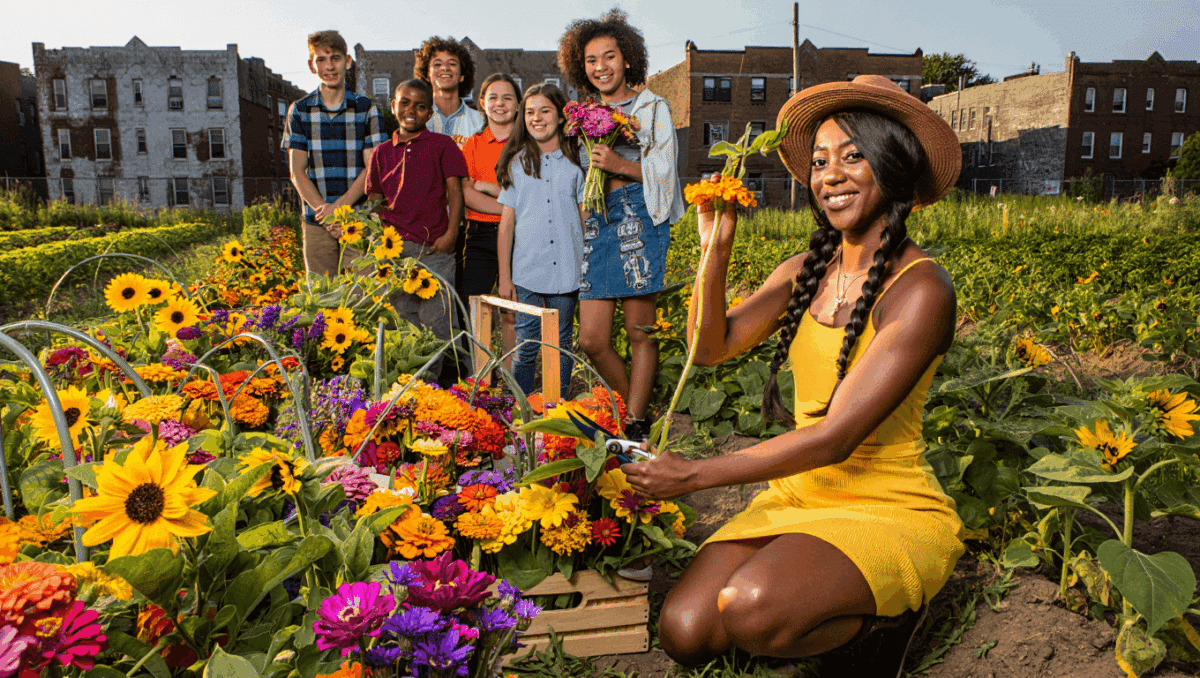
Hope is taking root on Chicago’s South Side where empty lots are being reclaimed and turned into thriving flower farms that pay local youth and brighten neighborhoods. What started as a small experiment has grown into a civic movement led by a couple determined to prove that urban land can produce both beauty and opportunity.
The initiative — a pair of nonprofits called Southside Blooms and Chicago Eco House — has gained national attention, earning its founder a major honor and a cash award to scale the work. But the real story is how formerly neglected parcels are becoming classrooms, jobs, and new economic pathways for young people in communities that have long been written off.
National recognition and the boost that followed
Quilen Blackwell was named CNN’s Hero of the Year in the event’s 19th installment, a spotlight that came with a $100,000 award to support his organizations’ growth. The recognition brought wider public awareness and fresh momentum to a model that pairs sustainable urban agriculture with job training and small-business skills.
The Growing Demand for Data-Driven Decision Making in Silicon Valley
He quit, ran out of money, and begged to come back — here’s how his boss reacted
Why flowers, and how a shift in strategy saved the project
After arriving in Chicago from Wisconsin — following time in the Peace Corps and studies in ministry — Blackwell settled in Englewood, a neighborhood facing deep economic distress. An early attempt to grow food ran into problems: local soils carried contaminants, and water access for safe irrigation proved complicated. Rather than abandon urban agriculture, Blackwell reconsidered the crop itself.
– He discovered a striking market gap: a large majority of cut flowers sold in the U.S. are imported.
– He saw an opportunity to use underutilized land to grow high-value blooms that can be sold locally without the same food-safety hurdles as produce.
That pivot led to flowers as the central crop. By focusing on floriculture, Blackwell and his team avoided some of the regulatory and environmental hurdles of vegetable farming while creating a product with strong local demand.
How Southside Blooms and Chicago Eco House operate
The two nonprofits work together as an ecosystem: Chicago Eco House converts vacant lots into solar-powered growing sites, and Southside Blooms runs a nonprofit flower shop and distribution channels. Their model blends urban farming with vocational training and enterprise development.
- Land conversion: Vacant parcels are remediated and fitted with raised beds, pollinator-friendly planting, and solar systems to power on-site needs.
- Workforce development: Young people learn everything from soil prep and planting schedules to harvesting, arranging, and retail sales.
- Sales and distribution: Flowers are sold through the organization’s shop and to customers across Chicago, replacing some of the imported supply with locally grown stems.
- Community engagement: Workshops and events connect residents to gardening skills, floral design, and small-business basics.
Real impact on the ground in South Side neighborhoods
The initiative has turned multiple empty lots into productive sites and created paying jobs for local youth. Currently, Southside Blooms employs about 25 young workers, primarily between 16 and 25 years old, and plans to expand with a second location on the West Side during the spring season. The farms are solar-powered, demonstrating a low-carbon approach to urban agriculture.
These projects deliver hands-on training and reliable income to young people who often face limited employment alternatives. Program participants gain skills in horticulture, floristry, and retail — practical experience that can translate into further education or steady work.
What participants learn
- Crop planning and sustainable cultivation methods
- Post-harvest handling and floral preservation
- Design and arrangement techniques
- Customer service, bookkeeping, and sales operations
Why locally grown flowers matter for cities
Beyond the immediate job and training benefits, growing flowers in urban lots challenges broader supply-chain assumptions. The fact that more than 70% of cut flowers sold in the U.S. are imported highlights a dependence that small urban farms can begin to correct. Locally grown blooms reduce transportation emissions, support community-based economies, and keep more revenue circulating inside the city.
Flowers also offer therapeutic and cultural value: tending plants provides mental-health benefits, public green spaces beautify neighborhoods, and floral products create new micro-enterprise opportunities for residents.
The people driving the effort
The program is a family-led effort. Quilen and his wife, Hannah — who leads floral design — have involved their children and built a team of young leaders. The couple emphasizes collective achievement over individual accolades, crediting the youth and staff who do the daily work of planting, harvesting, and arranging.
Their approach blends mentorship with entrepreneurship: young employees are treated as contributors, given responsibility, and taught how to run elements of a small business. That atmosphere of trust and agency is central to the project’s success.
Scaling the model and next steps
With the CNN award and growing community support, the nonprofits aim to replicate the model across other neighborhoods. Expansion plans include opening the new West Side site and strengthening sales channels throughout Chicago. The combination of solar-powered plots, vocational training, and a retail outlet creates a replicable template for other cities looking to convert vacant land into local economic engines.
- Open additional lots for cultivation
- Develop partnerships with local retailers and florists
- Formalize apprenticeships and certification for participants
- Document best practices for transfer to other urban communities

You might also like:
- Neither chemicals nor additives: sparkling water keeps your flowers fresh twice as long
- Kentucky school lunches get a farm-to-school makeover, ending pan pizza and fruit cups
- Wife lines entire street with daffodils after husband’s death
- Company hires disabled Americans for 20 years to make superior scents
- New Delhi teens recycle 2 million pounds of waste across 14 Indian cities after asthma attack

Michael Thompson is an experienced journalist covering U.S. and global news. With ten years on the front lines, he breaks down political and economic stories that matter. His precise writing and keen attention to detail help you grasp the real‑world impact of every event.


Man, that flower farm project on Chicagos South Side? Its like watching a phoenix rise from the ashes! CNNs hero of the year? More like hero of the century, turning vacant lots into vibrant blooms. Total game-changer!
Man, I remember when those vacant lots were just sad reminders of neglect. Now theyre blooming with flowers, thanks to CNNs hero of the year. Its like a real-life fairytale happening in the South Side. Hope it brings lasting change!
Man, those empty lots were like the saddest little patches of neglect, right? Its wild how theyve transformed into this flowery wonderland, all thanks to CNNs hero of the year. The South Sides really getting a fairytale makeover! Lets hope this change sticks around for good, yknow?
Man, I remember when those lots were just wastelands. Flowers bringing hope? Cool move. But, like, are they sustainable? Hope its not just a temporary fix, ya know?
Hey, I remember when folks said those vacant lots were a lost cause. Now, flowers bloomin everywhere thanks to Southside Blooms! CNNs hero? Yeah, thats the real deal. Time for more good news stories like this!
I remember when folks said vacant lots were just dead space. Now, South Side blooms with flowers, thanks to CNNs hero. Who needs a cape when you can wield a shovel? Time to smell the roses, yall!
Man, aint that the truth! Who needs Superman when we got our own gardening guru here in the story? Its like watching a real-life superhero movie, but with more dirt and less CGI. Guess its time for us to grab a shovel and join the flower power party, right?
Man, South Side bloomin with flower farms? Thats the kinda news I like to see! CNNs hero, makin a real change. Hope it spreads like wildflowers, bringin color and hope to the community.
Whoa, flower farms in the South Side? Thats some refreshing news, man! Color and hope blooming like wildflowers, huh? Lets hope it spreads like confetti at a party, bringing joy to the whole community!
Man, South Side Blooms got me reminiscin bout my grannys garden. Flowers bringin hope to vacant lots? Thats some real magic right there. CNNs hero of the year? Deserved.
Man, South Side Blooms be sproutin hope in them vacant lots! CNNs hero makin flower farms bloom where neglect once ruled. Thats the kinda story we need more of, diggin deep for change.
Man, I remember when those lots were just sitting there, empty and sad. Now theyre bloomin with flowers, bringin a little color to the South Side. Props to CNNs hero for makin it happen!
Man, that CNN hero aint playing games! Turning vacant lots into flower farms? Thats some next-level stuff. Wonder if other cities gonna follow suit. Big up to Southside Blooms and Chicago Eco House for making real change happen.
Man, I remember when those lots were just sad reminders of neglect. Now theyre blooming with hope and color. Big ups to the Southside Blooms crew for turning things around, keep spreading that positivity!
Yo, this project on Chicagos South Side? Its like a breath of fresh air in a concrete jungle. Turning vacant lots into flower farms? Thats some superhero stuff right there, making a real difference in the community.
Yo, this project on Chicagos South Side? Its like a ray of sunshine in a city jungle, right? Turning those empty lots into flower farms? Thats some real-life superhero action, making a positive impact in the hood. Love seeing the community bloom literally and figuratively!
Man, South Side Blooms is like a hidden gem, yknow? Turning vacant lots into flower farms? Thats some real magic right there. Its inspiring to see communities bloom like the flowers they grow.
Man, this story hits close to home. I remember when our block was just concrete and trash. Flowers bring hope. Southside Blooms is a game-changer, yall. Lets bloom where were planted!