
Show summary Hide summary
- How researchers tested chimps’ response to crystals
- What the chimps actually did — behaviors that stood out
- Why crystals may capture attention: shape, light, and rarity
- Value without utility: the barter finding
- Limits of the study and what should come next
- Broader animal examples and cultural echoes
- Implications for understanding human origins of material value
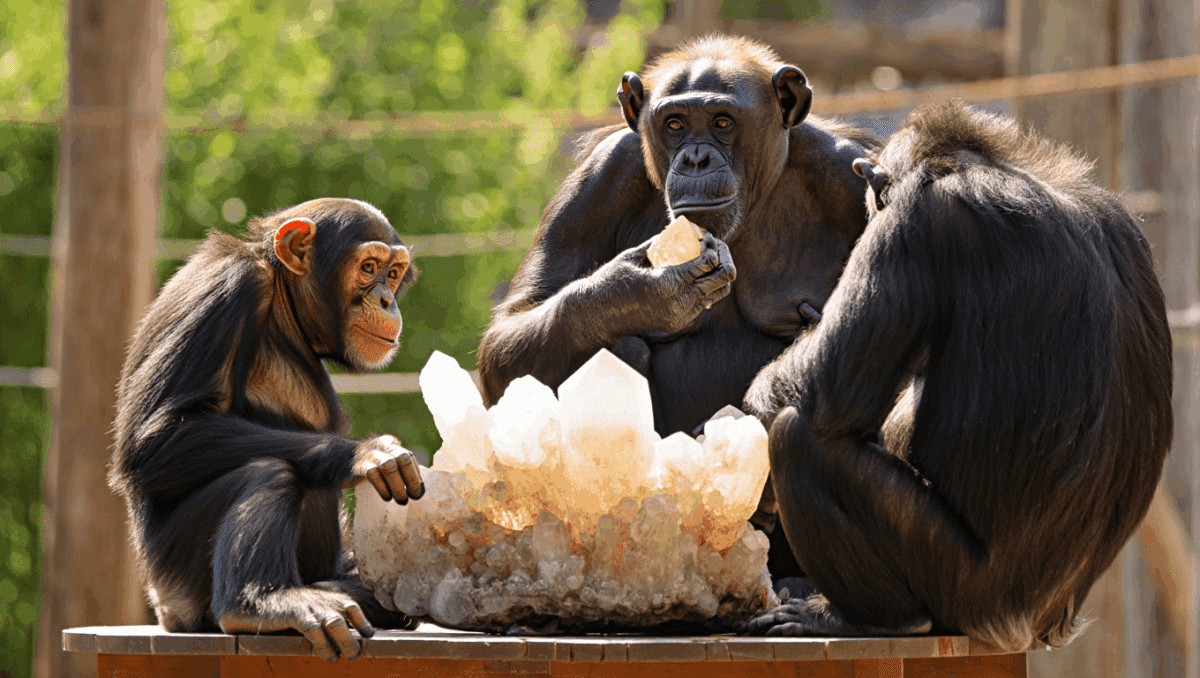
Scientists watching chimpanzees at a rescue center noticed something unexpected: the apes were drawn to sparkling stones in ways that looked strikingly like human fascination with gems. The behavior wasn’t limited to a passing glance — the animals inspected the crystals closely, carried them back to sleeping areas, and even engaged in exchanges that suggested they regarded the stones as valuable.
The findings raise intriguing questions about the roots of our species’ attraction to shiny objects. Could the human impulse to prize crystals and precious metals extend farther back in evolutionary history than previously thought? Spanish researchers say their results point toward deep-seated sensory or cognitive responses to crystalline forms that may be shared across great apes.
How researchers tested chimps’ response to crystals
Researchers at a primate rescue facility worked with nine enculturated chimpanzees—apes that have had extensive contact with humans—to explore whether these animals show special interest in crystalized rocks. The experiments used both large and small specimens and compared crystals to ordinary stones.
The Growing Demand for Data-Driven Decision Making in Silicon Valley
He quit, ran out of money, and begged to come back — here’s how his boss reacted
- Monolith test: A large quartz crystal and a similarly sized plain rock were placed side-by-side. Initial curiosity around both objects quickly shifted in favor of the crystal, which the animals examined and then carried away.
- Pebble selection: From a pile of 20 smooth pebbles, chimps were asked to choose smaller quartz crystals similar in size to stones recovered at ancient hominin sites. Selections happened within seconds.
- Mixed crystal types: When crystals with different shapes and lusters (quartz, pyrite, calcite) were added, the chimps still separated and selected crystalline specimens over non-crystalline pebbles.
- Exchange tests: Experimenters attempted to retrieve crystals by offering food. The chimps required substantial amounts of food in return, which researchers interpreted as evidence the apes valued the stones.
What the chimps actually did — behaviors that stood out
The animal behavior went beyond casual interest. Observers recorded a range of deliberate actions:
- Careful visual inspection — holding crystals up to eye level and tilting them to study transparency and reflections.
- Transport and storage — taking prized stones into hay-lined sleeping huts or carrying them in the mouth to a platform where items were sorted.
- Selective sorting — separating crystals by type and luster from ordinary pebbles, even when the crystals differed in shape.
- Reluctance to surrender — trading stones for food required greater returns than expected if the items were merely curious objects.
Researchers noted that carrying items in the mouth is atypical chimp behavior, raising the possibility that some apes were hiding or protecting the crystals rather than simply moving them.
Why crystals may capture attention: shape, light, and rarity
The team explored several explanations for the chimps’ fascination. One leading idea centers on the physical properties of crystals: they often present flat faces, straight edges, symmetry, and pronounced transparency — features rare in natural environments dominated by curved, irregular forms.
Perceptual distinctiveness
Crystals stand out visually:
- Flat planes and angles: Natural polyhedral faces produce lines and surfaces uncommon in foliage, rocks, and animal shapes.
- Transparency and sparkle: Light transmission and glitter create shifting visual cues when the object is moved.
These sensory attributes could have made crystals attention-grabbing to early hominins and, as this study suggests, to other great apes as well.
Archaeological echoes
Archaeologists have recovered crystals and polished minerals at hominin sites dating back hundreds of thousands of years. In many cases, the stones show no sign of practical use as tools or weapons, suggesting their appeal lay in appearance rather than function. The chimp observations provide a behavioral parallel that may help explain why ancient humans collected nonutilitarian stones.
Value without utility: the barter finding
One provocative component of the study was the apes’ willingness to trade crystals for food — but only for sizable food rewards. This mirrors a classic economic puzzle: humans assign high value to items like gemstones and precious metals despite their limited practical use.
Researchers reported that chimps would relinquish a crystal only in exchange for far more food than the stone could ever provide nutritionally. If the chimps were testing edibility, the scale of food demanded still points toward an assessment of the stones as something worth safeguarding.
Limits of the study and what should come next
The authors caution about broad conclusions. Key caveats include:
- Enculturation: The chimpanzees tested had substantial exposure to humans, which can alter behavior and reduce comparability with wild apes.
- Sample size and setting: Nine individuals at a single rescue center offer limited generalizability.
The team recommends repeating similar experiments with a wider range of subjects and settings. Suggested directions:
- Test wild chimpanzee populations where human contact is minimal.
- Include other great apes such as bonobos and gorillas to map the behavior across species.
- Compare responses to highly polished gems versus rough crystals to separate the effects of human alteration from raw crystalline features.
Broader animal examples and cultural echoes
The idea that nonhuman animals collect visually striking items is not new. Ornithologists have documented male bowerbirds decorating mating displays with bright or reflective objects — including quartz — to attract females. Such cross-species examples hint at common perceptual or social drivers that can make certain items desirable.
Some scientists suggest that the polished gems and cut stones of modern markets are simply a human refinement of a much older, possibly shared, attraction to crystalline qualities. Placing a prominent diamond or a gleaming crystal in front of an attentive chimp or a decorating bowerbird might provoke the same basic response: focused interest, selection, and protective behavior.
Implications for understanding human origins of material value
If the inclination to notice and prefer crystalline forms exists in other apes, it raises new ways to think about the emergence of symbolic value in human societies. Rather than purely cultural inventions, the roots of valuing certain objects could be partly perceptual and evolutionary—an interplay of sensory make-up, rarity, and social signaling that predates the full development of human culture.
You might also like:
- Apes imagine tea party scenes in lab experiments, scientists say
- Rescued orangutans released into isolated forest now raising babies, forming new wild population
- Orphaned orangutan returns to wild after 4 years in jungle school rehab
- Oldest poisoned arrowheads date back 60,000 years, show hunters’ knowledge of toxins
- Dogs learn new words by eavesdropping on their owners, study shows

Michael Thompson is an experienced journalist covering U.S. and global news. With ten years on the front lines, he breaks down political and economic stories that matter. His precise writing and keen attention to detail help you grasp the real‑world impact of every event.


Man, those chimps and their crystal obsession! Reminds me of that time I couldnt stop staring at a shiny disco ball. Who knew stones had such powers? Maybe I should start collecting some crystals myself!
I remember my cousins chimp going bananas over shiny trinkets. But crystals? Thats next level! Cant blame em, though. Who wouldnt be mesmerized by those sparkly gems? Humans and chimps, united by bling!
Oh man, shiny trinkets and crystals? Thats like the chimps hitting the jackpot in the bling department! Cant blame em for going gaga over those sparkly gems. I mean, who wouldnt be hypnotized by all that sparkle? Its like a universal language of fascination, bringing humans and chimps together in the dazzling world of bling-bling!
I remember watching those chimps on TV going bonkers over shiny stones! Who knew we shared this bling obsession? Maybe they were the OG trendsetters! Cant wait for the chimp fashion magazines!
I remember visiting the zoo and watching those chimps go nuts over shiny stuff. Makes you wonder if were not so different after all. Maybe we all just wanna bling out our lives with some sparkly rocks, you know?
Dude, imagine chimps getting all hyped about crystals! I mean, I get the shiny allure, but do they start a bling collection now? Next thing we know, theyll be making crystal jewelry and hosting fashion shows in the jungle!
Man, those chimps are onto something with those crystals! Reminds me of that time my dog went nuts over a shiny rock. Maybe were all just a bit too easily distracted by sparkly things, eh?
Oh man, I totally get what youre saying! My cat once went bonkers over a crumpled piece of foil like it was some ancient treasure. Its wild how we all get drawn to shiny stuff like magpies, huh? Maybe were just a bunch of easily distracted creatures in the end. Who knew pets and chimps had something in common, right?
Man, chimps vibin with crystals? Reminds me of my aunts weird obsession with gemstones. Maybe we all got a bit of that shiny rock love deep down. Who knew we had crystal-curious ancestors, huh?
I remember that time at the zoo, watching chimps go bananas over shiny things! Guess were not so different after all. Who knew crystals could be such a hit? Maybe I should try sparkly rocks next time I need a pick-me-up!
Man, those chimps and their crystal obsession are onto something. Reminds me of that time my cat couldnt stop staring at a disco ball. Guess we all have a weakness for shiny things, huh?
I once saw a chimp go bananas over a shiny rock. Guess we share that bling obsession! Explains our ancient love for crystals, huh? Maybe were not so different after all.
No way! That chimp sounds like a party animal! Maybe its onto something with the bling. Who knew we had crystal cravings in common? We could be long-lost twins, just one with less hair and more bling, you know what I mean?
I always knew chimps were onto something with their crystal obsession! Maybe they were the OG crystal healers, who knows? Next thing you know, theyll be meditating and doing yoga. Evolution is wild, man!
Man, those chimps are onto something with those crystals! Reminds me of my grandma collecting shiny rocks. Maybe were not so different after all. Who knew primates had such refined taste?
Man, those chimps vibin with crystals is wild! Makes you think about our own fascination with shiny stuff. Maybe were not that different after all. Who knew sparkly rocks could have such a deep history, right?
Man, these chimps got taste! Reminds me of my little cousin, always obsessed with shiny things. Maybe were not so different, after all. Hey, should I start carrying crystals in my pocket for good luck too?
Haha, gotta love those shiny-loving chimps! Your cousin and those primates could probably swap accessories without anyone noticing. As for the crystals, well, who knows? Maybe theyll bring you more luck than a rabbits foot or a four-leaf clover. Give it a shot and see if your pockets start feeling extra magical! ✨
Man, chimps and crystals, thats some wild stuff. Reminds me of that time I caught my cat staring at a shiny bauble for hours. Guess we all have a bit of magpie in us, huh?
I remember when my little cousin was obsessed with shiny rocks, like, no joke, carried them everywhere. Guess its in our genes, huh? Chimps feeling the crystal vibe makes you think… Maybe were not that different after all.
Man, those chimps and their crystal obsession! Reminds me of my little cousin and his rock collection. Maybe were not so different after all, huh? Who knew shiny things could captivate us all!