
Show summary Hide summary
- What the tea-party tests actually showed about ape imagination
- How the study was built to avoid mistakes and bias
- Context: how this fits with earlier observations of animal play
- Why researchers say the result is important for how we think about cognition
- Who took part and why Kanzi matters
- What’s next: questions the team plans to tackle
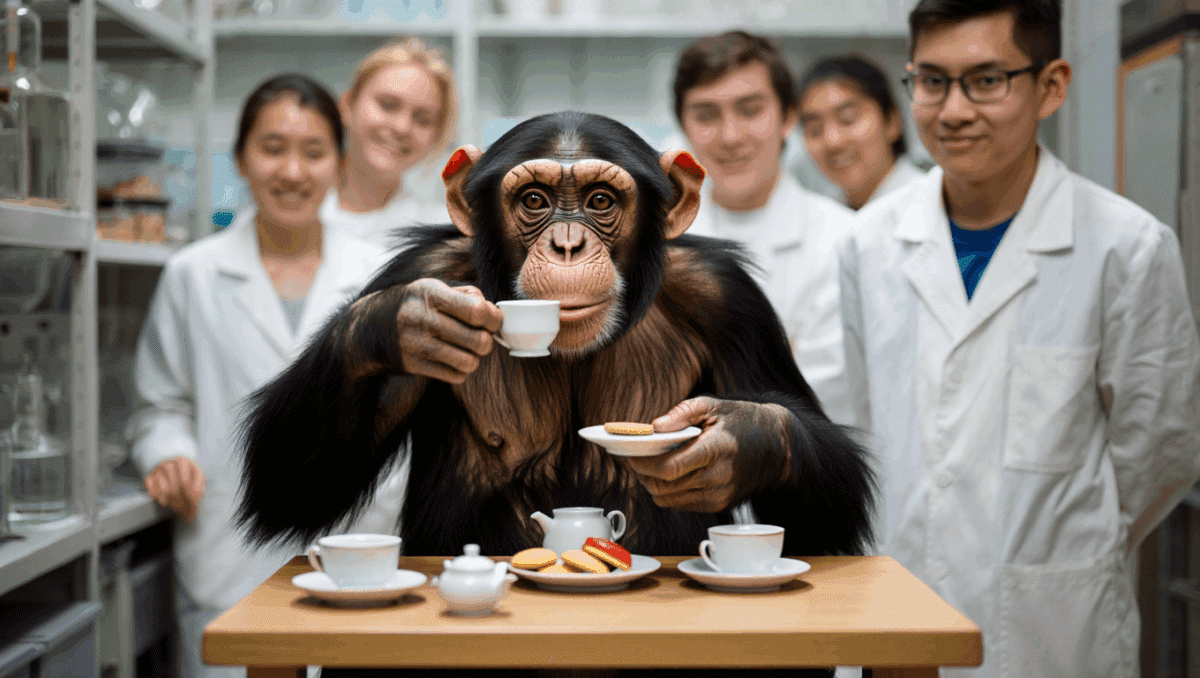
Researchers in Baltimore staged a series of whimsical “tea party” experiments and came away with evidence that at least some apes can imagine and play pretend. The findings, published in the journal Science, challenge the long-standing idea that imaginative play is a uniquely human trait.
At the center of the study was Kanzi, a 43-year-old bonobo known for unusual cognitive skills. Across controlled tasks, Kanzi treated invisible juice and grapes as real objects and reliably indicated their locations after a researcher pretended to pour or move them — suggesting he understood both the idea of a pretend object and its unreality.
What the tea-party tests actually showed about ape imagination
The Growing Demand for Data-Driven Decision Making in Silicon Valley
He quit, ran out of money, and begged to come back — here’s how his boss reacted
Scientists designed childlike scenarios to ask a simple question: can an ape form a mental representation of something that isn’t physically present? The experiments produced consistent behavior from Kanzi that points to the answer being yes.
- Pretend pouring: The researcher mimed pouring juice from a clear pitcher into two empty clear cups, then pretended to empty one cup. When asked where the juice remained, Kanzi pointed to the correct cup even after cup positions were swapped.
- Real vs. pretend choice: To rule out the idea that Kanzi was simply guessing where hidden liquid might be, the team presented a real cup of juice alongside a cup that only contained pretend juice. When offered a choice, Kanzi almost always selected the real juice.
- Pretend grape task: In a third setup, a researcher pretended to taste a grape and then moved an imaginary grape into one of two jars. Kanzi again indicated the jar he believed contained the pretend fruit more often than not.
How the study was built to avoid mistakes and bias
The researchers took steps to make sure the results reflected true understanding of pretense, not clever cue-reading or confusion about real versus imagined objects. They used transparent containers so Kanzi could see there was nothing physically present, varied the positions of items, and introduced real items alongside pretend ones to measure preferences.
Control features that mattered
- Visible empty containers, eliminating hidden-object explanations.
- Position swaps to prevent location-based guessing.
- Real-object trials to measure whether the ape could distinguish tangible rewards from pretend ones.
These controls strengthen the claim that the bonobo was representing the pretend object mentally rather than reacting to visible cues or prior training.
Context: how this fits with earlier observations of animal play
Ethologists and zookeepers have long reported behaviors that look like pretense among primates: young chimpanzees carrying sticks like dolls, captive apes miming the movement of imaginary blocks, and other playful actions that suggest an inner life. Until now, however, controlled experiments explicitly testing pretend representation were absent.
This study provides the first robust experimental evidence that a nonhuman primate can hold an idea of an object that isn’t actually there, and can distinguish that idea from reality.
Why researchers say the result is important for how we think about cognition
The implications reach into evolution and ethics. If imagination — the ability to create and manipulate mental representations of absent things — is shared with our closest relatives, its roots may extend back to the common ancestor of humans and apes several million years ago. That reframes imagination as an evolutionary continuity rather than a purely human innovation.
Scientists involved in the research note that imagining is a cornerstone of human mental life, linked to play, planning, empathy, and creative problem-solving. Finding precursors of that capacity in apes invites fresh questions about animal minds and how we value them.
Who took part and why Kanzi matters
Kanzi lives at the Ape Initiative, a sanctuary and research center devoted to bonobo study and conservation. He has a documented history of complex behavior and responsiveness to verbal cues, making him an ideal subject for a first controlled test of pretense.
- Age and background: Kanzi is an older bonobo with a history of interactive training and research participation.
- Behavioral record: Previous anecdotal reports suggested he sometimes engaged in pretend-like actions, which led researchers to formalize tests.
What’s next: questions the team plans to tackle
Researchers say this is only a starting point. Their next steps include expanding tests to other apes and species, and probing other forms of imagination — for instance, whether apes can envision future events, simulate possible outcomes, or infer what another individual might be thinking.
- Replicating the paradigm with more individuals and species.
- Exploring temporal imagination — the ability to imagine future scenarios.
- Investigating theory of mind capacities tied to pretend play.
The study encourages a rethink of assumptions that nonhuman animals live only in the immediate present and lack richly structured mental lives. If elements of imagination are shared across primates, both scientific understanding and conservation approaches may shift to reflect the deeper cognitive lives of these animals.
You might also like:
- Chimpanzees’ fascination with crystals offers clues to why early humans prized stones
- Dogs learn new words by eavesdropping on their owners, study shows
- Sperm cells turned into trackable microbots by scientists
- Hedgehogs could avoid extinction with car-mounted silent ultrasound to prevent roadkill
- MS: high-altitude yak gene protects and repairs myelin in early study

Michael Thompson is an experienced journalist covering U.S. and global news. With ten years on the front lines, he breaks down political and economic stories that matter. His precise writing and keen attention to detail help you grasp the real‑world impact of every event.


I swear, those apes are giving me a run for my money in creativity! Imagine having a tea party scene in a lab. Who knew they were into fancy gatherings? Next thing you know, theyll be asking for cucumber sandwiches!
A tea party with apes? Thats bananas! Can you imagine them sipping tea and gossiping? Were just one step closer to Planet of the Apes scenario. Who knew our primate pals had such refined taste!
I mean, who wouldve thought apes sippin tea and throwin imaginary parties? The labs got more drama than my Aunt Marthas bingo night. Cant wait for them to spill the tea on these tea parties!
Man, I always knew apes were cool, but now theyre throwing tea parties in labs? Thats wild! Can you imagine chimps sipping tea and gossiping about the latest jungle drama? Science never fails to amaze me, I tell ya!
A conspiracy nut: So, they want us to believe apes can plan a fancy tea party now? Whats next, monkeys hosting a book club? Im onto their monkey business! Its all a ploy, I tell ya.
I mean, who wouldve thought apes would be into tea parties? Next thing you know, theyll be hosting their own bake-offs! Seriously though, its fascinating how these experiments shed light on ape imagination. Who knows what else theyre capable of?
I once saw a chimp at the zoo sipping juice like a pro, but a tea party? Thats next level! Cant wait for the day they start discussing quantum physics over crumpets. Cheers to ape imagination!
Oh, chimps throwing a tea party? Reminds me of that time my cousin tried to teach her cat to fetch. Predictably chaotic but adorable. Animals are full of surprises, I tell ya!
Haha, I can totally picture that chaos! Cats and fetch – not the best combo, right? But hey, the unpredictability is what makes it fun. Animals always keep us on our toes, aint that the truth? Gotta love their surprises!
I mean, who knew apes had such vivid imaginations, right? Makes you wonder what else is going on in those furry heads. Maybe theyre planning the next great ape novel or plotting a banana heist. Fascinating stuff!
I mean, who knew apes had such vivid imaginations? Next thing you know, theyll be hosting their own book clubs! Honestly, though, its fascinating to see how similar our cognitive processes can be. Natures full of surprises, aint it?
Who woulda thought, right? Those apes could surprise us all! Imagine them discussing Hemingway over a banana smoothie! Nature sure pulls out some wild tricks. Wonder what else theyre hiding up their furry sleeves.
Man, these apes are really stepping up their game! Imagine them having a tea party – next thing you know, theyll be hosting their own cooking show. Cant wait to see what other surprises they have up their furry sleeves!
These apes aint messin around, huh? I can already picture them whipping up a storm in the kitchen! Who knows, maybe theyll give Gordon Ramsay a run for his money one day. Exciting times ahead – cant wait to see what they pull outta the hat next!
I mean, who wouldve thought apes are into tea parties too? Like, I can barely get my cat to sit still for a minute, and here we have apes sipping tea. Whats next, monkey business etiquette classes?
I once dressed my cat in a tiny hat for fun. Now, reading about apes hosting tea parties is making me rethink my pets entertainment. Who knew animals had such fancy imaginations? Time to step up my game!
Oh, I remember watching those videos! Apes at a tea party, sippin like theyre at a fancy brunch. Cant blame em for wanting to play pretend. Who wouldnt want to imagine themselves having a spot of tea?