
Show summary Hide summary
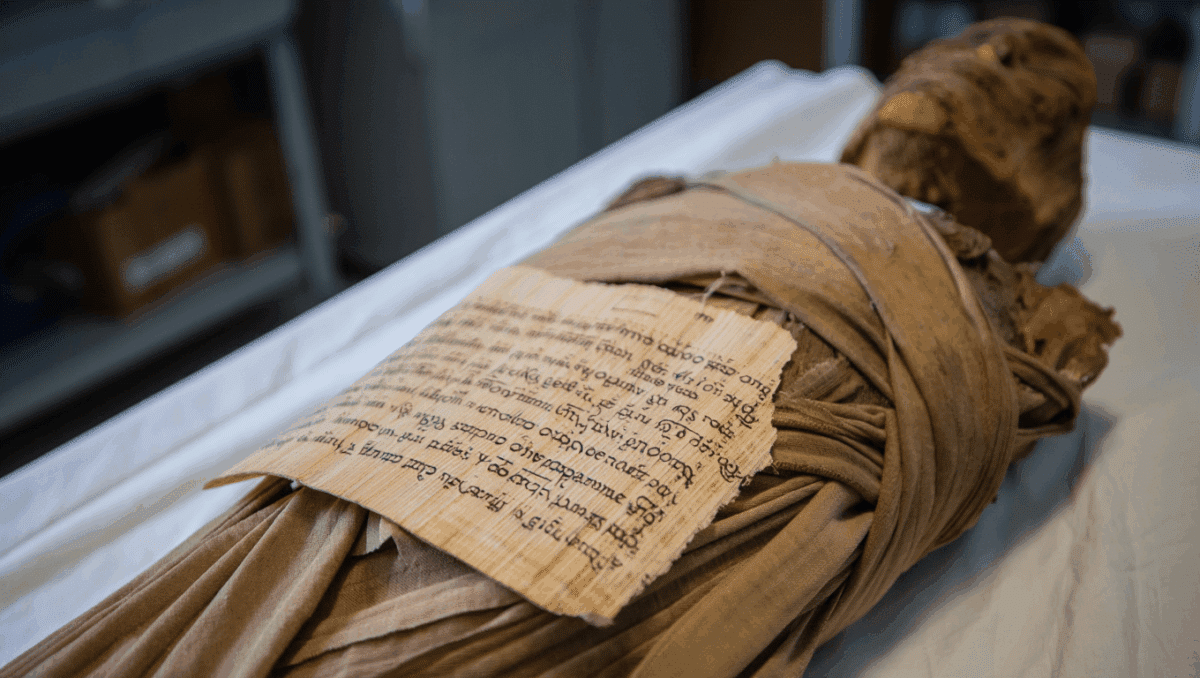
A fragment of Homer’s Iliad tucked into a 1,600-year-old Egyptian mummy has reshaped how archaeologists think about books, burial rites and cultural exchange in late antiquity. Unearthed by a Spanish team in a Roman-era tomb at the site of ancient Oxyrhynchus, the tiny strip of papyrus contains lines from one of Western literature’s most famous passages — and it is the first known instance of a literary work being placed deliberately within a mummy’s wrappings.
This find links the classical Greek world with Egyptian funerary practice in an unexpected way. Beyond the romance of Homer and mummies, the discovery offers fresh evidence about literacy, ritual behavior, and how prized texts traveled and were repurposed across the Mediterranean.
Where the papyrus was found and what it looked like
The fragment was recovered from Tomb 65 in Sector 22 of the Al Bahnasa necropolis, the archaeological site identified with Oxyrhynchus in Middle Egypt. The burial dates to the Roman period, roughly 1,600 years ago, and contained a mummified individual whose wrappings held a small, folded papyrus placed directly on the abdomen — a position previously associated with spells and magical amulets in the same cemetery.
The Growing Demand for Data-Driven Decision Making in Silicon Valley
He quit, ran out of money, and begged to come back — here’s how his boss reacted
Archaeologists recorded:
- Location: Al Bahnasa (ancient Oxyrhynchus), about 190 kilometers south of Cairo near the Bahr Yussef canal.
- Context: A Roman-era funerary complex with three limestone chambers, mummies, and wooden sarcophagi.
- Condition: The tomb showed signs of past looting, yet the papyrus remained legible enough for specialists to study.
The mission’s team emphasized that while Greek-written papyri have been found at Oxyrhynchus before, this is the first time a clearly literary text — rather than a magical formula or ritual instruction — has been incorporated into the embalming process.
Who identified the text and what it contains
Papyrologists working with the University of Barcelona analyzed the scrap early this year. Leah Mascia, together with Professor Adiego from the Department of Classical, Romance and Semitic Languages, examined the handwriting and the phrasing. Their reading places the lines within Book II of Homer’s Iliad, specifically the famed Catalogue of Ships — the section that inventories the Greek contingents that sailed to Troy.
This identification matters because the Catalogue of Ships is one of the Iliad’s most recognizable passages, central to Homeric tradition and widely cited in studies of ancient epic and oral performance. To find it within a funerary bundle challenges assumptions about what kinds of texts circulated in daily, ritual, and domestic contexts in Roman Egypt.
What the fragment implies about readership and value
The presence of Homeric verse in a burial suggests several possible social dynamics:
- Owners or relatives might have valued Greek literature as a marker of education or cultural affiliation.
- Passages from epic poetry may have been repurposed for protective or symbolic reasons, even if not strictly “magical.”
- Literary papyri could have circulated more widely among non-elite groups than previously believed.
The archaeologists pointed out that thousands of papyri from Oxyrhynchus have preserved literary works, but none had been documented inside a mummy’s wrappings until now.
Why this changes our view of funerary rites in Greco-Roman Egypt
Until this discovery, papyri placed within mummification bundles were overwhelmingly associated with spells, amulets or other ritual texts intended to assist the deceased. Finding a canonical Greek epic in the same role opens questions about intent: was the Iliad fragment valued for its words, its perceived protective power, or its symbolic connection to a Mediterranean identity?
Researchers stress that the novelty is not only the literary content but the deliberate placement during the mummification process. The papyrus was not a book casually buried with possessions; it appears to have been integrated into the ritual sequence, indicating a meaningful function for the living who prepared the interment.
Oxyrhynchus: a crossroads of languages, books and burial customs
Oxyrhynchus has long been famous among classicists and papyrologists. Excavations since the late 19th century have recovered a vast archive of documents — everything from private letters and receipts to early copies of Greek plays and biblical texts. The site’s long-lived necropolis served the city for centuries, creating layered evidence of changing customs and multilingual exchange.
Key points about the site:
- Duration: The necropolis was used for over a thousand years, spanning Pharaonic, Hellenistic, Roman and Byzantine periods.
- Diversity: Finds at Oxyrhynchus include Greek, Coptic and Latin material, reflecting a cosmopolitan population.
- Research legacy: The Oxyrhynchus papyri are among the most important documentary sources for ancient Mediterranean life.
The papyrus-within-a-mummy adds a new dimension to that legacy by connecting a high-status literary work with everyday ritual practice in a provincial Egyptian context.
The team behind the excavation and how the discovery is being shared
The find is credited to the Oxyrhynchus Archaeological Mission, led by Maite Mascort and Esther Pons under the University of Barcelona’s Institute of Ancient Near East Studies. The mission has operated at Al Bahnasa since 1992, combining fieldwork with conservation and scholarly publication.
Following the identification of the Iliad fragment, the university announced plans to present the details in a series of public lectures in Barcelona. These events aim to bring the discovery to wider audiences and to place the fragment in conversation with the broader trove of Oxyrhynchus texts.
Visitors and scholars can expect further study, including:
- Detailed palaeographic analysis to better date the handwriting.
- Comparative work on other papyri found in embalming contexts.
- Interdisciplinary research linking literary circulation with funerary practice.
The finding reframes the ways ancient people curated and deployed texts, suggesting that Homeric poetry could serve cultural functions far beyond the lecture hall or private library.
You might also like:
- 3,200-year-old tomb found in Luxor dates to Ramses era
- 600-year-old Peruvian tomb declared discovery of the decade after first unsealing
- Ancient Egyptian crypt in Luxor with 22 singing priests unsealed for first time
- Vesuvius scrolls decoded by AI reveal unknown stoic philosopher
- Celtic princely tomb found in Germany: nearly unmatched ancient noble burial

Michael Thompson is an experienced journalist covering U.S. and global news. With ten years on the front lines, he breaks down political and economic stories that matter. His precise writing and keen attention to detail help you grasp the real‑world impact of every event.


I mean, imagine being that mummy, chillin in your tomb for centuries, and suddenly they find out youre packed with some epic Homer vibes. Talk about a twist in the afterlife plot, huh?
Man, thats wild! Finding an Iliad papyrus in a mummy? Its like a crossover episode of ancient literature and archaeology. Wonder if the mummy was a bookworm or just liked to keep good company in the afterlife.
Dude, I know, right? Talk about a plot twist in real life! Like, was that mummy secretly a literary connoisseur, or did they just have a knack for scoring VIP company for the afterlife parties? Mustve been the coolest mummy on the block, for sure. Imagine the stories it could tell… if only mummies could talk, huh?
I remember when I found a crumpled note in my old jeans, not quite Homers Iliad, but close! Imagine a papyrus in a mummy?! Ancient fanfiction game strong!
Oh, mate, stumbling upon a crumpled note in your jeans is like finding a hidden treasure, innit? Not quite the Iliad, but close enough to spark that ancient fanfiction intrigue! A papyrus in a mummy? Now thats taking fanfic to a whole new level! Who knew our ancestors had such creative storytelling skills, eh?
Dang, finding Homers Iliad in a mummy? Thats wild, man. Imagine someone in ancient Egypt chillin with some epic poetry before kickin the bucket. Who knew mummies were literary connoisseurs?
Man, finding a piece of Homers Iliad in a mummy? Thats like discovering a treasure map inside a time capsule! Its mind-blowing how history keeps surprising us with these hidden gems. Makes you wonder what else is waiting to be unearthed, right?
Dang, finding Homers Iliad in a mummy? Thats like hitting the jackpot in a tomb, man! Imagine the ancient Egyptian pharaohs chillin with some epic poetry. History just got a whole lot cooler.
Dude, can you imagine the Pharaohs kickin back, sippin on some wine, and recitin Homers Iliad? Thats some wild crossover event history never prepared us for! Bet theyd be like, Yo, Cleopatra, check out this epic battle scene! History just got a whole lot more lit, man!
Man, finding an Iliad papyrus in a mummy? Thats some Indiana Jones stuff right there! Imagine uncovering ancient literature in a burial, feels like stumbling onto a treasure map in a dusty attic. Crazy!
Dang, talk about stumbling on history gold! I can almost see the dusty attic scene now – dust, cobwebs, then boom, ancient literature like jackpot! Makes you wonder what other hidden gems are chillin in those tombs, right? Its like a real-life movie plot unfolding!
Oh, the drama! Finding Homers piece in an old mummy, talk about a plot twist! Can you imagine that ancient reader, holding it close for the last journey? Its like finding a treasure map in a time capsule!
Who knew a mummy could be a bookworm? Finding Homers Iliad in a 1,600-year-old mummy is like a plot twist straight outta Hollywood. Can you imagine the mummys last bedtime story?
Man, can you believe they found a part of Homers Iliad in a mummy? Thats like a literary treasure hunt! Makes you wonder what other ancient secrets are still hiding out there, waiting to be discovered. Exciting stuff, right?
Dude, thats wild! Finding a chunk of the Iliad in a mummy sounds like something straight out of a movie. Who knew ancient history could be this much of a thrill ride? Makes you think, what else is lurking out there, right? The past never fails to surprise us!
Yo, imagine findin a 1,600-year-old mummy rockin Homers Iliad! Thats some lit archaeological jackpot right there. Can you picture the ancient peeps readin that stuff? Mind-blowin history vibes, man!
Man, imagine finding a 1,600-year-old mummy with a piece of Homers Iliad! Its like ancient fanfiction coming to life. Wonder if they shipped Achilles and Patroclus back then too.
Dude, finding a Homers Iliad papyrus inside a mummy? Thats some wild ancient literary mashup! Can you imagine the story this mummy carried to the afterlife? Talk about taking your favorite book with you, even in death!
Man, talk about a literary jackpot! That mummy mustve been the ultimate bookworm, taking Homers Iliad to the grave like a boss. Can you imagine the epic tales that mummys spirit is spinning in the afterlife? Thats some serious dedication to the classics, even beyond the grave!
Remember the time I found a crumpled love note in my old jeans? Now imagine finding a piece of the Iliad in a mummys hand! Historys full of surprises, aint it? What a tale that papyrus could tell!