
Show summary Hide summary
- China’s Three-North Shelterbelt: building the “Green Great Wall” around the Taklamakan
- Satellite evidence: how researchers detected a carbon sink in the desert
- What changed on the ground: rainfall, vegetation, and carbon storage
- Global context and comparable reforestation efforts
- Limits, trade-offs, and what scientists are watching next
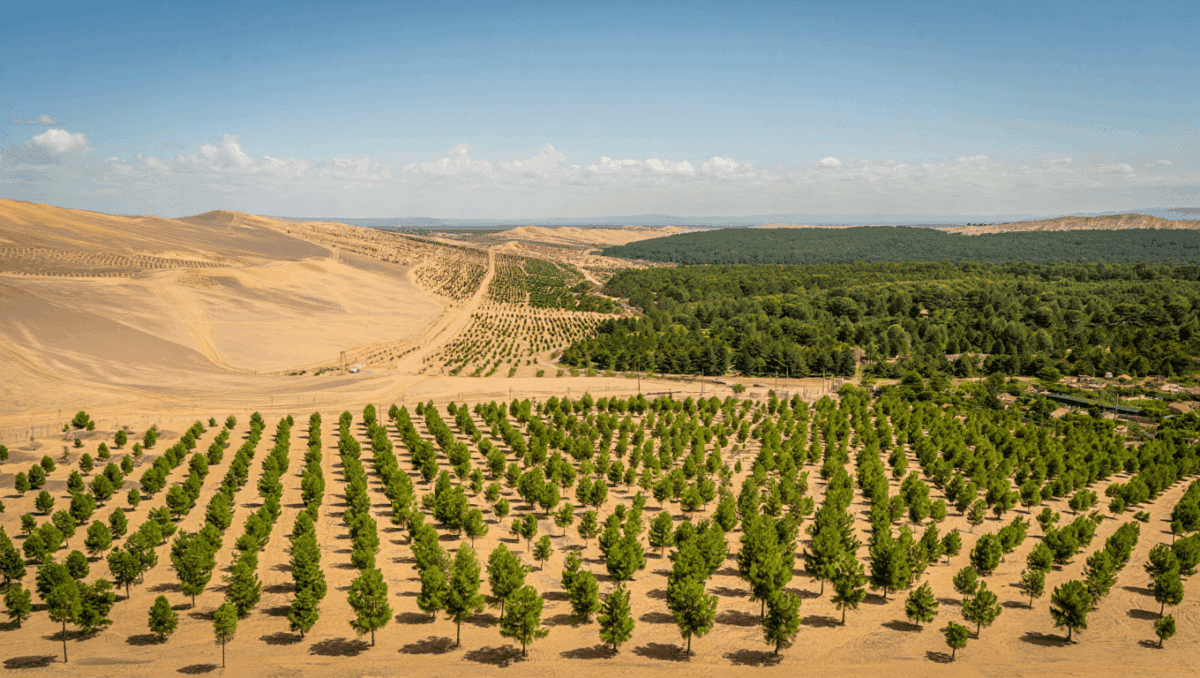
A decades-long Chinese reforestation push has quietly reshaped the margins of one of Earth’s most forbidding deserts, producing a surprising climate benefit: formerly barren terrain is now pulling extra carbon out of the atmosphere. What began as a defense against sand and wind is being credited by scientists with creating a measurable carbon sink at the edge of the Taklamakan Desert.
The intervention—part of the country’s expansive Three-North Shelter Belt initiative—used large-scale tree planting to anchor shifting sands and shield cropland and pastoral areas. New satellite research led by NASA and Caltech now shows those planted belts not only stopped desert expansion but also increased vegetation and localized carbon uptake, offering a rare example of an arid landscape converted into a net absorber of CO2.
China’s Three-North Shelterbelt: building the “Green Great Wall” around the Taklamakan
The Growing Demand for Data-Driven Decision Making in Silicon Valley
He quit, ran out of money, and begged to come back — here’s how his boss reacted
Launched in 1978, China’s shelterbelt program aimed to hold back the encroaching deserts that threatened farms, grazing land, and communities. Over more than four decades the program expanded into a ring of planted trees and shrubs along the margins of the Taklamakan—one of the driest, most isolated basins on the planet, hemmed in by the Himalayas, Pamirs, Tian Shan, and Altai ranges.
The effort, often nicknamed the Green Great Wall, combined government planning with local labor and a variety of species chosen for drought tolerance. By the program’s completion in 2024, estimates put the total number of trees planted across China at roughly 66 billion, much of it concentrated in northern and northwestern regions to act as a living barrier against sandstorms.
Satellite evidence: how researchers detected a carbon sink in the desert
Remote-sensing data was key to confirming the unexpected carbon benefits. Scientists from Caltech and NASA analyzed multiple satellite datasets to track changes in surface greenness, soil moisture, and atmospheric CO2 concentration over time. The combination of imagery and atmospheric measurements allowed them to link increased plant growth along the shelterbelt to higher rates of photosynthesis and carbon uptake.
Methods used to measure the shift
- Vegetation indices from satellite imagery to quantify leaf area and seasonal growth cycles.
- Soil moisture and precipitation records showing subtle increases at the tree line during wet seasons.
- Atmospheric CO2 observations comparing concentrations over the restored areas with surrounding desert air.
The team reports a small but detectable change in local atmospheric CO2 concentrations, with readings shifting from about 416 parts per million (ppm) to roughly 413 ppm near the planted belt. For context, global CO2 averages hover higher—around 429.3 ppm—and pre-industrial levels were near 350 ppm.
What changed on the ground: rainfall, vegetation, and carbon storage
Planting trees along the desert edge altered microclimates in measurable ways. The presence of vegetation increased local water retention and slightly raised average rainfall by a few millimeters in some seasons, which in turn supported more natural regrowth during wet months. That seasonal green-up boosts photosynthetic activity and enhances the landscape’s capacity to draw down carbon.
- Increased vegetation cover: The planted belts created continuous lines of foliage that interrupt wind-driven sand movement and provide habitat.
- Improved soil stability: Root systems reduce erosion and help retain moisture, improving conditions for further plant growth.
- Higher carbon uptake: New and regenerating plants absorb CO2 through photosynthesis, contributing to net carbon sequestration in a landscape that previously stored very little carbon.
Despite their vast area—deserts cover roughly one-third of Earth’s surface—they account for less than one-tenth of global carbon stocks because vegetation and organic soils are scarce. Converting even marginal strips into vegetated corridors can therefore produce outsized local benefits for carbon sequestration and ecosystem resilience.
Global context and comparable reforestation efforts
China’s project is one of several ambitious afforestation and restoration efforts around the world aimed at cooling cities, reversing desertification, and capturing CO2. Each program differs in scale, species selection, and water strategy, but they share a common goal of restoring plant cover to degraded landscapes.
- Community-led projects in arid regions have reversed desertification at local scales by planting hardy shrubs and rebuilding soil on hundreds of thousands of acres.
- Urban initiatives—such as ring forests planted to shade and cool metropolitan areas—are being tested in European and Asian cities to reduce heat and sequester emissions.
- Large-scale national campaigns in parts of South Asia and Africa have increased forest cover significantly through coordinated planting and monitoring.
Limits, trade-offs, and what scientists are watching next
While the Taklamakan findings are encouraging, researchers caution that reforesting deserts is not a universal fix for climate change. Key limitations include water scarcity, the long-term survival of planted trees, and the ecological consequences of introducing nonnative species in fragile environments. There is also a practical cap on how much land can be repurposed for forestry without harming food systems or natural desert ecosystems.
Scientists emphasize a set of priorities for future restoration work:
- Use locally adapted species and mixed plantings to support biodiversity and reduce failure risk.
- Design water-wise practices—such as rainwater harvesting and soil moisture conservation—to minimize irrigation needs.
- Employ continuous satellite monitoring and ground-truthing to track carbon uptake, tree health, and surface-climate interactions.
- Assess socio-economic impacts to ensure programs protect livelihoods and avoid unintended resource conflicts.
Ongoing studies will refine how much carbon arid-zone reforestation can realistically store and identify the most sustainable approaches for scaling restoration without creating new environmental pressures. Researchers are continuing to track the long-term trajectory of the shelterbelt and similar projects to better understand how vegetation, water cycles, and atmospheric CO2 interact at the edges of the world’s deserts.
You might also like:
- 1 million trees planted: local man’s campaign mobilizes 30,000 volunteers to fight desertification
- Permafrost thaw emits and absorbs CO2, landmark study finds
- NASA time-lapse video shows drastic Virginia landscape change in just 9 weeks
- Revolutionizing Dry Landscapes: Woman Transforms Barren Streams into Lush Oases in USGS Study
- Ostriches return to Saudi Arabia’s desert after 100-year absence, marking major rewilding milestone

Michael Thompson is an experienced journalist covering U.S. and global news. With ten years on the front lines, he breaks down political and economic stories that matter. His precise writing and keen attention to detail help you grasp the real‑world impact of every event.


Man, I remember when folks said planting trees wont solve a dang thing. Look at China now, flipping a desert into a carbon sink! Mother Natures the real MVP when we give her a chance.
Dang right, bud! Chinas out here turning deserts into lush green havens, like some sorta magic trick. Mother Natures flexin hard with those carbon sinks, aint she? Its like watchin a superhero movie unfold in real life! Makes you wonder what other tricks she got up her sleeve, huh?
Man, that Green Great Wall in China? Thats next-level eco-warrior stuff! Turning desert into a carbon sink? Mind-blowing! Natures the real MVP, aint it? Mother Earth be flexin hard!
Remember when we thought deserts were just barren lands? Now were out here turning them into carbon sinks! Natures playing 4D chess while we catch up. Cant wait to see what else well pull off.
Man, aint that the truth! Natures out here making moves while were just trying to keep up. Its wild how Mother Earths throwing down those 4D chess moves. Excited to see what other tricks shes got up her sleeve!
Man, I remember hearing bout that project in China, planting billions of trees in the desert. Crazy how nature fights back when we give it a chance. Maybe we should take the hint, huh?
Man, planting billions of trees in the desert? Thats like turning a wasteland into a lush paradise! Natures the real MVP, cleaning up after us like that. We should take notes and step up our game too!
Dude, totally! Mother Natures out here flexing her eco-superpowers like its NBD. Turning desert into a green wonderland? Thats some next-level magic right there! We gotta step up our game, man. Cant let the trees show us up like that!
Man, Mother Natures the real MVP here! Planting billions of trees in barren deserts, turning them into carbon sinks? Thats like turning a wasteland into a green paradise. We gotta keep supporting projects like this, for real.
Man, planting all those trees in the desert sounds like a superhero move! Like, who knew barren land could turn into a carbon sink? Mother Nature be like, Hold my roots! Pretty rad stuff.
Man, who knew planting trees could turn a desert into a carbon sponge? Its like Mother Natures ultimate power move, yknow? From barren wasteland to green paradise, take that, CO2!
Man, talk about giving Mother Nature a makeover! Turning barren land into a carbon sink, thats like natures version of a glow-up! Who knew planting billions of trees could be so lit? Props to China for that epic Green Great Wall move.
Man, thats like Mother Nature putting on a fresh coat of paint! Turning dry spots into a carbon sink is like hitting the gym and getting those gains, but for the planet, you feel me? Planting all those trees is definitely a flex move. Chinas Green Great Wall is the real MVP here! Who knew going green could be so lit, right?
Man, that desert-to-forest glow-up is like a nature makeover show on steroids! Planting billions of trees in barren lands? Thats some next-level Earth TLC. Who knew deserts could be so trendy?
I mean, who knew planting trees in a desert could be such a game-changer, right? Talk about turning things around! Its like natures own superhero move, taking that barren land and turning it into a carbon-crunching paradise. Wild stuff!
Dude, right? Its like Mother Natures pulling a total plot twist on us! Turning a desert into a green paradise? Thats some next-level eco-magic right there. Who knew trees could be the ultimate game-changers, huh? Its like a real-life superhero origin story, but with leaves instead of capes. Crazy stuff, man!