
Show summary Hide summary
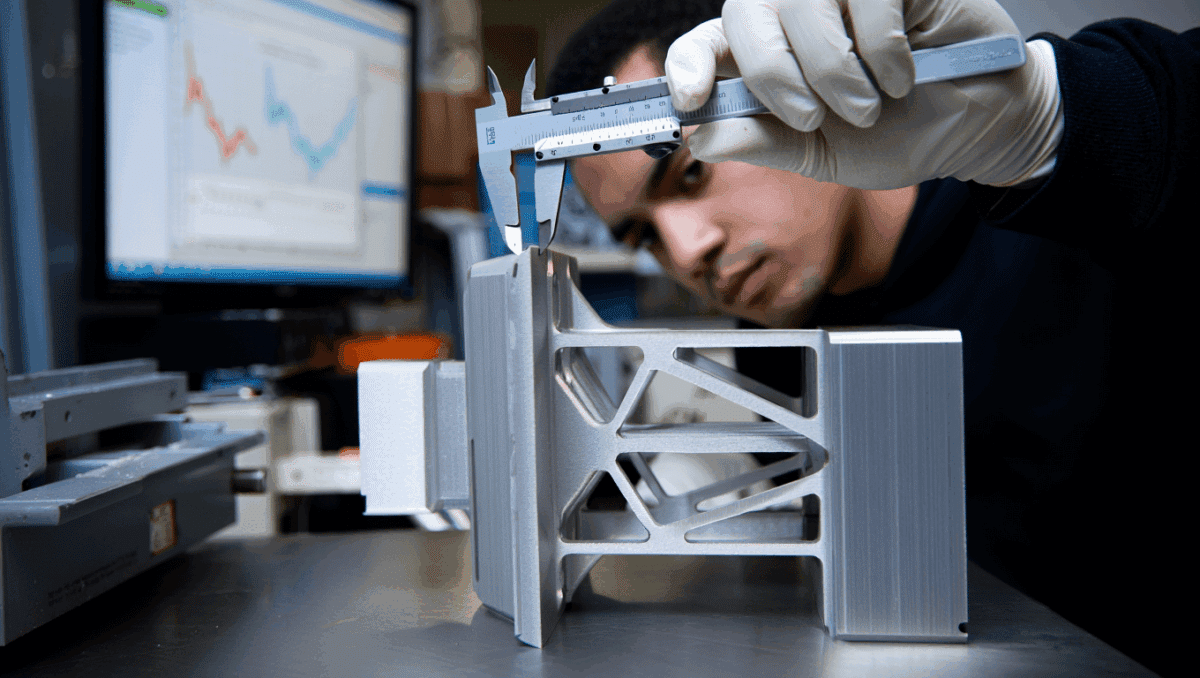
MIT researchers have combined machine learning and metal 3D printing to create an aluminum-based alloy that outperforms conventional printed aluminum by a wide margin. The team’s new material holds up at much higher temperatures and delivers strength levels that could let engineers replace heavier, costlier metals in critical components.
Developed by narrowing millions of possible compositions down to a handful of candidates using simulations and AI, the alloy is targeted at applications where weight, heat resistance, and complex geometry matter most—think jet-engine fan blades and other aerospace parts that benefit from both strength and lightness.
AI-driven alloy discovery: cutting millions of options to a few winners
The Growing Demand for Data-Driven Decision Making in Silicon Valley
He quit, ran out of money, and begged to come back — here’s how his boss reacted
The project began as an academic challenge in an MIT materials course and evolved into a research program that used machine learning to guide materials selection. Rather than testing endless permutations by trial and error, the team used computational screening to quickly eliminate unlikely mixes, helping them focus on the most promising combinations.
Key points about the selection process:
- Simulations initially explored a vast design space of element mixtures and microstructures.
- Machine-learning models then identified which elemental combinations and processing parameters most strongly influenced strength and temperature stability.
- The effort reduced millions of theoretical variants to roughly 40 practical candidates before the researchers zeroed in on a finalized formula.
The resulting composition pairs aluminum with five other elements chosen to promote fine microstructural features that boost mechanical performance. According to the researchers, this targeted approach found a stronger alloy than what they achieved through brute-force simulation alone.
Why 3D printing unlocks stronger aluminum
Traditional casting methods struggle to produce the tiny, evenly distributed particles within the metal that give the alloy its strength. Additive manufacturing—specifically powder-based metal 3D printing—offers a decisive advantage because of its rapid cooling rates and layer-by-layer control.
Microstructure and temperature resilience
The printed alloy exhibits a high volume fraction of very small precipitates—microscopic particles that impede dislocation motion and dramatically increase yield strength. Those tiny features also remain stable at temperatures up to roughly 400°C, a notable improvement for aluminum-based materials.
- Fast solidification from 3D printing helps lock in small precipitates that would otherwise coarsen during slower cooling.
- Dense, fine-scale microstructure gives the material exceptional mechanical properties for its weight class.
- Thermal stability near 400°C extends potential use into hotter operating environments than typical aluminum alloys tolerate.
Potential uses: lighter, cheaper, and more efficient aircraft parts
The team envisions the alloy being used where light weight and high temperature tolerance deliver major operational benefits. A high-profile example is jet-engine fan blades, which are often made from titanium—a metal that is heavier and significantly more expensive than aluminum.
- Jet-engine fan blades and other rotating engine parts
- Advanced vacuum pumps and thermally demanding industrial components
- High-performance automotive parts that require both stiffness and low mass
- Heat-exchange and cooling hardware for data centers where material performance and geometry matter
Replacing titanium components with a printable aluminum alloy could lower weight and cost, and the researchers point to potential fuel and energy savings across transportation systems if lighter materials are adopted widely.
From a classroom problem to peer-reviewed research
The breakthrough traces back to a materials-design assignment where students were asked to propose aluminum alloys with improved printable strength. Building on that challenge, the lead author expanded the project with machine learning to find nonintuitive combinations that classical intuition might miss.
One of the project leaders explained that many factors influence a metal’s behavior in nonlinear ways; machine learning can reveal which variables are most important and guide experimental focus. The research has been documented in a paper published in Advanced Materials, offering methods other teams can adapt for 3D-printable alloy design.
Industry implications and the path forward
Senior researchers highlight several advantages that make the new alloy attractive to industry: the ability to form complex geometries with 3D printing, material savings from additive processes, and mechanical performance that challenges current manufacturing choices.
Researchers suggest this combination could lower production costs and reduce aircraft weight, which would translate into energy savings during operation. The team also notes broader opportunities for the printable alloy across transportation, high-end manufacturing, and electronics cooling.
Ongoing work will focus on scaling up manufacturing, qualifying parts for demanding service conditions, and exploring design possibilities that exploit the alloy’s unique combination of light weight and high-temperature strength.
You might also like:
- Metal grown by scientists is 20x stronger than 3D printed
- Old mattresses recycled by scientists to save lives
- Singapore 3D-printed bridge to open in 2028 after rigorous testing
- Kentucky teacher of the year builds prosthetic hand for student in school 3D printing lab
- Unsinkable metal tubes inspired by spiders could transform maritime engineering

Michael Thompson is an experienced journalist covering U.S. and global news. With ten years on the front lines, he breaks down political and economic stories that matter. His precise writing and keen attention to detail help you grasp the real‑world impact of every event.


Man, imagine the planes they could build with this tech! I remember my old toy planes breaking in minutes. Now theyre out here printing alloys. Whats next, planes that fly themselves? Oh, wait…
Man, 3D printing’s like magic, aint it? Just read about this aluminum alloy hitting strength records for aircraft parts. Imagine the possibilities with lighter, tougher planes. Futures looking sleek and fast!
Oh yeah, 3D printings like a modern-day wizard, innit? Aluminum alloys breaking strength records? Sounds like science fiction coming to life! Lighter, tougher planes – thats some next-level stuff right there. Imagine cruising through the sky in sleek, speedy aircrafts. The futures gonna be one wild ride, mate!
3D printing aluminum? My cousins into that stuff, swears its the future. But hey, if it means lighter planes and cooler tech, count me in. Wonder if theyll ever 3D print a spaceship… thatd be wild!
Man, 3D printing is like the wild west of innovation, aint it? Aluminum alloys for lighter planes? Next thing you know, well be printing jetpacks! But seriously, this tech is gonna revolutionize the way we fly.
Man, back in my day, we thought aluminum was just for cans. Now theyre 3D printing super-strong alloys for aircraft? Crazy world! Cant wait to fly in those lighter, cheaper planes!
Dang, I remember when aluminum was just for cans and foil! Now its breaking strength records for aircraft parts? Thats some sci-fi stuff right there. Cant wait to see these lighter, cheaper planes in action!
Man, back in my day, wed dream of stronger, lighter aircraft parts. Now theyre 3D printing aluminum alloys setting records! Whats next, AI crafting alloys like its nothing? The futures wild, I tell ya.
Back in the day, we were dreaming of flying cars, now were printing alloys like its nothing! AI crafting alloys? What a time to be alive, huh? The futures throwin some crazy curveballs, man. Who knows whats next? Maybe robots designing the fastest jets while we sip on our morning coffee!
Man, back in my day, aluminum was just aluminum. Now, were talking about 3D printing it into super-strong alloys for planes? Thats some sci-fi stuff right there. Whats next, space elevators?
Back in the day, aluminum was just aluminum, right? Now were out here talking about 3D printing it into super-strong alloys for planes! Its like were living in a sci-fi movie or something. Space elevators next? Who knows, man, the futures looking wild!
Man, back in the day, aluminum was like the ugly duckling of metals – weak and flimsy. Now, with this 3D printing wizardry, they got it flexing like a bodybuilder. Crazy times we live in, huh?
Man, I remember when aluminum was the lightweight champion. Now, 3D printings in, setting strength records like its no biggie. Gotta hand it to tech for keepin us on our toes! Excitin times for aircraft parts!
Man, back in the day, we were dreaming about flying cars. Now, with these crazy 3D printed aluminum alloys making aircraft parts lighter and stronger, who knows whats next? Maybe flying houses? Sign me up!