
Show summary Hide summary
- Who’s building Singapore’s first 3D-printed bridge
- How the printed segments were tested and what the results showed
- Design, assembly plan, and bridge specifications
- Material science and printer settings that mattered
- Why Singapore is testing 3D concrete printing now
- How this bridge fits into the global picture of 3D-printed infrastructure
- Next steps, timeline, and potential follow-ups
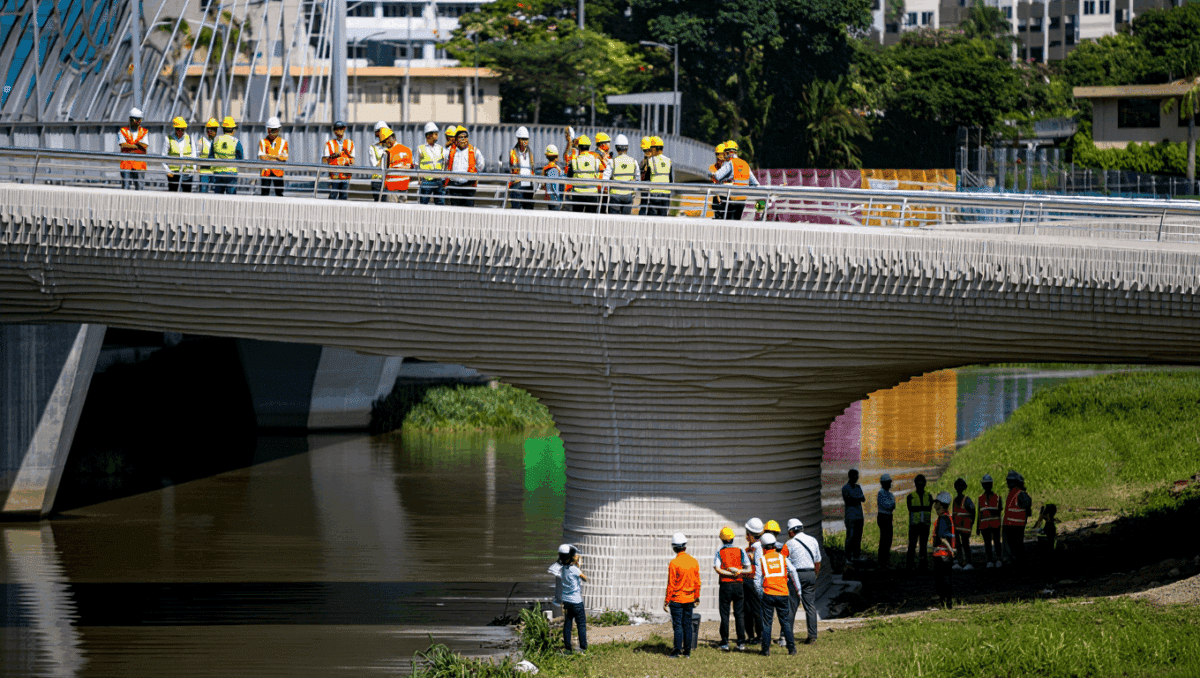
Singapore is preparing to unveil its first pedestrian bridge made from 3D-printed concrete, a compact but high-profile project that could reshape how the city-state approaches small-scale infrastructure. The modular crossing will span a waterway in the Jurong River and Temah neighborhoods and represents a test case for additive construction on public transit routes.
Engineered pieces of concrete were recently printed, assembled into a scale mock-up, and pushed through rigorous load trials. The Land Transport Authority (LTA) and local partners are using what they learn to fine-tune materials and printing protocols ahead of full construction, with the completed 30-foot walkway planned for 2028.
Who’s building Singapore’s first 3D-printed bridge
The Growing Demand for Data-Driven Decision Making in Silicon Valley
He quit, ran out of money, and begged to come back — here’s how his boss reacted
The initiative brings together academic researchers, private contractors, and municipal engineers. Key contributors include:
- Land Transport Authority (LTA) — project lead and client, responsible for integrating the bridge into broader transit upgrades.
- Singapore Centre for 3D Printing at Nanyang Technological University (NTU) — developed the printing process and led the fabrication effort.
- Witteveen+Bos — engineering consultancy providing structural expertise and testing oversight.
- CES_Innovfab — specialist construction firm handling 3D concrete printing operations.
The research and development work included designing a bespoke printing mixture and process controls. Developers invested roughly $1.4 million in creating and supplying the specialized concrete blend used for the prototype pieces.
How the printed segments were tested and what the results showed
Teams printed ten prototype segments and built a physical scale model to simulate the full bridge. Rather than relying solely on computer models, engineers subjected the sections to real-world stress checks.
- Each printed segment endured load tests using large water tanks weighing about 1 metric ton to replicate concentrated stresses.
- The testing regimen focused on layer adhesion, flexural strength, and the ability of the printed geometry to distribute weight without cracking.
The manufacturing phase for the trial pieces proved markedly faster than traditional methods: the ten segments took roughly 40 hours to print, compared with an estimated two weeks for manual concrete casting and finishing for comparable components.
Design, assembly plan, and bridge specifications
When assembled, the pedestrian span will be a compact but sturdy connection across the water. Key specifications and assembly notes include:
- Final length: 30 feet
- Width: around 15 feet
- Construction method: the ten printed modules will be linked and suspended on heavy-duty steel cables rather than relying on traditional foundations.
- Visual approach: sculpted, conical supports give the bridge a segmented, almost organic look likened to a caterpillar’s body.
The project team plans to thread the segments together on-site, using robust cable anchoring to form a continuous pedestrian deck.
Material science and printer settings that mattered
Mix composition and printing parameters
Although the ingredients are straightforward—cement, sand, and water—the final performance hinged on precise control of the printing process. Engineers tuned:
- Mix rheology (how the material flows) to ensure each printed layer retained shape without sagging.
- Flow rate and nozzle speed to promote uniform layer deposition and bonding.
- Layer curing schedule to avoid trapped moisture and thermal stresses that could cause cracks.
Because the bridge segments are intended to carry loads while suspended, even small variations in the printing sequence or mix behavior could compromise long-term durability.
Why Singapore is testing 3D concrete printing now
Several practical drivers explain the LTA’s interest in additive construction:
- Labor constraints — shortages in skilled construction workers have made alternative building methods attractive.
- Speed — the prototype production timetable demonstrates potential time savings for repeatable, modular elements.
- Design freedom — 3D printing enables complex geometries, such as the bridge’s sculpted feet, without expensive formwork.
Successful load-bearing tests on the scale model would clear the way for wider adoption of the technology on other transit and public-works projects in Singapore.
How this bridge fits into the global picture of 3D-printed infrastructure
Singapore’s bridge joins a growing list of 3D-printed pedestrian crossings worldwide. Notable examples include projects in China and the Netherlands. The Dutch city of Nijmegen currently holds the record for the longest 3D-printed footbridge, stretching roughly 95 feet across a canal.
The new Singapore project is smaller in scale but significant as a government-backed, urban transit application that links advanced research with practical municipal needs.
Next steps, timeline, and potential follow-ups
With the prototype load tests complete, the team is refining the mix and printing parameters ahead of full-scale fabrication. The LTA has scheduled the bridge’s completion for 2028, allowing time for additional testing, regulatory approvals, and site preparation in the Jurong River / Temah corridor.
Researchers are also watching how the lessons from bridge fabrication might translate to other uses of 3D concrete printing—particularly in housing, where buildings are printed from the ground up and pose different engineering challenges than suspended modular elements.
You might also like:
- Kentucky teacher of the year builds prosthetic hand for student in school 3D printing lab
- 3D printed aluminum alloy sets strength record for lighter aircraft systems
- US-Canada pedestrian and bike bridge set to open in 2026
- NYC bridge replacement completed $93M under budget while trains kept running
- Metal grown by scientists is 20x stronger than 3D printed

Michael Thompson is an experienced journalist covering U.S. and global news. With ten years on the front lines, he breaks down political and economic stories that matter. His precise writing and keen attention to detail help you grasp the real‑world impact of every event.


Man, 3D-printed bridge in Singapore? Thats some sci-fi stuff! Wonder if it can withstand the crazy weather there. Bet itll be a cool sight for selfies, though. #FutureIsNow
Oh man, 3D-printed bridge in Singapore? Thats straight outta a sci-fi flick! Gotta wonder if it can handle the wild weather there, right? Would def make for some epic selfie spots though. #FutureIsNow.
Man, talk about futuristic vibes! Can you picture strolling over a 3D-printed bridge in Singapore? Wild stuff. Wonder if itll be as sturdy as they claim. Bet itll be a hit on Instagram!
Man, 3D-printing a bridge? Thats some sci-fi stuff right there. Wonder if itll hold up in a storm. Hope they didnt forget to add the print more support button!
Man, I remember when bridges were just, like, boring old steel and concrete. Now theyre out here 3D-printing them in Singapore? Whats next, a holographic rainbow bridge? Cant wait for the future to arrive!
Man, imagine walking on a 3D-printed bridge! Its like stepping into the future, aint it? Singapores onto something cool. Cant wait to see if this tech spreads like wildfire or fizzles out.
So, in 2028, Singapore’s getting a 3D-printed bridge? Thats some futuristic stuff! Wonder if itll hold up against heavy rain or a Godzilla attack. Hope they tested it well!
Man, imagine strolling over a 3D-printed bridge in Singapore. Like, is this some sci-fi flick coming to life, or what? Cant wait to see those printed segments holding up real weight. Hope they got the math right!
Man, remember when bridges were just, like, regular bridges? Now they gotta be all high-tech, 3D-printed and whatnot. Cant wait to see if this fancy new bridge in Singapore actually holds up!
A skeptical critic weighing in here. Lets hope this 3D-printed bridge in Singapore holds up better than my printer at home—constantly jamming and running out of ink! But hey, fingers crossed for innovation, right?
Haha, I hear you, mate! Those pesky printers always up to no good, right? Hopefully, that 3D-printed bridge doesnt decide to go on a jamming spree too. Innovations a gamble, but hey, lets root for it to come out on top!
Man, 3D-printing a bridge in Singapore? Thats some sci-fi stuff right there. I hope they tested it well, cant have people walking on it and suddenly… oops, down they go!
A conspiracy nut: That 3D-printed bridge in Singapore, huh? Bet its all a cover-up for some secret government experiment. Theyre probably hiding alien technology in those printed segments, mark my words!
Man, imagine a 3D-printed bridge? Thats some sci-fi stuff right there! Cant wait to see if it holds up in 2028. Hope they tested it with more than just a few matchbox cars, haha!
Man, 3D-printed bridge in Singapore? Thats some next-level tech! Wonder if it can handle my heavy backpack. Hope they stress-tested it with a bunch of backpacks like mine!
Man, 3D-printing a bridge in Singapore? Thats some next-level stuff! Wonder if it can withstand my daily commutes chaos. Hope it doesnt collapse like my plans when my alarm doesnt go off.
Man, 3D-printed bridges in Singapore? Thats some sci-fi level coolness! Wonder if it can handle heavy rain or a Godzilla attack. Hope they got a plan B just in case!
Whoa, 3D-printed bridge in Singapore? I remember when 3D printers were just for making tiny statues or phone cases. Cant wrap my head around a whole bridge, man. Wonder if itll withstand the crazy weather there!
Man, 3D printing a whole bridge? Thats some next-level stuff. Wonder if it can withstand a Godzilla attack or a sudden dance flash mob. Cant wait to see it in action in 2028!
Oh dang, 3D printing a whole bridge? Thats some futuristic stuff right there! Imagine Godzilla stomping through or a flash mob breaking out on it – now that would be a show! Cant wait to see if its sturdy enough for all that action in 2028!
Wait, a 3D-printed bridge? That’s some futuristic stuff right there! Can’t wait to see this tech wonder in Singapore. Hope it holds up, though. Wouldn’t want to be driving on a bridge that starts glitching like a broken printer, haha!
Man, 3D-printed bridges? Can you imagine the future? I bet theyll be like, Hey, remember when we used to build bridges the old-fashioned way? Crazy how tech is changing everything.
Man, 3D-printed bridges? Whats next, flying cars? Just kidding, its awesome to see innovation like this. Cant wait to see how this bridge in Singapore holds up after all that testing!
Haha, right? Flying cars might not be too far off at this rate! But seriously, its wild to think about how far technology has come. Can you imagine cruising around in a 3D-printed car one day? The future is gonna be a trip!
Man, 3D-printed bridges sound like something straight out of a sci-fi flick! Singapores really pushing boundaries. Cant wait to see if it stands the test of time or if were in for a bumpy ride in 2028!
Oh man, 3D-printed bridges do sound like theyre straight out of a sci-fi flick, right? Singapores really pushing the envelope, no doubt. Its gonna be a wild ride seeing if this bridge holds up or if were in for some drama in 2028. Buckle up, folks!
Man, 3D-printed bridges in Singapore? Thats some sci-fi stuff! Wonder if itll withstand a Godzilla attack. Cant wait to see if its as sturdy as they claim. Hope its not just for show!
Oh man, 3D-printed bridges in Singapore? Thats some next-level stuff right there! I can already picture Godzilla stomping through and the bridge holding up like a champ. Its like a real-life sci-fi movie plot unfolding before our eyes. Cant wait to see if its more than just a fancy display piece. Lets hope its got the strength to back up the hype!
Man, 3D-printed bridges in Singapore? Thats some sci-fi stuff right there. Wonder if they tested it with a bunch of folks jumping up and down like crazy. Bet that would make for a wild stress test!
Man, I remember when 3D printing was all about tiny trinkets and now theyre out here making bridges! Can you imagine the possibilities? Pretty soon, well be printing entire buildings! The future is wild, yall.
Dang, I feel ya! Its like 3D printing went from making cute keychains to full-blown engineering feats! Can you picture printing skyscrapers next? The possibilities are endless! Im all in for a future where we can print our dream houses! Lets make it happen!