
Show summary Hide summary
- Growing metal inside a hydrogel: the basic process
- Why this differs from traditional 3D metal printing
- Performance gains: stronger parts, less shrinkage
- Applications that could benefit from cultivated metals
- Limitations, improvements in progress, and industrial implications
- Where the research was published and what’s next
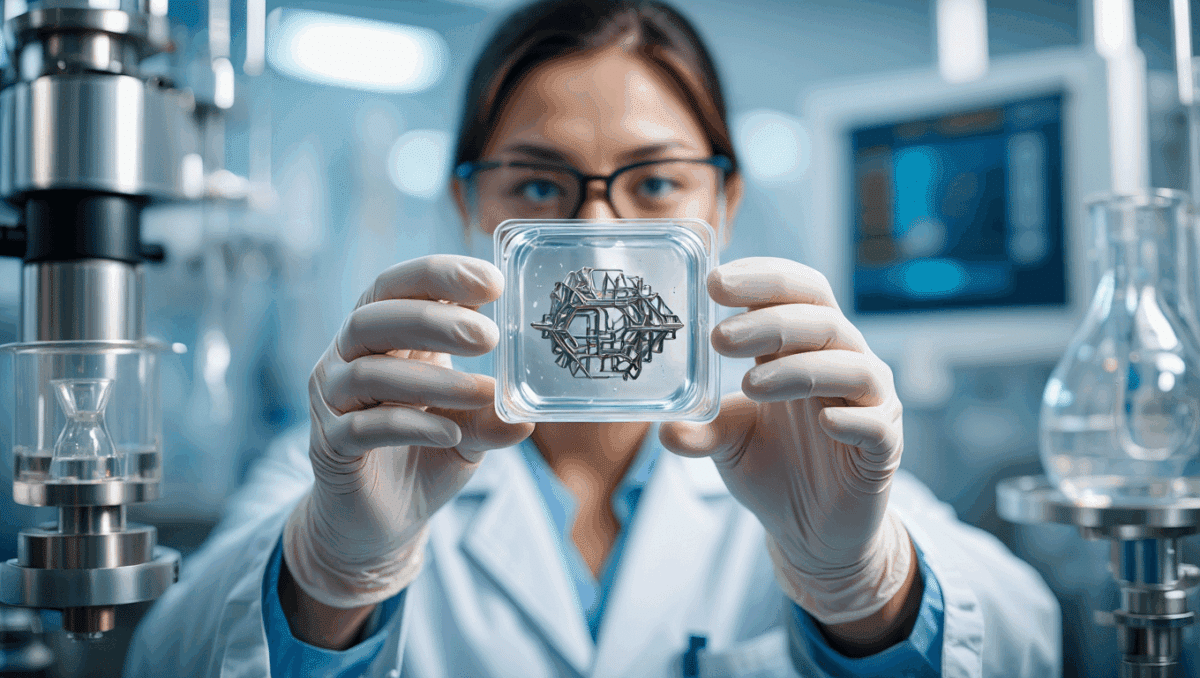
Swiss engineers at the École Polytechnique Fédérale de Lausanne have announced a striking shift in how metal parts can be made: instead of directly printing metal, they grow it inside a water-based gel. The team’s technique produces dense, intricately shaped metal and ceramic pieces that promise marked improvements in strength and precision for applications from energy devices to medical sensors.
By decoupling shape creation from material selection, the researchers can print a reusable hydrogel scaffold and then infuse it with dissolved metal ions to build up metal-rich composites. Early tests show finished parts that are significantly stronger and far less prone to warping than those produced by some existing 3D-print-to-metal methods.
Growing metal inside a hydrogel: the basic process
The Growing Demand for Data-Driven Decision Making in Silicon Valley
He quit, ran out of money, and begged to come back — here’s how his boss reacted
Rather than mixing metal compounds into a light-sensitive resin before printing, the EPFL team starts with a neutral, printable hydrogel. That scaffold serves as a template:
- Print a complex hydrogel shape using ordinary additive-manufacturing equipment.
- Soak the printed template in a solution containing metal salts (for example, iron, silver or copper ions).
- Chemically reduce the salts inside the gel so they form nanoscale, metal-containing particles dispersed throughout the network.
- Repeat the infusion and reduction cycles multiple times—typically about five to ten—to raise the metal content and build a continuous metallic phase.
- Remove the remaining hydrogel by heating, leaving a dense metal or ceramic object that faithfully reproduces the original geometry.
This approach lets one hydrogel form act as a blank canvas that can be converted into different metals, ceramics, or composites after the printing step.
Why this differs from traditional 3D metal printing
Conventional vat photopolymerization and other light-driven 3D printing strategies require photosensitive resins loaded with metal precursors. Those methods can create shapes, but they often leave porous parts and suffer heavy shrinkage and distortion during conversion to metal.
The EPFL method avoids mixing metal into the printable feedstock. By adding metal salts after shaping, the team reduces the pores that weaken the material and controls shrinkage more effectively. As Daryl Yee, head of the Laboratory for the Chemistry of Materials and Manufacturing, explained, earlier techniques ended up with parts that were porous and warped—problems this new workflow directly addresses.
Performance gains: stronger parts, less shrinkage
To benchmark their results, the researchers printed complex lattice geometries—mathematically generated gyroids—and converted them into iron, silver and copper structures. Using a universal testing machine to apply compressive loads, the team compared their grown metals with parts made by previous conversion strategies.
The outcomes were dramatic: the cultivated metal parts endured about 20 times the pressure of their predecessors, while showing around 20% shrinkage instead of the 60–90% commonly reported. Those figures point to much denser microstructures and better preservation of the original geometry.
Applications that could benefit from cultivated metals
The technique opens design space for three-dimensional components that need to be both lightweight and mechanically robust. Potential uses include:
- Energy conversion and storage: catalysts and high-surface-area metal components for fuel cells, batteries and supercapacitors.
- Thermal management: porous metal heat sinks or cooling architectures with optimized surface area.
- Biomedical devices: patient-specific implants or sensor housings with fine, tailored structures.
- Advanced sensors and small actuators where precise, intricate metal geometries improve performance.
Limitations, improvements in progress, and industrial implications
The main trade-offs are processing time and the need to increase final density. Building metal content requires multiple infusion/reduction cycles, which lengthens production compared with some single-step conversion approaches. The EPFL group is tackling these bottlenecks:
- Automation: robotic systems to speed up and standardize the repeated infusion cycles.
- Material tuning: optimizing chemical conditions to raise metal loading each cycle and reduce total steps.
- Scale and throughput: adapting the workflow for larger parts and higher-volume manufacturing.
Lead author Yiming Ji, a doctoral researcher on the project, emphasizes that the method’s ability to create geometrically complex, high-strength metal components could be especially useful where weight, surface area and mechanical reliability matter simultaneously.
Where the research was published and what’s next
The team reported their findings in the journal Advanced Materials, detailing the hydrogel-to-metal conversion steps, mechanical testing and examples of produced gyroid architectures. Moving forward, the researchers plan to push density higher, shorten cycle times, and refine robotic automation to make the approach more practical for industrial use.
You might also like:
- 3D printed aluminum alloy sets strength record for lighter aircraft systems
- E-waste vaporization recovers precious metals at 13x lower cost, study finds
- Old mattresses recycled by scientists to save lives
- Meteorites mined for precious metals on the International Space Station
- Singapore 3D-printed bridge to open in 2028 after rigorous testing

Michael Thompson is an experienced journalist covering U.S. and global news. With ten years on the front lines, he breaks down political and economic stories that matter. His precise writing and keen attention to detail help you grasp the real‑world impact of every event.


Man, this whole metal growing thing got me thinking. Remember when we used to joke about growing money on trees? Now were growing metals stronger than ever! Whats next, growing time? Just imagine the possibilities!
Man, remember when we thought 3D printing was the coolest thing ever? Now we got metal grown in hydrogels thats 20x stronger! Science keeps leveling up, huh? Cant wait to see whats next.
I used to think science was all about potions and explosions, but growing metal in jelly? Thats some next-level Hogwarts stuff! Cant wait to see these super-strong parts in action. Accio, metal!
Dude, right? Science aint just test tubes and bangs anymore! Growing metal in jelly is like Willy Wonka meets Tony Stark. Cant wait to see these parts flex their muscles. Accio, metal indeed!
Man, I remember when 3D printing was like the coolest thing ever, but now theyre growing metal like its a science experiment. 20x stronger, huh? Wonder if my old printed trinkets are feeling insecure now.
Man, I remember when metal was just metal, you know? But this sci-fi stuff blows my mind. Twenty times stronger? Thats like upgrading from a butter knife to a lightsaber! Cant wait to see where this tech takes us.
Dude, totally get what you mean! Metal used to be straightforward, now its like, Boom! Sci-fi upgrade, baby! Its wild how techs evolving, right? Cant wait to see what else they come up with! Like, are we gonna have laser guitars next? Exciting times ahead for sure!
Man, imagine if they can grow metal like they grow plants next! Thatd be wild! But, like, this new tech is cool too, I guess. Twenty times stronger than 3D printing? Dang, science is on fire!
Man, imagine if they could grow metal like plants! Sounds like sci-fi stuff. But, for real, 20 times stronger than 3D printing? Thats some serious upgrade. Bet Iron Man wishes he had that tech!
Man, I remember my uncles rants about how everything used to be stronger back in his day. Now, with metal grown in hydrogels being 20 times tougher than 3D printing? I cant wait to see his mind explode!
Growing metal in a lab, huh? Reminds me of that sci-fi flick where they cooked up a metal monster. Guess were not far off! Wonder if my bikell be 20x tougher soon. Cant wait to see this tech in action!
Dude, imagine a metal so tough, its like Hulk-level strong, but not green. Scientists out there are growing metal inside a hydrogel, making it 20 times tougher than regular 3D printed metal. Thats some Iron Man stuff right there!
I tell ya, growing metal like plants, whats next? Metal trees in the backyard? But hey, if it makes stuff 20 times stronger than 3D printing, sign me up! Cant wait to see what this sci-fi tech brings to the table!
Man, this metal growth thing sounds like a plot twist in a sci-fi flick! Twenty times stronger, huh? I wonder if my old toaster can get an upgrade with this tech. Imagine a super toaster that never breaks down, now thats a dream come true!
Man, metal growth like that? Reminds me of my bonsai phase, trying to control natures course. But this? Its like sci-fi meets reality. Cant wait to see what industries will pull off with this tech.
Hey, remember when we thought 3D printing was the pinnacle? Now scientists are cooking up metal in hydrogels thats 20 times tougher! Bet those 3D printers are feeling a bit rusty now, huh?
Man, imagine metal grown in labs being stronger than 3D printed stuff? Thats some sci-fi level evolution right there! Cant wait to see how this tech shakes up industries, bet traditional methods are sweating buckets now.
I used to think metal was just metal, yknow? But now theyre growin it like a plant? Thats wild! Imagine the possibilities! Nature meets tech, man. What a time to be alive.