
Show summary Hide summary
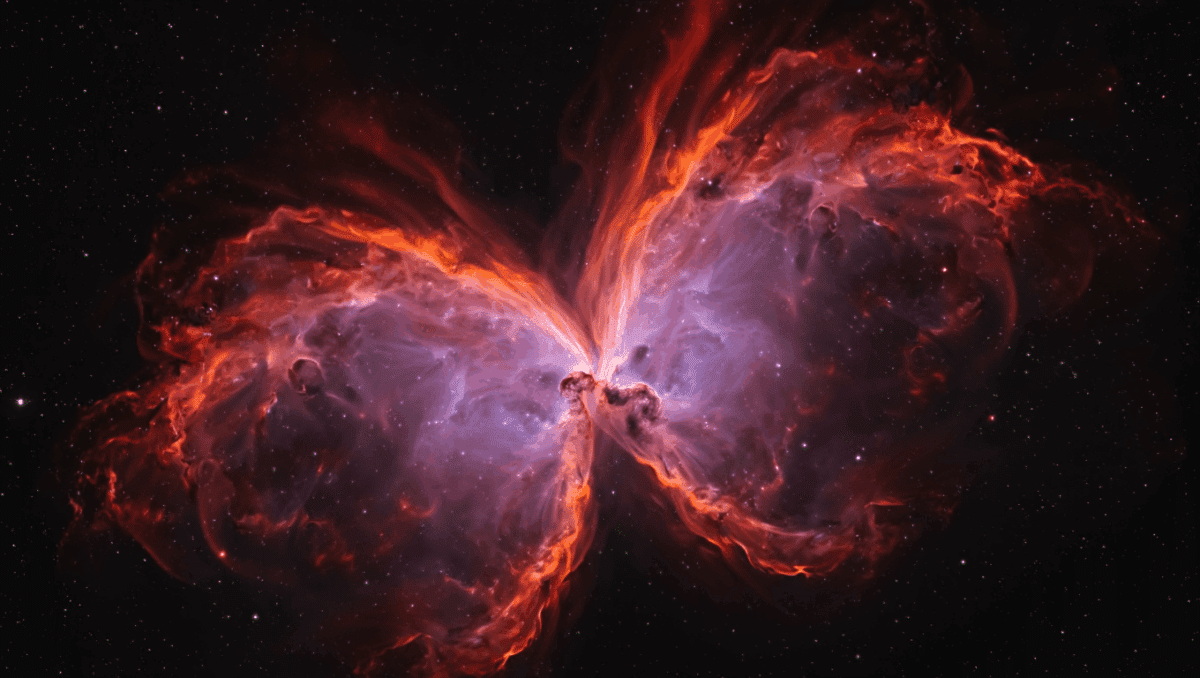
The new image from the Gemini South telescope in Chile reveals a cosmic shape so vivid it barely needs a name: the Butterfly Nebula. Against a dark sea of stars, twin lobes of glowing gas fan outward like wings, offering a dramatic snapshot of a dying star’s final, beautiful gasp.
As telescopes keep sharpening their view of the galaxy, this picture stands out for both its visual drama and the story it tells about stellar evolution — a compact central star stripping off layers of material and lighting them from within, creating colors and structures astronomers can decode.
How the Gemini Telescope Framed the Butterfly
The photograph was taken with the 8.1-meter Gemini South telescope, part of the International Gemini Observatory network. The image combines infrared and optical observations to reveal details not visible in a single wavelength. Students in Chile selected this target as part of the Gemini First Light Anniversary Image Contest, a public outreach effort marking the observatory’s legacy since Gemini South first began operations in November 2000.
The Growing Demand for Data-Driven Decision Making in Silicon Valley
He quit, ran out of money, and begged to come back — here’s how his boss reacted
- Instrument and ownership: The Gemini telescopes, supported in part by the National Science Foundation, use large mirrors and advanced cameras to capture faint, extended nebulae.
- Image technique: Layering infrared and optical data enhances contrast between dust, ionized gas, and the hotter central object.
- Education angle: The contest invited students in host communities to propose observing projects, tying outreach to real scientific opportunity.
What Created the Winged Shape?
The Butterfly Nebula is a type of planetary nebula — a misleading term dating to early telescopic observations — produced when a star like our Sun expels its outer layers near the end of its life. What makes this object striking is how those ejecta form elongated lobes rather than a simple spherical shell.
Central engine: a scorching white dwarf
At the heart of the nebula sits a compact white dwarf whose intense radiation ionizes the surrounding gas, causing it to glow. Roughly 2,000 years ago (on astronomical timescales a recent event), the star began shedding material that now streams outward in opposing directions, sculpted into wings by winds, magnetic fields, or companion interactions.
- Distance: The nebula lies approximately between 2,500 and 3,800 light-years from Earth, in the direction of the Scorpius constellation.
- Shape drivers: Asymmetric mass loss, fast stellar winds, or binary companions can produce bipolar morphologies like the butterfly wings.
Colors, Temperatures, and Why They Matter
Colors in the image are not decoration but diagnostics. The bright red regions indicate energized hydrogen, while the blue traces map out oxygen atoms excited by intense ultraviolet radiation. These emission lines let astronomers measure chemical composition, density, and velocity of the gas.
The central star is among the hottest known: its surface temperature can reach around 450,000 degrees Fahrenheit. That extreme heat bathes the surrounding shell, making the expelled gas glow at tens of thousands of degrees and revealing fine filaments and shock structures in the nebula.
What the light reveals
- Hydrogen emission highlights where cooler ionized gas dominates the structure.
- Oxygen emission pinpoints hotter zones or regions exposed to harder radiation.
- Spectroscopy of these lines helps astronomers estimate expansion speeds and the mass of material ejected.
Why This Image Matters to Scientists and the Public
Beyond its aesthetic appeal, the Gemini South photo contributes to research into how stars die and recycle material back into the galaxy. Planetary nebulae seed interstellar space with elements forged over a star’s lifetime; mapping their structure informs models of stellar winds, magnetic activity, and binary interactions.
The image also underscores the value of connecting communities to science. By letting students request targets and participate in the observatory’s anniversary celebration, the project shows how modern astronomy can inspire new generations while still delivering data useful to professional researchers.
Other Recent Nebula Highlights Worth Checking
- James Webb Space Telescope imagery probing deep cavities in the Cat’s Paw region, revealing cold dust and star formation.
- New observations of the so-called Dragon’s Egg Nebula that shed light on violent late-stage stellar mass loss.
- A high-resolution view of the Lobster Nebula from Chilean facilities, illustrating clustered star birth in dense clouds.
You might also like:
- Exoplanet magnetospheres detected for first time, opening new window on planets
- James Webb Space Telescope may have captured the earliest supernova ever
- Winter constellations: 7 easy ones beginners can find
- Can you find the duck, bat, and butterfly in this old family photo? Most can’t
- NASA’s new telescope to hunt exoplanets and search for signs of life

Michael Thompson is an experienced journalist covering U.S. and global news. With ten years on the front lines, he breaks down political and economic stories that matter. His precise writing and keen attention to detail help you grasp the real‑world impact of every event.


Whoa, like, that Butterfly Nebula pic from the Gemini telescope? Its like cosmic artwork, man. Those gaseous wings are outta this world! Makes you feel small in the grand scheme, yknow?
Man, that Butterfly Nebula pic from the Gemini Telescope? Its like a cosmic masterpiece painted with stardust! Makes me wonder if Van Gogh ever had a peek through a telescope. Imagine the art hed create!
Yo, did yall see those gaseous wings in the Butterfly Nebula pic? Its like Mother Nature decided to throw a cosmic rave party! Cant believe were just tiny specks in this wild universe.
Man, looking at this Butterfly Nebula pic got me pondering life itself. Its like natures own art show up in space, you know? Makes you wonder what other crazy beauties are hiding out there in the cosmos. Mind-blowing stuff, really.
Yo, check out this Butterfly Nebula pic! Reminds me of that time I tried to draw a butterfly in art class and ended up with a mutant insect. Natures got some serious art skills!
Man, this Butterfly Nebula pic got me feeling like Im stargazing from my grandmas porch again. Those glowing gaseous wings are straight-up mesmerizing. Makes you wonder about all the secrets hiding in the cosmos, yknow?
Man, that Butterfly Nebula pic from the Gemini Telescope hits different! Its like space is showing off its craft skills again. Those glowing gaseous wings got me feeling like I need to step up my glow-up game, yknow?
I remember when I first saw the Butterfly Nebula through a telescope, felt like a tiny dot in the universe. This Gemini image now, with those gaseous wings, makes me feel like Im surfing cosmic waves, dude!
Man, that Butterfly Nebula pic is like a cosmic painting! Reminds me of that art exhibit last year – same colorful vibes. Anyone know if I can get a print for my room? Thatd be outta this world!
Man, this Butterfly Nebula snap got me feeling like Im stargazing from my couch! The Gemini Telescope really nailed it, capturing those gaseous wings in all their cosmic glory. Makes you wonder what else is out there, yknow?
Man, this Butterfly Nebula pic got me feeling like a tiny speck in the galaxy. The Gemini Telescope really nailed it, capturing those gaseous wings glowing like cosmic fireworks. Makes you ponder life, huh?
Man, that Butterfly Nebula snaps like a cosmic painting, huh? Its wild how nature just throws these mind-blowing visuals at us. Makes you wonder what other interstellar artworks are out there to discover!
Man, that Butterfly Nebula snap is like a cosmic masterpiece, yknow? Its like nature showing off its artsy side. Those glowing wings are giving me some serious celestial vibes. Wonder what other surprises space has in store for us!
I remember stargazing with my grandpa, and hed point out shapes in the sky like it was his job. This Butterfly Nebula pic feels like a cosmic high-five from him up there. Cool to see the universe throwing us some winged art, aint it?
Yo, thats some deep connection, man. Sounds like your grandpa was a real stargazing sensei. Butterfly Nebula high-fives from the great beyond? Thats some next-level cosmic art, for sure. The universe sure knows how to throw us some mind-bending stuff. Keep looking up, who knows what else youll spot up there!