
Show summary Hide summary
In a feat that seems to defy common sense, engineers in China have achieved something extraordinary: they moved an entire 30,000-ton building nearly 300 meters—without dismantling it, without cranes, and without so much as cracking a wall. The project has now earned a Guinness World Record, and beyond its spectacle, it signals a shift in how cities might rethink construction, sustainability, and urban innovation.
A record-breaking move
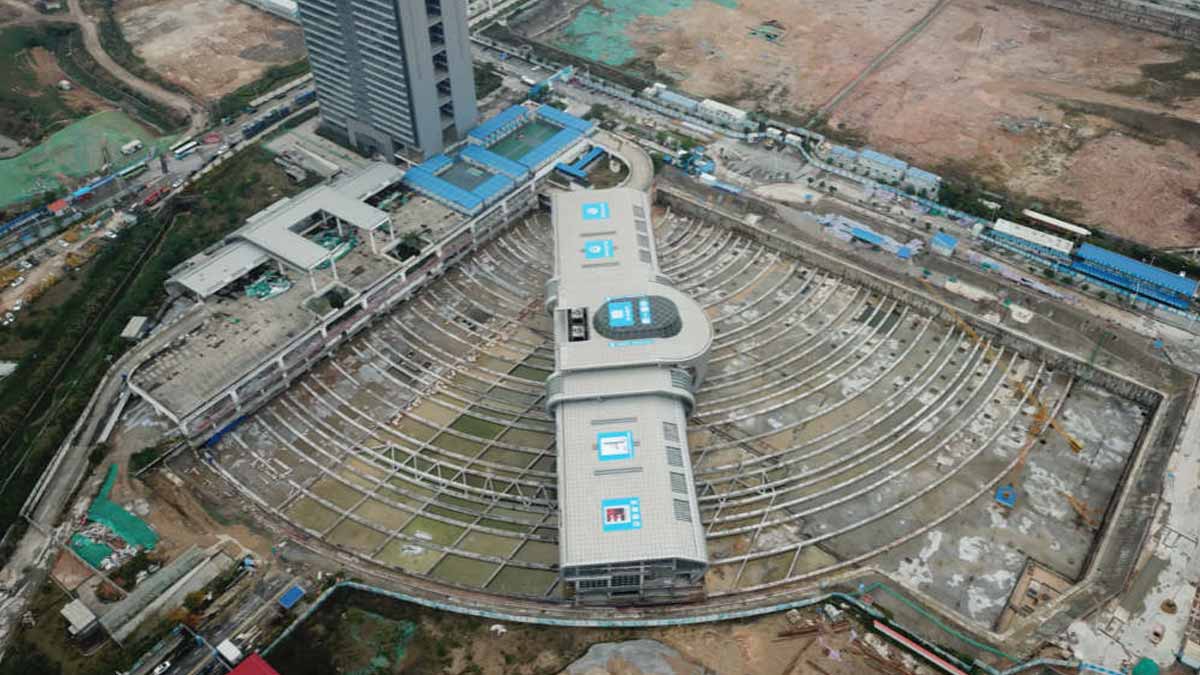
The story unfolded in Xiamen, a coastal city in China’s Fujian province. Back in 2019, the construction of a high-speed railway line required relocating the Houxi Long Distance Bus Station—a massive, recently built structure that was far too valuable to demolish.
Instead of tearing it down, engineers devised a remarkable plan: move the building as it stood. Using a cutting-edge system called “structured assisted translation,” 532 hydraulic jacks and a network of motorized rails worked in perfect harmony to inch the structure along its new path. Every lift and shift was synchronized by a computer program to prevent strain or cracks.
The Growing Demand for Data-Driven Decision Making in Silicon Valley
He quit, ran out of money, and begged to come back — here’s how his boss reacted
Over 40 days, the building was first rotated, then “slid” 288 meters to its new foundation—an operation so precise that it became the world’s heaviest building ever moved on rollers, as officially certified by Guinness World Records.
Precision over demolition
Watching the time-lapse footage of the move is mesmerizing. The massive structure seems to glide silently, almost as if it were alive, its slow progress guided by the quiet rhythm of engineering choreography.
The cost? About €7 million (roughly $7.6 million). While that’s no small sum, rebuilding the same station from scratch would have cost five times more and disrupted the surrounding area for much longer. This method, engineers noted, also reduced construction noise, dust, and waste, offering an environmentally responsible alternative to demolition.
Local authorities hailed the operation as a win on all fronts—financially, logistically, and environmentally. “This approach minimizes waste and urban disruption,” one city official explained, emphasizing how it could reshape urban development strategies in densely populated cities.
Engineering lessons and future applications
Since the record-breaking move, engineering schools across China have been studying the project’s technical blueprints. The operation required a deep understanding of load balancing, foundation behavior, and real-time stress monitoring. As one professor from the China Academy of Building Research put it, “It’s not just a record—it’s a masterclass in precision engineering.”
The technique holds huge potential for urban redevelopment. In cities where space is scarce, relocating buildings could save heritage structures or streamline major infrastructure projects without lengthy demolition and reconstruction. There are also environmental benefits, including lower carbon emissions and reduced debris transport.
However, experts caution that the method isn’t one-size-fits-all. Soil conditions, underground networks, and surrounding structures must all be meticulously evaluated. As impressive as the achievement is, it remains a tool best used in select, carefully planned scenarios.
More than a record—an idea for the future
This move was more than a spectacle; it was a demonstration of what can happen when innovation meets restraint. In an era of rapid urban growth, China’s engineers have shown that modernization doesn’t have to mean destruction.
By earning a Guinness World Record for the largest building ever moved, the Xiamen project not only showcased China’s technological prowess but also posed an important question: what if the future of urban development lies not in rebuilding, but in rethinking what already exists?
One thing is certain—this 30,000-ton journey has made its mark, both in the record books and in the imagination of engineers worldwide.
You might also like:
- Huawei and Xiaomi’s secret weapon revealed: how China stunned the U.S. tech world
- Kitesurfer breaks Guinness World Record with 1,500-foot flight above iconic landmark
- Massive 672-Ton Church Relocated in Arctic Town: A Historic Move!
- Italy Begins Construction on Long-Awaited Bridge to Sicily: A Monumental Engineering Feat!
- Fusion Reactor Breakthrough: Chinese Scientists Create ‘Impossible’ Steel!

David Miller is an entertainment expert with a passion for film, music, and series. With eight years in cultural criticism, he takes you behind the scenes of productions and studios. His energetic style guides you to the next big releases and trending sensations.


Man, China just flexed hard with that 30,000-ton giant move! Its like watching a real-life game of Jenga but on a massive scale. Bet the engineers behind it are feeling like superheroes right now!
Man, that giant move in China… Reminds me of when I tried to rearrange my whole room by myself. Lets just say, precision wasnt my strong suit. Kudos to the engineers, though!
I once tried moving my sofa, and let me tell you, it was a whole workout. But China? They go and move a 30,000-ton giant like its no big deal. Thats some next-level heavy lifting! Wonder if they need help with my sofa next time.
Man, China be flexin hard with that 30,000-ton beast move! Imagine the traffic jam thatd cause in my city! Props to that precision, though. Wonder if theyll start movin entire skyscrapers next!
Dang, China really out there flexin with that massive 30,000-ton beast move! Can you imagine the chaos if they tried that in our city? Traffic jam of the century! Gotta give em props for the precision, though. Who knows, next thing you know, they might be relocatin whole skyscrapers like its no big deal! Crazy times were livin in, huh?
Yo, did yall see that China flexin their engineering muscles? Moving a 30,000-ton giant like its no big deal. Makes me wonder what else they got up their sleeves, man. Impressive stuff!
I mean, moving a 30,000-ton giant? Thats some next-level Tetris skills right there! China aint playin with those record-breaking moves. Wonder what else they could shuffle around with that precision!