
Show summary Hide summary
Researchers in Singapore have produced the first randomized, city-scale evidence that releasing male mosquitoes infected with Wolbachia bacteria can sharply reduce both mosquito populations and the number of human dengue infections. The trial, carried out across multiple dense urban neighborhoods, tracked insect trap counts and health records for almost two years to measure the public health impact of this biological control method.
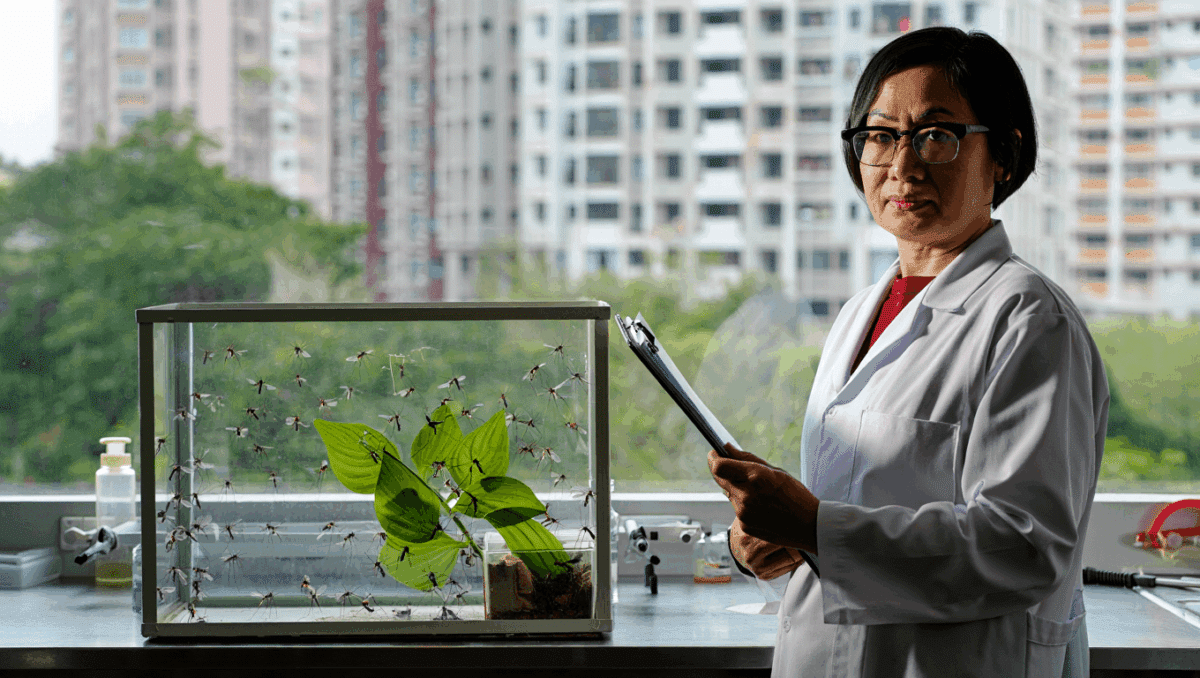
The experiment targeted Aedes aegypti, the mosquito species most responsible for spreading dengue. By releasing laboratory-reared males carrying a modified strain of Wolbachia, scientists aimed to interrupt breeding and cut disease transmission without broad insecticide spraying.
What the Wolbachia sterile-male approach actually does
The Growing Demand for Data-Driven Decision Making in Silicon Valley
He quit, ran out of money, and begged to come back — here’s how his boss reacted
The strategy uses a naturally occurring bacterium, Wolbachia, which can affect insect fertility and reproduction. In this program, male Aedes aegypti are infected and then released to mate with wild females. Because of the particular Wolbachia manipulation used, eggs resulting from those matings fail to develop into viable offspring, gradually driving down the local mosquito population.
Key features of the method
- It relies on releasing only male mosquitoes, which do not bite or transmit disease.
- The technique combines Wolbachia-induced incompatibility with sterile insect methods, often called IIT-SIT (incompatible insect technique–sterile insect technique).
- It is species-targeted, focusing on Aedes aegypti and minimizing ecological disturbance compared with broad insecticide use.
How the randomized city trial was designed and executed
To test whether the intervention not only suppresses mosquito numbers but actually reduces human dengue cases, researchers selected 15 densely populated urban areas and assigned them at random to either receive Wolbachia-infected male releases or serve as untreated control zones. The teams collecting entomological and health data were blinded to which neighborhoods received releases, ensuring unbiased measurement.
- Study duration: approximately 20 months of monitoring after releases began.
- Measurements: routine mosquito trapping to estimate Aedes aegypti abundance, together with national dengue case reports aggregated by neighborhood.
- Randomization and blinding: neighborhoods were randomized and data collectors were kept unaware of treatment status to meet rigorous trial standards.
Clear reductions in mosquito numbers and dengue infections
The trial produced strong and measurable effects on both the vector and the disease it carries. Trap catches in treated areas fell dramatically, and dengue case numbers were substantially lower compared with control areas.
- Mosquito decline: mosquito counts from traps in release neighborhoods dropped by about 77%.
- Dengue transmission decline: among residents who tested positive for dengue, only 6% came from treated areas versus 21% from control areas—an estimated transmission reduction of roughly 71%.
Why this trial matters for dengue control efforts
This is the first randomized, controlled trial to link a Wolbachia-based IIT-SIT release program with a major decline in recorded dengue cases, providing robust, real-world proof that the intervention can protect human health at neighborhood scale.
Public health and operational advantages
- Reduces reliance on chemical insecticides and their accompanying health and environmental concerns.
- Targets the specific species that transmits dengue, lowering non-target impacts.
- Uses males only, avoiding additional biting or direct disease risk from released insects.
- Scalable to urban neighborhoods and compatible with routine public health surveillance systems.
How this fits into the broader fight against rising dengue cases
Worldwide, dengue incidence has been climbing in recent decades due to urbanization, global travel, and climate-related changes that expand mosquito habitats. Existing control tools—source reduction, community cleanups, and insecticides—often fall short of stopping outbreaks on their own. The Singapore trial shows that biologically based population suppression can be a powerful addition to integrated vector management.
Questions and next steps still under study
- Long-term sustainability: how often and how many males must be released to maintain suppression over years?
- Geographic scaling: how the method performs in different urban layouts, climates, and socioecological settings.
- Cost-effectiveness comparisons against other interventions, including vaccination where available.
- Community acceptance and regulatory frameworks needed for broader rollout.
You might also like:
- Exercised mice pass fitness to male offspring but not via DNA
- No mosquitoes all summer: here’s the plant everyone swears by—but is it safe?
- Endangered sharks caught on video mating in three-way encounter
- Uneaten mystery: every fig hides this surprising insect inside its sweet flesh
- Neither spray nor candle: this plant alone keeps mosquitoes away naturally

Michael Thompson is an experienced journalist covering U.S. and global news. With ten years on the front lines, he breaks down political and economic stories that matter. His precise writing and keen attention to detail help you grasp the real‑world impact of every event.


I remember when those mozzies were always ruining picnics! Now theyre getting a taste of their own medicine with this bacteria trick. Revenge is sweet, huh? Hope it sticks!
Man, talk about fighting fire with fire! Infecting mosquitoes with bacteria to fight off dengue? Thats some next-level science stuff. Wonder if theyll start giving mosquitoes tiny lab coats next!
Man, I remember those days swatting mosquitoes like it was a full-time job. If this bacteria thing can actually cut the dengue risk by 70%, sign me up! Maybe I can finally enjoy a BBQ in peace without being a blood buffet.
Oh man, I remember those pesky mosquitoes ruining summer nights! If this bacteria trick works, count me in! Lets kick those disease-spreading buzzers to the curb. Way to go, science!
Man, talk about turning the tables on those pesky mosquitoes! Infecting them to fight dengue? Sounds like a sci-fi flick plot. Hope this trials a game-changer. Natures got some tricks up its sleeve, huh?
Man, they really out here playing 4D chess with these mosquitoes! Injecting bacteria to stop Dengue? Im here for it. Imagine bugs fighting bugs to keep us safe. Natures got some wild tricks up her sleeve, huh?
Yo, Im all for these mosquito mind games! Who knew bugs could be so strategic, right? Nature be like, Hold my beer, I got this! Its like a tiny bug battlefield out there, man. Cant wait to see what other surprises Mother Nature pulls outta her hat!
Oh man, this whole thing about infecting mosquitoes with bacteria to curb dengue risk… Its like a sci-fi movie plot coming to life, you know? Nature fighting back with its own weapons. Mother Nature be like, Ive got some tricks up my sleeve too, humans!
Man, natures got its tricks! Infecting mosquitoes to fight dengue? Thats some wild science right there. Can you imagine the bugs carrying their own defense system? Its like a tiny superhero movie playing out in our own backyards!
Man, talk about fighting fire with fire! Using bacteria to stop dengue? Thats some sci-fi stuff right there. Wonder if those mosquitoes are going to evolve a new defense against it. Nature always finds a way, right?
Man, talk about turning the tables on those pesky mosquitoes! Injecting em with natural bacteria to curb dengue? Thats some sci-fi stuff right there. Wonder what else science got up its sleeve for these buzzing critters.
Man, this whole bacteria thing to fight dengue sounds like a sci-fi plot twist! I mean, infecting mosquitoes with natural bacteria to cut the risk by 70%? Thats some next-level pest control right there. Wonder what else they can pull off with these tiny bug warriors!
Man, those pesky mosquitoes aint gonna know what hit em with that bacteria twist! Finally, a cool way to tackle Dengue. But hey, whats next? Insect-friendly fashion shows? Sign me up!
Man, these mosquitoes got a taste of their own medicine! Literally! Injecting them with bacteria to curb dengue? Thats some next-level pest control. Wonder if theyll start buzzing thank you now!
I remember when folks said theyd try anything to zap those pesky mozzies. But infecting them with bacteria? Thats some wild science, man. 70% cut in dengue risk? Whoa, thats like a superhero showdown but with tiny winged villains!
Man, I remember when those skeeters were out for blood every summer! Now they hit em with some bacteria magic. Science is wild, turning tiny terrors into allies against dengue. Whats next, mosquitoes bringing me coffee in bed?
I mean, infecting mosquitoes with bacteria to fight dengue sounds like a sci-fi plot twist, right? But hey, if it works, why not! Nature striking back… in a good way.
Yo, totally feel you on that sci-fi vibe! Its like were living in a movie, right? But, hey, if squashing dengue means turning mosquitoes into tiny warriors, then bring it on! Mother Natures got some tricks up her sleeve, and this one might just be a game-changer. Who knew those pesky little bugs could be our allies, huh?
Man, this Wolbachia thing sounds wild! Infecting mosquitoes with bacteria to fight dengue? Who comes up with this stuff? Science never fails to surprise me. Cant wait to see if it sticks in the long run!
Yo, right? Science be droppin bombs! Its like a sci-fi movie plot, but real life! Always wonderin whos cookin up these crazy ideas in the lab. Gotta admit, this Wolbachia moves got me hooked, too. Cant wait to see if its the real deal or just a quick fix. Exciting times ahead!
Man, this reminds me of that time I tried to outsmart mosquitoes with citronella candles. Guess theyve upped their game with bacteria now. Who knew fighting dengue could be this sci-fi?
Dude, those mosquitoes are evolving faster than we are! Citronella candles? Pffft, theyre laughing at us now with their bacteria squad. Next thing you know, theyll be knocking on your door asking for a cup of sugar. Who knew wed be in a sci-fi showdown with these tiny bloodsuckers!
Man, this whole Wolbachia thing is like a sci-fi movie come to life! Infecting mosquitoes with bacteria to fight dengue? Thats some next-level stuff. Who knew tiny bugs could hold the key to saving lives? Natures got some tricks up her sleeve, huh?
Yo, tell me bout it! Its like were living in some wild sci-fi flick for real. Whod have thought those tiny mosquitoes could become the good guys, huh? Natures definitely a sneaky one with her bag of tricks!