
Show summary Hide summary
- Building a mountain rainforest inside a lab: how captive breeding worked
- From captivity to a protected release: partnerships on the ground
- Key threats to the red and yellow mountain frog and how they’re being tackled
- Why this small frog matters for broader conservation
- Next steps for monitoring and expansion
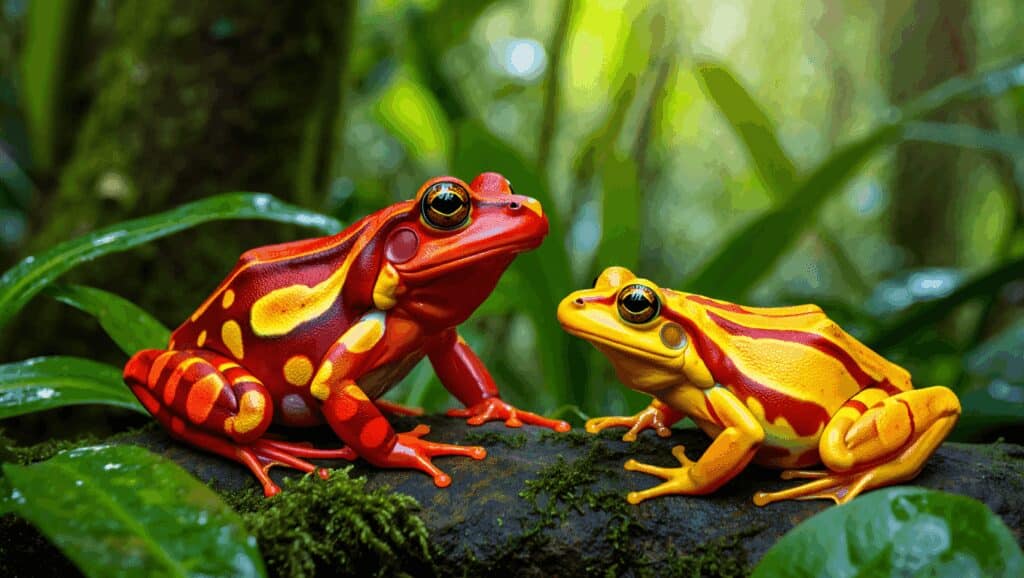
The red and yellow mountain frog — a tiny, vividly colored amphibian that lives high in the rainforests between southeast Queensland and northern New South Wales — has been bred in captivity and returned to the wild after years of painstaking work by scientists, Indigenous partners, and park managers. The achievement marks a rare success in amphibian conservation: replicating a complex mountain habitat under controlled conditions and nurturing a species with an unusual life cycle from egg to breeding adult.
Researchers say the effort is both scientific and cultural, involving careful environmental simulation, on-the-ground habitat protection, and collaboration with the Githabul people. In a discreet release, a small group of captive-bred frogs were placed into a fenced enclosure to begin rebuilding a local population — a symbolic and practical step toward preventing the species’ slide toward extinction.
Building a mountain rainforest inside a lab: how captive breeding worked
Getting these frogs to reproduce outside their native streams required far more than typical aquarium setups. Scientists at Southern Cross University designed enclosures that mimic the frogs’ montane rainforest home in multiple ways — temperature cycles, the right leaf litter and substrate, plant structure, and even the soundscape. The team found that when the environment didn’t match the frogs’ cues, breeding failed.
The Growing Demand for Data-Driven Decision Making in Silicon Valley
He quit, ran out of money, and begged to come back — here’s how his boss reacted
What the teams had to recreate
- Daily and seasonal temperature fluctuations that match higher-elevation rainforest conditions.
- Specific substrate and plant species for egg-laying and shelter.
- Natural acoustic cues: recordings of frog choruses played to encourage mating behavior.
- Careful microhabitat humidity and water features to support egg development.
Slow progress, careful milestones
This was not a quick experiment. Scientists describe the process as slow and methodical: from an egg to a breeding adult took roughly four years in captivity. The frog’s unusual development added difficulty — instead of free-swimming tadpoles, hatchlings develop within egg capsules and emerge at about 3 millimeters in length, requiring magnified inspection and delicate care. Reaching the adult, breeding stage meant repeated trials to get every environmental cue right.
From captivity to a protected release: partnerships on the ground
The release was a group effort. Southern Cross University led the captive-breeding program while national parks staff and Githabul traditional owners helped choose and prepare a secure release site. The release was carried out quietly and respectfully — a guarded event in a fenced area intended to give the newly released frogs the best chance to survive and reproduce.
Seven captive-bred individuals were returned to the wild during the release — a modest number, but one conservationists describe as an important step toward establishing a self-sustaining population.
Why the Githabul partnership matters
Collaboration with Indigenous rangers and landowners brings local knowledge of the terrain, traditional custodianship of country, and ongoing stewardship. The inclusion of the Githabul people in planning and release activities reflects both cultural respect and practical benefit: they contribute monitoring and reporting that help protect the frogs’ fragile habitats.
Key threats to the red and yellow mountain frog and how they’re being tackled
These small rainforest frogs face threats that are typical for many Australian amphibians, but particularly acute at high elevations.
- Feral pigs: Pigs wallow in and disturb shallow pools where eggs are laid. A single rooting event can destroy an entire year’s cohort.
- Drought and drying streams: Reduced water availability can leave breeding sites unusable.
- Habitat fragmentation and degradation: Loss or alteration of rainforest canopy, understorey and streamside vegetation undermines breeding and shelter sites.
Park managers and landholders have rolled out targeted responses:
- Feral pig trapping and control to reduce disturbance at key breeding pools.
- Fencing of sensitive habitats to exclude pigs and livestock.
- Active monitoring by local landowners and traditional custodians to detect threats early.
Why this small frog matters for broader conservation
Protecting a tiny, range-restricted frog has outsize ecological and symbolic importance. The red and yellow mountain frog is part of a complex rainforest web that supports many species; protecting its pools and riparian areas helps preserve water quality, plant communities, and other wildlife. The species was also listed among priority conservation targets by state and federal programs aiming to save 110 threatened species over the coming decades, underscoring its role in larger recovery strategies.
Conservation as a multi-pronged effort
The success so far blends several strands:
- Scientific innovation in captive-breeding techniques for a challenging amphibian life history.
- Traditional knowledge and local stewardship supplied by Githabul partners and landowners.
- Government-backed measures such as trapping, fencing, and protected-area management.
Strong coordination between these groups increases the chance the frogs will persist and, ideally, expand beyond the initial fenced release site.
Next steps for monitoring and expansion
After the release, scientists and rangers will continue to monitor the frogs’ survival, breeding success, and any threats that arise. Long-term plans include expanding protections to additional breeding sites and repeating captive releases if needed to bolster wild numbers. Researchers are also refining captive-rearing methods so future cohorts can be produced more efficiently and with higher survival rates.
Saving a species that measures only a few centimeters is a labor-intensive, detail-driven task, but conservationists say the work preserves an entire ecosystem and honors the people who live on and care for that landscape.
You might also like:
- Frog wiped out by disease returns to wild with help from frog spas and saunas
- Frog breaks its own bones to grow wolverine-like claws
- World’s first giant anteater reintroduction in Brazil shows early success
- New bird species discovered in Ecuador could reshape conservation
- Orangutan released after 9 years of intensive rehabilitation at nonprofit jungle school

Michael Thompson is an experienced journalist covering U.S. and global news. With ten years on the front lines, he breaks down political and economic stories that matter. His precise writing and keen attention to detail help you grasp the real‑world impact of every event.


Whoa, imagine being one of those conservation peeps who finally got those red and yellow mountain frogs to breed in captivity! Its like, Hey little froggies, we got your back now. Maybe theyll be throwing a froggy party soon!
Man, those red and yellow mountain frogs finally makin moves! Took em long enough, but hey, better late than never, right? Props to the conservation crew for putting in the work. Hope these lil guys thrive out there.
I remember trekkin those mountains as a kid, barely seein those red and yellow frogs. Now hearin theyre breedin em in labs, its like a miracle, man. Hope they thrive in the wild again. Natures wonders, yo.
Man, those red and yellow mountain frogs finally getting some love! Its like watching a comeback of a forgotten band. Big up to the conservation peeps for pulling off this miracle. Natures got its own little rockstars now!
Yo, dude, totally feel ya on that! Those red and yellow mountain frogs are like the rockstars of the wildlife scene now! Its rad to see them finally getting the spotlight they deserve. Kudos to the conservation squad for making it happen. Natures got some real VIPs strutting their stuff!
Man, talk about dedication! Breeding those red and yellow mountain frogs after all that conservation hustle? Thats some serious commitment right there. Hope those little hoppers appreciate the effort put into their love lives!
Man, those red and yellow mountain frogs finally gettin some love! Bout time theyre bred after all that conservation hustle. Hope these lil guys thrive in their new homes. Props to the teams makin it happen!
Man, those red and yellow mountain frogs finally got their happy ending! Its like a feel-good movie in real life. Lets give them a round of applause for making a comeback against all odds. Natures the best storyteller, aint it?
Man, those red and yellow mountain frogs finally getting some love after all that conservation hustle is heartwarming. Its like watching a rom-com where the underdog triumphs. Kudos to the teams for pulling off this wildlife fairytale!
A nature-loving city dweller:
Man, its like a miracle seeing those red and yellow mountain frogs bred after all that hard work. Building a rainforest in a lab? Crazy stuff! Hope they keep up the good work for these lil guys.