
Show summary Hide summary
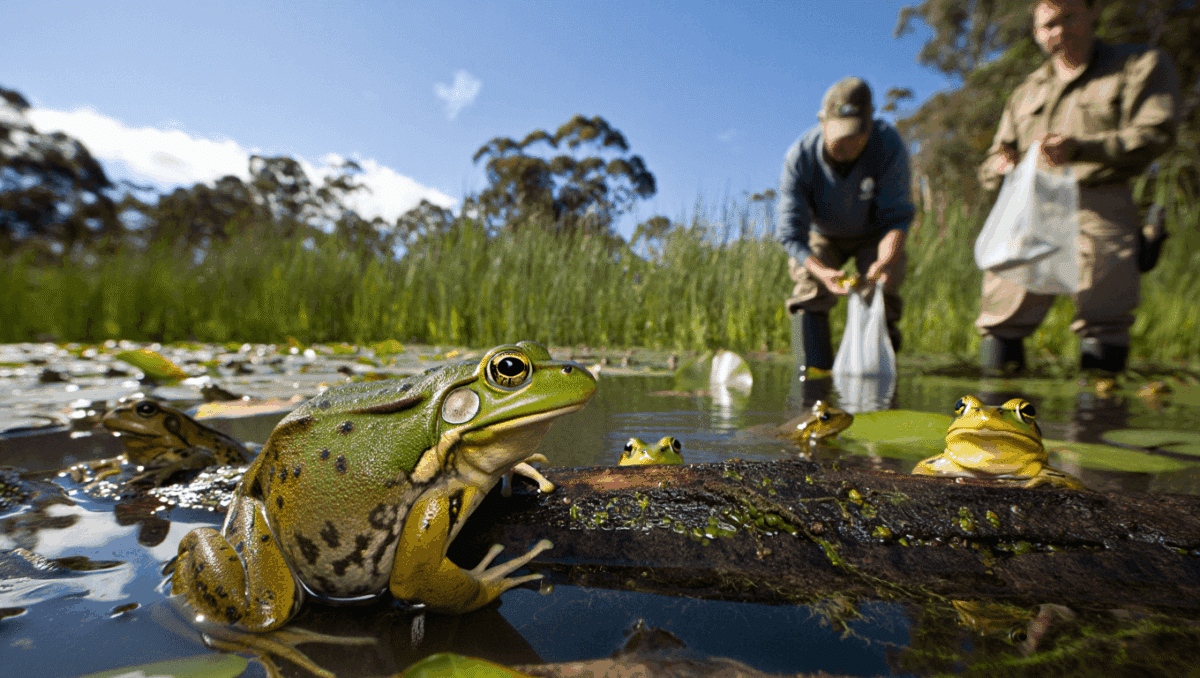
The green and golden bell frog is making a cautious comeback to wetlands around Canberra after vanishing locally decades ago. Conservationists have bred hundreds in captivity and are releasing them back into carefully chosen ponds, armed with an unusual arsenal: warm, slightly salty “frog spas” and man-made “frog saunas” designed to outmatch the deadly chytrid fungus that knocked amphibian populations worldwide to their knees.
This effort blends hands-on husbandry with simple engineering and thermal science. By putting captive-bred frogs into environments that favor the animals but stress the pathogen, researchers hope to give a species once lost from the region a fighting chance to rebuild.
From local disappearance to a focused rescue effort
Scientists say the green and golden bell frog largely disappeared from the Australian Capital Territory around the early 1980s. Local universities and wildlife teams have since concentrated on captive breeding as a bridge back to the wild.
The Growing Demand for Data-Driven Decision Making in Silicon Valley
He quit, ran out of money, and begged to come back — here’s how his boss reacted
Associate Professor Simon Clulow and colleagues at the University of Canberra coordinated the program, describing the reintroduction as an emotional milestone for the team. After years of propagation and preparation, the captive-bred animals are now being released in staged groups to reestablish wild populations in targeted wetlands near Canberra.
What are frog saunas and why they matter
Frog saunas are low-tech, thermal refuges built to exploit a vulnerability in the chytrid fungus. The design is straightforward but effective:
- Stacks of black bricks form a porous core with slots and crevices that frogs can shelter in.
- A pyramid-shaped covering of rigid plastic over the bricks traps heat.
- The internal spaces warm to temperatures that are survivable or even preferred by the frogs while being harmful to the fungus.
Researchers found the pathogen struggles above about 25°C, with temperatures near 27–28°C becoming lethal. The green and golden bell frog prefers warmer microclimates and will comfortably use spots that reach roughly 30°C (about 88°F)Frog spas: warm, slightly salty ponds
Alongside saunas, teams have identified and prepared a series of ponds dubbed “frog spas.” These sites typically feature:
Together, saunas and spas create a two-layered strategy: warm refuges for adults to escape infection, and ponds that support reproduction and juvenile survival.
Release plan, numbers, and what researchers expect
The initial phase of the program involves releasing more than 300 captive-bred frogs into a network of ponds. Details include:
- Releases in groups of about 15 frogs per site to encourage social and breeding behavior.
- Installation of roughly 180 frog saunas across the selected wetlands.
- A target population of roughly 200 frogs per pond over time.
Female green and golden bell frogs are prolific: a single breeding season can produce around 8,000 eggs. That high reproductive potential means recovery could be rapid if survival rates improve. However, hatchlings and juveniles will still face exposure to chytrid and other hazards; the saunas and suitable ponds aim to reduce that risk and boost survival through critical early life stages.
The science behind the thermal approach
Chytridiomycosis, the disease caused by chytrid fungus, has been linked to steep declines and extinctions of amphibians globally. Part of what makes the fungus so destructive is its ability to thrive in cool, moist conditions common to many frog habitats.
Thermal management targets a biological weakness: the fungi do not tolerate sustained higher temperatures. Creating microhabitats that reach those higher temperatures gives frogs a behavioral option to reduce infection loads without chemical treatments. Captive breeding and immunization steps prepare animals to face the wild, while engineered heat refuges reduce pathogen pressure at release sites.
Monitoring, risks, and next steps in the recovery effort
Field teams will monitor survival, breeding success, and disease prevalence at release sites. Key activities include:
- Regular population checks and tadpole surveys.
- Maintenance and expansion of sauna and spa infrastructure.
- Adaptive management—adjusting site selection and habitat features based on what works.
The project is iterative: as data accumulate, researchers will refine site choices, breeding numbers, and thermal refuge distribution to increase the chances of a lasting wild population. Ongoing work will also feed into broader strategies for protecting other amphibian species threatened by chytrid.
You might also like:
- Endangered red and yellow mountain frogs bred for first time after years of conservation work
- Frog breaks its own bones to grow wolverine-like claws
- World’s first giant anteater reintroduction in Brazil shows early success
- Vietnamese pheasant returns to wild after 20 years thanks to zoo coalition
- Zoo saves 21 snails from extinction, returns hundreds to pristine Atlantic island

Michael Thompson is an experienced journalist covering U.S. and global news. With ten years on the front lines, he breaks down political and economic stories that matter. His precise writing and keen attention to detail help you grasp the real‑world impact of every event.


Man, these frog spas and saunas sound like luxury treatment for our amphibian pals! Its like a five-star resort for frogs. Maybe I should start a business for stressed-out humans too. Froggy wellness retreats, anyone?
I remember when I used to think all frogs were the same. But now, hearing about these frog spas and saunas, Im starting to wonder if Ive been missing out on some luxury frog lifestyle! Hop on, little froggies, its spa day!
Man, these frog spas and saunas sound like a five-star treatment for amphibians! Can you imagine the spa music they play for those little guys while they kick back and relax? Hoping they thrive back in the wild!
Man, these frogs got it made with their own spas now! Wish I could chill in a warm, salty pond all day. Maybe I should start a human spa for stressed-out folks. Frogs deserve some pampering too.
Man, these frog spas sound like the VIP treatment, huh? Imagine coming back from a rough time and getting a full-body relaxation session in a warm, slightly salty pond. Frogs living their best life!
Man, these frog spas are the real deal! I mean, who knew frogs needed pampering too? Next thing you know, theyll be signing up for yoga classes. Good on those researchers for getting those little hoppers back in the wild!
Man, I always knew frogs were onto something with their chill vibes. Frog spas, really? Next thing you know, theyll be sippin on tiny froggy lattes. Cant deny, though, glad to see em bouncin back!
Man, those frogs got the VIP treatment with their own spas and saunas! I wish I could live that life. Maybe I should start a petition for human spas in the wild too. Whos with me?
No way, frog spas? Thats next level pampering for our slimy buddies! Imagine the relaxation in those slightly salty ponds. I bet those frogs are hopping back into the wild feeling fresher than ever. Natures got its own rejuvenation secrets, huh?
Man, talk about luxury treatment for frogs! Frog spas and saunas? Thats a new one. Wonder if they offer facials and massages too! Maybe I should introduce my pet frog to this fancy lifestyle.
I remember when my pet frog hopped away, never to return. Reading this, I cant help but feel a glimmer of hope. Frog spas, saunas – talk about luxury treatment! Who knew frogs were living the high life too? Hop on, little buddy!