
Show summary Hide summary
- How the “wolverine” frog produces bony claws
- Why this extreme tactic makes biological sense
- What studies reveal about behavior and recovery
- Where the hairy frog lives and how it behaves in the wild
- Comparisons to other animals with defensive weapons
- What this adaptation tells us about evolution and survival strategies
- Conservation status and human impact
- Common questions researchers are still investigating
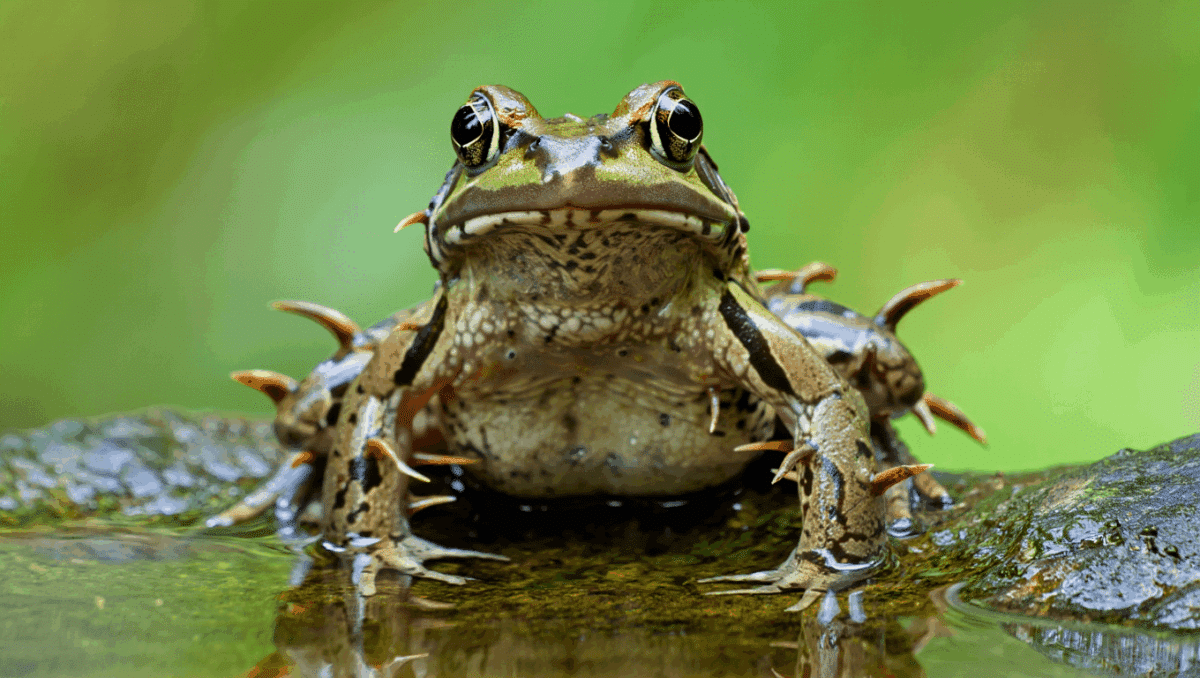
The hairy frog — sometimes nicknamed the “wolverine frog” — sounds like something out of a superhero sketch. This Central African amphibian can force sharpened pieces of bone through its own skin to create defensive claws, a startling adaptation that blurs the line between self-destructiveness and survival strategy.
Scientists have long watched this frog’s dramatic reaction to threats and studied the anatomy that enables it. The mechanism is unusual: rather than keratinized nails like mammals, the frog relies on modified toe bones that can be projected through the skin when needed, making it one of the few known vertebrates to intentionally damage its own tissue to form weapons.
How the “wolverine” frog produces bony claws
The Growing Demand for Data-Driven Decision Making in Silicon Valley
He quit, ran out of money, and begged to come back — here’s how his boss reacted
The frog’s claws are formed from its own toe bones. When threatened, the animal appears to deliberately break or dislocate small bones inside its toes, pushing them outward until they puncture the skin and act as sharp defensive spikes. Unlike mammalian claws, these are not made of keratin; they are extensions of the frog’s skeleton itself.
Anatomy behind the projection
- Each claw originates from a specialized distal phalanx — the terminal bone in the toe.
- Muscular contractions and flexion create pressure that helps drive the bone tip outward.
- The bone then pierces the overlying skin, emerging as a hard point the frog can use to fend off predators.
This is a rare example of a vertebrate using intentional bone projection as a defensive tool, a trait that has fascinated researchers because it combines behavior, physiology, and skeletal modification in a single survival tactic.
Why this extreme tactic makes biological sense
Risking injury to escape predation sounds counterintuitive, but when a predator’s jaws close or a larger animal pins a small amphibian, quick and painful defense can be the difference between life and death. For the hairy frog, producing bony spikes offers:
- Immediate deterrence — a sudden, painful response that can cause a predator to release its grip.
- Minimal long-term cost — these frogs can regenerate damaged tissues and, in many cases, recover from the bone damage.
- Evolutionary value — individuals that survived attacks by using this tactic left genes for the trait, reinforcing the behavior in the population.
What studies reveal about behavior and recovery
Field observations and anatomical research show that the frog does not rely on this mechanism constantly. Instead, it reserves the bony projection for acute threats. After a defensive episode, the damaged skin and bone structures undergo repair and regeneration — a capacity common in many amphibians, though still remarkable given the self-inflicted nature of the wounds.
Regeneration and healing
- Amphibian skin heals quickly compared with many other vertebrates, helping limit infection risk.
- Regrowth of bone and scar tissue restores toe function over time.
- Periodic use of claws appears sustainable across the frog’s adult life span.
Where the hairy frog lives and how it behaves in the wild
Native to parts of Central Africa, this species favors fast-flowing streams and forested areas where hiding spots are limited and predation risk is high. The frog’s bulky body, muscular limbs, and the occasional appearance of hair-like flaps on males during breeding season have contributed to its common names and the interest it draws from both scientists and nature enthusiasts.
Typical behaviors
- Mostly nocturnal: active at night hunting insects and other small prey.
- Breeding season changes male appearance, with temporary skin protrusions that resemble hair.
- When confronted by predators, the frog will inflate, struggle, and deploy its bony claws if escape is otherwise impossible.
Comparisons to other animals with defensive weapons
Most animals rely on claws, teeth, spines, or toxins that develop as part of normal anatomy. What sets the hairy frog apart is the combination of a normally hidden, internal skeletal projection and the apparent willingness to sacrifice tissue in a high-stakes moment. In that sense, it’s functionally similar to:
- Porcupines, which use quills as passive defense.
- Some lizards that detach tails to escape predators.
- Invertebrates that eject defensive secretions or autotomize limbs.
But the hairy frog’s approach remains unusual among vertebrates because it involves deliberate bone exposure rather than the use of preformed external structures.
What this adaptation tells us about evolution and survival strategies
The evolution of such an extreme defense highlights how natural selection can produce unexpected solutions when pressures are intense. It also underscores the trade-offs animals make: the cost of injury versus the benefit of surviving a life-threatening encounter. For scientists, the hairy frog provides a live example of behavioral and anatomical innovation driven by predation pressure.
Broader scientific interest
- Insights into wound healing and bone regeneration in amphibians may inform medical research.
- Studying the frog helps clarify how physical traits can be co-opted into behavioral defenses.
- Comparative anatomy across species reveals which pathways are more likely to produce similar adaptations.
Conservation status and human impact
Like many amphibians, hairy frogs face threats from habitat loss, pollution, and climate change. While their dramatic defense grabs headlines, the long-term survival of populations depends on preserving clean streams and forest habitat where they breed and feed. Researchers and conservationists monitor these habitats to understand population trends and protect the ecosystems the frogs rely on.
How people can help
- Support conservation groups working in Central African forests and waterways.
- Promote policies that reduce pollution and deforestation in amphibian habitats.
- Back scientific research that tracks species distribution and health indicators.
Common questions researchers are still investigating
- Exactly how the frog coordinates the breaking and projection of bone without causing fatal damage.
- How frequently individual frogs deploy the claws in natural settings.
- The genetic and developmental pathways that enable bone modification and rapid healing.
Understanding this frog’s remarkable defense is an ongoing project, one that connects behavior, anatomy, and ecology while challenging assumptions about how far natural selection will go to preserve life.
You might also like:
- Frog wiped out by disease returns to wild with help from frog spas and saunas
- Endangered red and yellow mountain frogs bred for first time after years of conservation work
- 289-million-year-old fossil reveals earliest known lung function, mummified skin, scales, proteins
- Megaraptor fossil found with ancient crocodile in its mouth
- Pachycephalosaur skull upends understanding of dome-headed dinosaurs

William Anderson is a multimedia producer specializing in videos, podcasts, and interactive galleries. With five years of immersive content creation, he turns information into a rich audio‑visual experience. His storytelling skills draw you directly into the heart of every story, on any platform.


Yo, check this out! Imagine if we could break our bones to grow some superhero-style claws like this wolverine frog. Talk about taking evolution to the next level. Nature never ceases to amaze me!
Man, nature is wild! This frog out there breaking its own bones just to get some wolverine-mode claws? Thats next level dedication right there. Can you imagine if we humans had to go through that kind of extreme makeover for a new look?
Man, natures like a horror movie sometimes. This frogs out there breaking its own bones just to look like Wolverine? Thats some next-level commitment. Wonder what theyll do next – grow laser eyes to shoot down flies? Natures wild, man.
Yo, imagine if we could just break our bones to get superpowers like these frogs? Natures wild, man. Evolutions like, Hey, let me give you some Wolverine vibes, and these frogs are just like, Sure, why not? Crazy stuff.
I mean, who needs a superhero when you got a frog breaking its own bones for wolverine claws? Natures wilder than any comic book, man. Imagine if all animals started leveling up like this, wed have a real-life Avengers team!
Man, nature is wild! Imagine having to break your own bones just to grow claws like Wolverine. Thats some next-level adaptation right there. The things creatures do to survive, its both fascinating and kinda brutal, dont you think?
Dude, totally! Nature be out there playin some hardcore survival games, right? Breaking bones just to get some Wolverine claws? Thats like next-level Fear Factor stuff! Its like a whole reality show out there, but for animals. Wonder if they got a host too, like Animal Planets got the next David Attenborough in the making? Just picturin it makes me wanna grab some popcorn and watch the drama unfold!
So, like, this frog is out here breaking its own bones just to grow wolverine-like claws? Nature be wild, man. Imagine if we had to do that for a cool party trick. Natures got some twisted sense of humor, for real.
Man, nature be wildin! A frog breakin its own bones? Thats some next-level evolution right there. Nature always findin ways to surprise us. Can you imagine if humans could do that? Like, Oops, just broke my arm but no worries, gonna grow a Wolverine claw now!
I always thought I was tough til I read about this wolverine frog! Breaking its own bones for claws? Talk about extreme makeover, am I right? Natures wild, man.
I once saw a frog jumpin around like it owned the place. Turns out, it breaks its own bones for wolverine claws! Nature aint playin games, yall. Crazy how creatures adapt, huh?
Dude, natures wild, man. Imagine being a frog, just chillin, and then youre like, You know what? I need some wolverine claws. So you break your own bones to make it happen. Natures on some next-level stuff, for real.
Man, nature be wildin! Frogs breakin bones for claws, like, whats next? Birds growin extra wings? Nature always got somethin up its sleeve, keepin us on our toes. Nature, you crazy!
Dude, that wolverine frog be on some next-level self-improvement grind, like, Imma break my bones to flex these claws! Thats some savage dedication right there. Nature aint playing around with its upgrades, man.
Seriously, frogs are out here breaking their bones to grow claws? Nature is wild, man. I thought I was tough for walking on a sprained ankle once. Respect to these wolverine frogs for taking it to the extreme for survival.
Dude, imagine if we could regrow body parts like its no biggie. This wolverine frogs on another level, breaking its own bones for claw upgrades. Natures wild, man!
Yo, imagine if we could regrow our nails like that! Breakin bones for claws, next-level stuff. Natures wild, man. Wonder if I could pull off a wolverine look at the next party…
I mean, talk about dedication to self-improvement! This frogs out here breaking bones for wolverine-like claws. Guess we could all learn a thing or two about commitment from these little amphibians, huh?