
Show summary Hide summary
- How the AI-guided robot chooses where to plant on the Great Barrier Reef
- What the “baby corals” are and how they’re protected
- From spawning tanks to targeted reef seeding: the restoration pipeline
- Why automation matters and how people stay involved
- What’s next for reef-scale coral restoration technology
After back-to-back bleaching events, parts of the Great Barrier Reef need help to recover. Scientists at the Australian Institute of Marine Science (AIMS) are pairing decades of ecological research with artificial intelligence and robotics to place juvenile corals where they have the best chance to survive and grow.
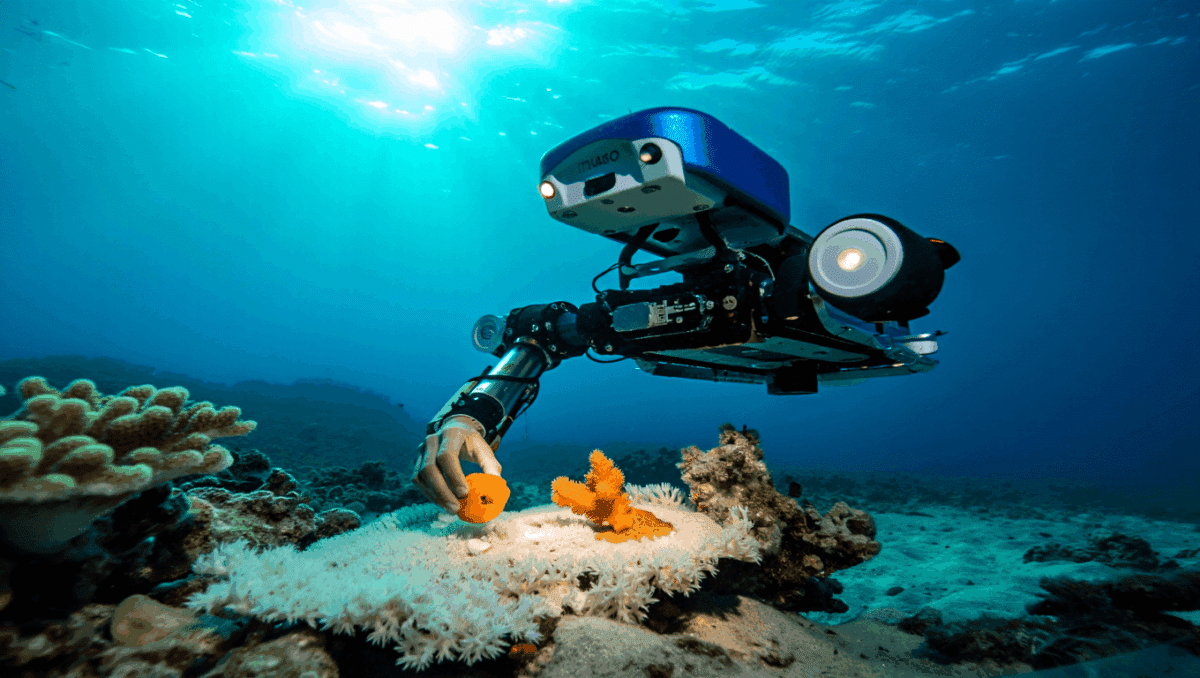
The effort uses a machine called the Deployment Guidance System to scan reef seafloor, pick target locations and deliver protective coral starters — a process that would be extremely difficult to perform accurately by hand at scale.
The Growing Demand for Data-Driven Decision Making in Silicon Valley
He quit, ran out of money, and begged to come back — here’s how his boss reacted
How the AI-guided robot chooses where to plant on the Great Barrier Reef
The Deployment Guidance System (DGS) fuses multiple data streams to make placement decisions. Sensors map the seafloor, cameras and computer vision classify substrate quality, and a deep-learning model synthesizes years of oceanographic and ecological records to identify promising microsites.
Rather than relying on a single instrument, the DGS coordinates a workflow of technologies so that each deployment is informed by the latest science. Dr. Ben Moshirian, the project engineer who helped develop the system, says the goal is to “ensure coral seeding devices are accurately and safely deployed in pre-specified locations.”
Key capabilities the system combines
- High-resolution seabed scanning and imaging
- Real-time classification of suitable substrate
- Deep-learning timing predictions for optimal larval release
- Precision release mechanisms that place devices close to target points
What the “baby corals” are and how they’re protected
AIMS deploys small, specially designed structures that act as nursery platforms for coral recruits. These ceramic coral analogues shelter young corals while they establish and grow, increasing survival compared with letting larvae settle unaided on bare reef rubble.
The DGS lowers the analogues from an AIMS vessel and releases them to land within about three feet of the chosen microhabitat, giving the juvenile corals a much better start than random settlement across degraded areas.
From spawning tanks to targeted reef seeding: the restoration pipeline
Over the last two decades, researchers have learned to time mass coral spawning events, capture free-swimming larvae, and rear juveniles in controlled aquarium settings. That progress has made coral seeding — deliberately placing young corals back onto reefs — a practical restoration method.
- Scientists predict spawning windows based on seasonal and environmental cues.
- Larvae are collected and grown until they can survive on settlement substrates.
- Robotic deployment systems then place those substrates in locations chosen for survival potential.
Why automation matters and how people stay involved
Automation extends the reach of restoration teams. According to project engineers, the system isn’t intended to replace researchers or Traditional owners; instead, it amplifies human-led decisions so crews can scale up seeding across vast reef areas that were previously impractical to treat.
Future plans include mounting the DGS on unmanned vessels for continuous, around-the-clock seeding and adapting the hardware so smaller recreational or tour boats — and even Traditional owner-operated craft — can deploy devices during routine trips. That approach would create more opportunities for communities and visitors to contribute to reef recovery.
What’s next for reef-scale coral restoration technology
As field deployments proceed, the DGS’s decision-making will evolve with new observations and ecological findings. The system’s developers emphasize that improved model accuracy and updated deployment rules will be built into the workflow, ensuring each mission reflects the best available science.
AIMS has released footage showing the DGS in operation and plans to continue testing ways to make coral seeding both more effective and more accessible to those who live by and rely upon the reef.

You might also like:
- Great Barrier Reef recovery from bleaching aided by monsoon rains
- Heat-resistant coral helps Mauritius restore reefs with 98% survival rate
- Oyster reef restoration off Portsmouth becomes England’s largest with 200+ volunteers
- 3 million oysters eaten by New Yorkers help rebuild New York City’s reefs
- Pearl necklace spider discovered: what scientists know about the new species

Michael Thompson is an experienced journalist covering U.S. and global news. With ten years on the front lines, he breaks down political and economic stories that matter. His precise writing and keen attention to detail help you grasp the real‑world impact of every event.


Man, these AI-guided robots planting baby corals on the Great Barrier Reef? Thats some next-level tech blending with nature, huh? Hope those little corals grow big and strong, like kids in a high-tech nursery!
Dang, aint that the truth! Its like Mother Nature got herself a high-tech upgrade. Who knew robots could be all about that coral nursery life, right? Hope those little suckers grow up big and strong, ready to take on the ocean world. Lets root for those corals like theyre the underdogs in a tech-savvy superhero movie!
Man, technology these days, right? AI-guided robots planting baby corals on the Great Barrier Reef? Thats wild. Hope those little corals thrive and bring back some life to the reef. Nature meets sci-fi, I guess.
Man, these AI-guided robots planting baby corals on the Great Barrier Reef are like something out of a sci-fi flick! Its wild how techs helping nature bounce back. Cant wait to see those reefs thrive again!
Man, AI robots planting baby corals on the Great Barrier Reef is like sci-fi come true! Nature getting a tech boost, huh? Hope those little corals grow big and strong, thanks to our robo-friends!
Man, these AI-guided robots planting baby corals on the Great Barrier Reef got me thinking. Its like a sci-fi meets nature kinda vibe, yknow? Gotta admit, its pretty cool how tech is helping out Mother Nature.
I remember diving in the Reef years back, magical colors everywhere. These robot helpers sound cool, but can they really mimic natures touch? Hope were not just replacing the real deal with tech. Nature knows best, right?
Man, AI-guided robots planting baby corals on the Great Barrier Reef? Thats some next-level eco-saving stuff! Can you imagine the robots having little coral planting parties down there? Saving the oceans one byte at a time!
Man, technologys getting wild! AI-guided robots planting baby corals on the Great Barrier Reef? Thats some sci-fi stuff right there. Cant wait to see those little guys grow and thrive with a bit of robotic help!
Oh, mate, technologys on a whole other level, innit? I mean, AI-guided robots planting baby corals on the Great Barrier Reef? Thats like straight out of a sci-fi flick! Can you imagine those little coral buds getting a robo-boost to grow big and strong? Its like Mother Nature teamed up with the Terminator or something. Cant wait to see those underwater cyborg gardeners in action!
Man, these AI-guided robots planting baby corals on the Great Barrier Reef got me feeling like were in a sci-fi movie or somethin! Can you imagine telling a fish in a few years, You see that coral over there? Yeah, a robot planted that! Wild times we live in, huh?
Dang, mate, these robots in the sea are really upping their game, eh? Imagine a fish getting the news – Hey mate, that coral? Robot planted it! Makes you wonder if theyll start asking for autographs next! Crazy times were living in, innit?
Man, these AI-guided robots planting baby corals on the Great Barrier Reef are like the Earths little helpers, you know? Its like natures own tech support squad coming through to save the day. Pretty cool stuff if you ask me!