
Show summary Hide summary
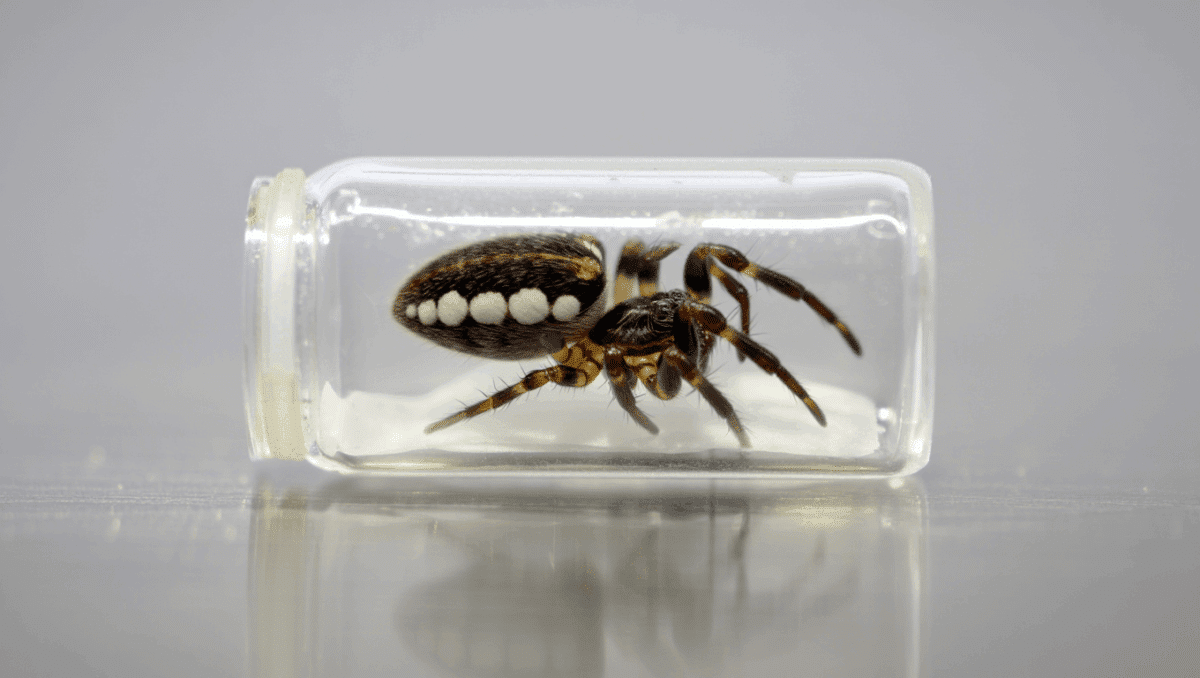
A routine look through a museum drawer in Brazil turned into an unsettling — and scientifically valuable — surprise. Curators and researchers examining a tiny preserved juvenile spider noticed what at first glance appeared to be a delicate beaded necklace wrapped where the spider’s abdomen meets its head. Closer inspection revealed the beads were not jewelry but living organisms that had been feeding on the little arachnid.
The case is a reminder that museum collections are more than static displays; they’re time capsules where unexpected ecological interactions can be rediscovered decades after the specimens were collected. In this instance, the real protagonists are microscopic parasitic mites, newly documented in a context that expands what scientists know about spider–mite relationships in Brazil.
How the “pearl necklace” was identified and cataloged
Researchers publishing their work in the International Journal of Acarology describe how the clustered larvae were noticed along the spider’s pedicel — the narrow connection between the cephalothorax and abdomen. That location is thinly sclerotized, making it easier for parasites to puncture the cuticle and extract fluids.
The Growing Demand for Data-Driven Decision Making in Silicon Valley
He quit, ran out of money, and begged to come back — here’s how his boss reacted
Key steps in the discovery
- Specimens examined came from zoological collections rather than field observations.
- Microscopic inspection revealed the small, swollen larvae attached in a ring-like formation.
- Taxonomic work identified these mites as belonging to a family not previously recorded on Brazilian spiders.
Ricardo Bassini‑Silva of the Butantan Institute played a central role in recognizing the parasitic larvae. The mites had become engorged while feeding and were visible as beadlike swellings around the spider’s body — an image that captured both scientists’ attention and public imagination.
What these mites reveal about parasitism on spiders
This discovery represents only the second formal record of spider-parasitic mites in Brazil and the first time this particular mite family has been associated with Brazilian spiders. The findings open new questions about host specificity, life cycles, and the ecological niches exploited by tiny parasitic arthropods.
Why the pedicel matters
The pedicel provides a strategic feeding site for mites because its cuticle is thinner, allowing larvae to attach and consume hemolymph more easily. In effect, these mites turn juvenile spiders into a concentrated nutrient source until detachment.
- Larval parasitism: Many mite species are parasitic only in their larval stage, later becoming free-living as adults.
- Host range: The mites were found on juveniles from three different spider families, suggesting either opportunistic feeding or a broader host tolerance than expected.
- Size dynamics: The spiders were only a few millimeters long; the mites were even tinier and visible mainly because they were engorged.
Details on the specimens and collection sites in Rio de Janeiro state
The affected spiders were small juveniles collected near caves and grottoes in Rio de Janeiro state — the same general region where Brazil’s first spider‑parasitic mite had been recorded years earlier. These microhabitats can harbor unique arthropod assemblages, and caves often concentrate both spiders and their associated parasites.
Why Brazil remains important for this research
- Brazil’s rainforests and associated ecosystems harbor a massive diversity of spiders — more than 3,000 described species — making the country a rich territory for discovering new host‑parasite relationships.
- Historical collections housed in museums provide snapshots across time, allowing scientists to detect rare or ephemeral interactions that fieldwork alone might miss.
- Ongoing taxonomic work is essential: many mite species are described only from their larval stage, complicating identification and our understanding of their full life histories.
What remains unknown and the next research steps
Scientists still lack complete life‑cycle data for these mites: adults have not been matched to the larval forms found on the spiders, and it’s unclear whether the parasites are specialists or generalists across spider hosts. Further field surveys, molecular analyses, and targeted rearing of larvae to adulthood will be needed to place these mites more precisely within acarological taxonomy.
You might also like:
- Honeybees in southern California resist deadly varroa mites
- 30 centimeters wide and 170 grams: meet the world’s largest spider, eaten by locals
- Spiders build fake bodies to fool predators
- Heartbreak High actor Bryn Chapman Parish: can men really change?
- Nonphotosynthetic plant discovered: species abandoned photosynthesis entirely

William Anderson is a multimedia producer specializing in videos, podcasts, and interactive galleries. With five years of immersive content creation, he turns information into a rich audio‑visual experience. His storytelling skills draw you directly into the heart of every story, on any platform.


A nature enthusiast here! This pearl necklace spider find is wild! Nature never fails to surprise me with its creativity. Cant wait to learn more about these tiny critters and their parasitic relationships. Mother Nature, youre a real artist!
Oh man, that spider bling is off the charts! Natures really out here flexin its style game. Cant believe those critters are into fashion too! Bet they got more drip than half the folks I know. Mother Natures like the ultimate designer, huh? Wonder if shes got a whole line of accessories we havent even seen yet. Keep those discoveries coming!
Man, nature never ceases to amaze me! A spider with a pearl necklace? Thats wild! Can you imagine stumbling upon that in your backyard? Bet that spiders the fanciest critter at the arachnid ball!
Ive always loved spiders, but a pearl necklace spider? Thats next-level cute! Cant wait to learn more about these little fashionistas and their unique style. Nature never fails to surprise me!
I once saw a spider rockin a pearl necklace. Thought it was a fancy pet, turns out its a whole new species! Science never ceases to amaze me. Wonder what other bling those critters are hiding.
Oh man, a spider with a pearl necklace? Thats wild! Reminds me of that fancy aunt who always wore way too much jewelry. Wonder if shed be friends with this spider or just steal its style.
Whoa, spiders with pearl necklaces? Natures really upping its fashion game! Next thing you know, well have arachnids strutting down runways. Cant wait to see what other stylish surprises Mother Natures got up her sleeve!
Aunt Marlene here, sweetie! Back in my day, spiders were just spiders. Now they got fancy names like pearl necklace spiders! Well, aint that something! Cant wait to tell the ladies at bingo.
A conspiracy nut: Well, well, well, what do we have here? A pearl necklace spider, huh? Sounds like something straight outta a sci-fi flick. Who knows what else those sneaky scientists are hiding from us, eh?
A spider with a *fashion statement*, huh? Reminds me of Aunt Mabels quirky jewelry choices. Wonder if these mites are trendsetters in the spider world or just freeloaders crashing a stylish party.