
Show summary Hide summary
A new generation of wind power is taking to the sky, trading towers for dirigible-like platforms that float where the air is strongest. By lifting turbines to heights most ground-based machines can’t reach, developers aim to deliver steadier electricity to remote towns, disaster zones, and places where conventional turbines are impractical.
Two companies stand out in advancing this airborne approach: an MIT spinout that first proved the concept in Alaska, and a Beijing-based firm that recently tested a much larger system capable of producing utility-scale output. The race now is to turn prototype promise into reliable, affordable power at scale.
How airship-style wind systems capture higher, steadier winds
The Growing Demand for Data-Driven Decision Making in Silicon Valley
He quit, ran out of money, and begged to come back — here’s how his boss reacted
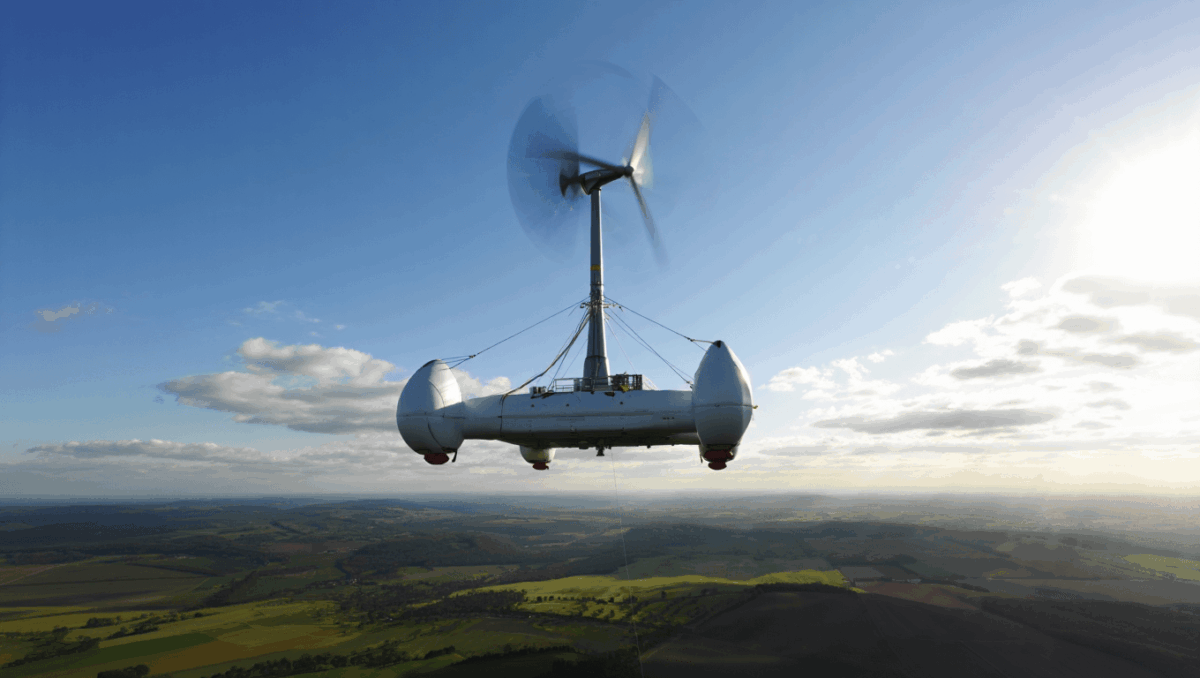
Airborne wind systems combine a buoyant envelope with a turbine and a tether that carries power down to the ground. Floating at roughly 1,000 to 2,000 feet, these platforms tap wind resources that are stronger and more consistent than the air available to traditional towers.
Key technical features
- Buoyant shell: Inflatable materials similar to modern blimps lift the unit off the ground and stabilize it in higher-altitude flow.
- Tethered power transfer: A reinforced cable transmits generated electricity and anchors the system to its ground station.
- Remote siting: Because they do not require heavy foundations, airborne turbines can be deployed in terrain or weather conditions that make conventional turbines expensive or impossible to install.
Floating above the usual rotor height eliminates a major limitation of onshore wind: variability. Higher altitude winds tend to blow more consistently and with greater force, enabling airborne turbines to produce steadier output and to avoid some environmental impacts associated with ground-based towers.
From early prototypes to a one-megawatt test in Xinjiang
The earliest commercially minded project emerged from MIT with a compact, inflatable unit aimed at remote Alaska. That initial design demonstrated the concept’s potential by supplying tens of kilowatts to isolated communities that rely heavily on diesel generation.
More recently, a Chinese start-up scaled up the idea dramatically. Their S1500 device — roughly as long and wide as a basketball court and as tall as a 13-story building — completed a field trial in a windy desert province and reached a milestone rarely seen outside utility-scale land or offshore turbines: it produced 1 megawatt of power and delivered it to the ground through its tether.
- The S1500’s output represented an order-of-magnitude increase over a smaller prototype that produced about 100 kilowatts in a prior test.
- Company leadership described the megawatt result as a turning point on the path toward commercial production, with mass manufacturing planned to follow successful testing.
Costs, materials and the economics of airborne wind
Proponents say airborne turbines could be significantly cheaper to build and install than conventional machines because they avoid heavy towers and deep foundations. The developer behind the S1500 reports that its units are about 40% cheaper to construct and deploy than standard turbines, and that the delivered energy could be roughly 30% less expensive for consumers.
Research and development teams are also experimenting with new materials and manufacturing processes to push costs down further. One ambitious target cited by engineers is a delivered-cost figure in the range of $0.01 per kilowatt-hour, a level that would dramatically undercut many existing generation sources if achieved in real-world conditions.
Economic advantages at a glance
- Lower civil works and foundation costs compared with onshore towers.
- Faster site deployment in remote or rugged locations.
- Potentially higher capacity factors due to steadier winds at altitude.
Remaining technical and regulatory challenges
Technical hurdles remain before airborne turbines become commonplace. Teams are addressing questions about durability in extreme weather, tether wear and tear, and safe operations during storms. In addition, the systems must meet aviation regulations and local permitting rules that vary by country.
Main challenges to commercial rollout
- Storm response: developing reliable retraction, secure mooring, or controlled descent strategies for severe winds.
- Tether reliability: ensuring long-term strength and electrical conductivity under constant load and abrasion.
- Airspace and safety: coordinating with aviation authorities to prevent conflicts and protect birds and aircraft.
- Grid integration: connecting intermittent airborne output to local networks and competing with established energy suppliers, including coal in some regions.
Industry observers note that public acceptance, environmental review, and financing models will also shape how quickly these systems move from test sites to widespread deployment.
Where airborne wind could make the most difference
Floating turbines may offer the biggest near-term benefits to communities that currently pay a premium for imported fuels or that lack infrastructure for large turbines. Typical use cases include remote Arctic villages, island grids, disaster-relief staging areas, and off-grid industrial sites.
- Remote communities: reduced reliance on diesel or fuel deliveries.
- Post-disaster power: rapid deployment of local generation where infrastructure is damaged.
- Hard-to-reach locations: access to higher-altitude winds without major ground construction.
Some developers are also adapting the same buoyant platform concept for telecommunications, providing an additional revenue stream and operational rationale for deploying airships in places that lack fiber or cellular infrastructure.
You might also like:
- Two-headed wind turbine could solve offshore wind industry challenges
- Offshore wind turbine prototype powers onboard data center while ocean disperses heat
- 86 MW solar farm: Singapore to build on its largest reservoir
- Largest US renewable project comes online with more power than Hoover Dam
- Dutch Designers Innovate: Tiny Home Inside Recycled Wind Turbine Unveiled!

Michael Thompson is an experienced journalist covering U.S. and global news. With ten years on the front lines, he breaks down political and economic stories that matter. His precise writing and keen attention to detail help you grasp the real‑world impact of every event.


Man, I remember dreaming bout flying ships as a kid. Now theyre talking bout airship-style wind turbines? Thats like sci-fi come alive, man. Bet theyll revolutionize the whole power scene with those bad boys!
Dude, those airship-style wind turbines are straight outta a kids wildest dream, right? Its like playground fantasies meeting the real world. Who knew flying ships would morph into power giants? Can you imagine the sound effects on those bad boys? Next level, man!
Man, these airship-style wind turbines got me feeling like a kid dreaming of flying kites! Wonder if theyll soar high or crash like a deflated balloon. Exciting or just a lofty idea? Time to see if they really take off!
Dude, those airship-style wind turbines? Theyre like the cool big brother of regular windmills, right? Imagine them floating up there, doing their thing like a bunch of oversized kites. Will they rock the skies or flop like a popped balloon? Guess we gotta sit back and watch if theyre the real deal or just a sky-high fantasy!
Ah, the wind turbines taking it to the skies now, huh? Feels like Im in some sci-fi flick! But hey, cheaper power sounds good to me. Wonder if these airship-style gizmos will become a common sight soon.
Man, these airship-style wind turbines got me thinking of that time I tried to fly a kite in a storm. Stronger winds sound great, but arent we just asking for trouble up there? Hope theyve got it all figured out!
Bro, I feel you on that kite-in-a-storm vibe! Sounds like a wild ride up there with those airship-style wind turbines. Strong winds can be a double-edged sword, aint it? Hope theyve got their safety game on point cause we dont need any trouble in the sky, *fingers crossed*.
Dude, imagine flying kites for energy? Wild! Gotta hand it to the tech wizards for thinking outside the box. Bet those airship wind turbines are gonna make Mother Nature proud. #RenewableRevolution
I remember when I first heard about these airship-style wind turbines – thought it was straight out of a sci-fi flick! But now, seeing how they tap into those high-altitude gusts, gotta admit, its some next-level innovation. Wonder if theyll become the norm someday?
Man, I remember watchin those airships in sci-fi flicks, now theyre harnessin wind power? Crazy cool! Wonder if this techs gonna take off or crash like a lead balloon. Timell tell, I guess.
Man, these airships are like the cool kids in high school who always catch the best breezes! Its like they know the secret handshakes of wind power. Cant wait to see them soaring high and bringing in that sweet, steady energy!
Man, these airship-style wind turbines are like something out of a sci-fi flick! Imagine cruising the skies, harnessing those powerful winds for clean energy. Its like Mother Natures own rollercoaster ride up there! Would you take a spin on one of these bad boys?
Man, the thought of high-altitude airship wind turbines? Its like something outta sci-fi, right? But hey, if it means more stable and cheaper power, count me in! Wonder how thisll shake up the renewable energy game.
Whoa, talk about thinking outside the box! Imagine giant airships snagging wind power like a boss. Sounds like something out of a sci-fi flick, but hey, if it works, why not ride the wind, right?
I remember reading about those high-altitude wind turbines years ago! Crazy how theyre finally getting off the ground. Cant wait to see if they really make a dent in the energy game or if its just another hyped-up tech dream.
Man, these high-altitude airship-style wind turbines are like the superheroes of renewable energy! Snatching up those strong winds like its nobodys business. Mother Natures power at its finest!
Man, these airship-style wind turbines sound like something out of a sci-fi flick! Tappin into those high-altitude gusts for cheaper, steadier power? Sounds like a game-changer! Cant wait to see these bad boys in action!