
Show summary Hide summary
- Who’s building the twin-rotor 50 MW turbine and what makes it different
- How dual rotors increase efficiency and reduce the number of turbines
- Performance, durability and lessons from extreme-weather trials
- Environmental impacts: concerns and ways larger turbines could help
- Timeline, market effects and wider implications for offshore wind
A Chinese manufacturer is preparing to roll out a radically larger twin-rotor wind turbine that it says will produce roughly 50 megawatts from a single unit—enough to reshape how offshore wind projects are designed and priced. The push follows years of rapid scaling in China’s wind sector and could shift the economics and environmental footprint of future sea-based farms.
Already operating smaller twin-rotor units, the company behind the design plans to introduce a model twice the size of its current twin-rotor machine in 2026. If deliveries proceed on schedule, developers and grid operators will be watching closely to see whether the concept lives up to bold claims about output, resilience and cost reductions.
Who’s building the twin-rotor 50 MW turbine and what makes it different
The Growing Demand for Data-Driven Decision Making in Silicon Valley
He quit, ran out of money, and begged to come back — here’s how his boss reacted
Ming Yang Smart Energy, a major Chinese energy equipment maker listed among Fortune 500 companies, is the firm pushing the twin-rotor concept into industrial scale. The manufacturer already operates twin-rotor prototypes in waters off China and has been refining both the turbine architecture and the floating platforms that support them.
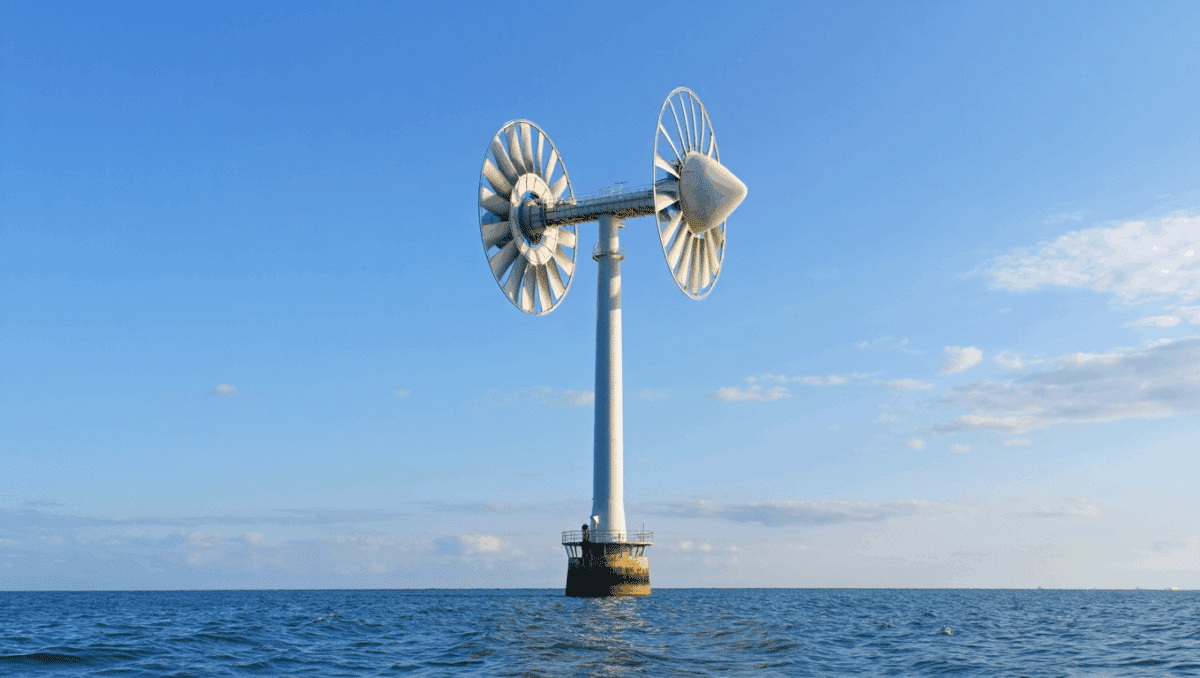
The existing twin-rotor system—marketed under the OceanX name—pairs two turbine rotors on angled towers mounted to a single floating foundation. That layout aims to extract more energy from the same wind column by using counter-rotating blades and an optimized platform footprint. The new version under development targets a single-unit capacity near 50 MW and is slated for a 2026 debut.
How dual rotors increase efficiency and reduce the number of turbines
Conventional offshore farms achieve higher output by deploying many individual turbines. The twin-rotor approach looks to multiply the generation per structure instead. Key performance ideas include:
- Counter-rotating rotors that can improve energy capture compared with two separated units.
- Shared drivetrain and platform costs, potentially reducing capital expenses per megawatt.
- Fewer foundations and moorings for the same aggregate capacity, shrinking seabed disturbance and layout complexity.
Ming Yang’s engineers argue that larger, high-output units could dramatically lower the levelized cost of energy (LCOE). Company leadership has suggested the new turbines could cut per-kilowatt prices in certain Chinese markets to a small fraction of current European offshore costs, though independent validation will be essential.
Performance, durability and lessons from extreme-weather trials
China’s offshore fleet has been tested by severe storms, and Ming Yang has invested in mooring and platform designs meant to withstand tropical cyclones. The company says its typhoon-resistant floating mooring systems passed a critical test when a major storm swept across an area with a large concentration of turbines, leaving the units intact and operational.
That real-world resilience matters as developers push turbines farther offshore and into harsher wind regimes. At the same time, prototype tests have exposed engineering challenges: high loads on the twin rotors have, in some trials, caused blade damage. Engineers are iterating on materials, control systems and structural reinforcements to address those failure modes.
Environmental impacts: concerns and ways larger turbines could help
Offshore wind draws sharper ecological scrutiny than land-based projects because of potential effects on birds, marine mammals, seafloor habitats and coastal economies. Research to date is growing but remains limited given how recently many large offshore farms have been built.
Principal environmental issues raised
- Bird displacement and collision risks: studies show population-level impacts depend on species, migration routes and farm location.
- Marine mammal disturbance from construction noise and operational presence.
- Seabed and sediment disruption related to foundations and mooring installation.
- Visual and tourism concerns for coastal communities near deployment zones.
How high-output turbines could reduce local impacts
- Fewer installations needed for equivalent capacity, lowering the total footprint across sea lanes and habitats.
- Smaller foundation or mooring count, meaning reduced seabed disturbance during installation.
- Potential to site energy production farther offshore where interactions with wildlife and recreation are less intense.
Choosing larger, more powerful units is not a panacea, but it offers a tangible path to minimize the number of structures in sensitive areas if developers prioritize ecological siting alongside capacity goals.
Timeline, market effects and wider implications for offshore wind
Ming Yang has begun marketing the larger twin-rotor model and signaled production could start within the next year, with a formal product introduction expected in 2026. Early deployments—already underway for smaller twin-rotor units—offer a preview of how the machines perform when integrated into commercial wind farms.
Potential market effects include:
- Lower capital and operational cost per megawatt if scaling and reliability targets are met.
- Faster build-out of large-capacity projects with fewer individual foundations and platforms.
- Shifts in supply chain demand toward larger composite blades, heavier-duty drivetrains and more robust floating platforms.
Some developers see the twin-rotor, high-capacity concept as a way to reduce the number of turbines in ecologically sensitive corridors such as migration routes and whale habitats, while grid planners are watching to understand how such large, individual units would affect power balancing and transmission design. If a single turbine can reliably deliver tens of megawatts, electrical infrastructure and project layouts will need to adapt accordingly.
You might also like:
- High-altitude airship-style wind turbine taps stronger gusts for cheaper, steadier power
- Offshore wind turbine prototype powers onboard data center while ocean disperses heat
- Offshore wind right upheld by US judge for 5th time since White House attempted ban
- Dutch Designers Innovate: Tiny Home Inside Recycled Wind Turbine Unveiled!
- Antarctic wind farm cuts diesel use by 122,000 gallons over 15 years at McMurdo Station

Michael Thompson is an experienced journalist covering U.S. and global news. With ten years on the front lines, he breaks down political and economic stories that matter. His precise writing and keen attention to detail help you grasp the real‑world impact of every event.


Man, imagine a two-headed wind turbine! Thats some sci-fi stuff right there. If it helps the offshore wind industry and the environment, count me in. Lets see if this dual-rotor beast lives up to the hype.
Oh man, a two-headed wind turbine? Thats some next-level sci-fi stuff! Count me in too if its gonna help the environment. Can you picture the sea with this dual-rotor beast spinning away? Lets hope its not just hype and actually makes a difference out there!
Man, imagine a wind turbine with two heads. Thats like having a two-headed dragon guarding the sea! Wonder if this double trouble design will really tackle those offshore wind challenges or just cause more headaches. Lets see if this twin-rotor beast can slay the efficiency game!
Man, this two-headed wind turbine idea is like something out of a sci-fi flick! Cant wait to see if it lives up to the hype. Double the rotors, double the power? Count me in!
Oh, so now were talking about two-headed wind turbines? Thats some sci-fi stuff right there! Cant wait to see if this dual-rotor contraption really shakes things up in the offshore wind game. Double the blades, double the power, right?
Ive always thought wind turbines look like giant pinwheels. Now theyre talking about a two-headed turbine? Thats some sci-fi stuff! Cant wait to see if it really solves those offshore wind challenges. Exciting times!
I once saw a sci-fi flick with a two-headed alien, now its like realitys copying movies! Dual rotors on wind turbines? Whats next, flying cars and teleportation devices? Exciting times were living in, folks!
Man, this dual-rotor wind turbine is like the dynamic duo of the offshore wind world! Its all about efficiency and durability, cutting down on those turbines cluttering up the ocean. Cant wait to see these bad boys in action!
Man, imagine a two-headed wind turbine! Its like that two-faced friend who talks outta both sides, but this time its actually useful. Efficiency boost and fewer turbines? Count me in! Lets see this twin-rotor beast in action!
Dang, thats some mad scientist-level innovation right there! Two heads are better than one, eh? Efficiency AND fewer turbines? Sign me up for that double trouble wind wizardry! Cant wait to see this powerhouse in action. Twin-rotor beast gonna rule the wind farm!
Man, this dual-rotor turbine sounds like a sci-fi dream come true! Can you imagine those massive blades spinning in sync? Hope it lives up to the hype and helps the environment for real.
Man, a two-headed wind turbine sounds like something out of a sci-fi flick! But for real, if its gonna help tackle offshore wind challenges, Im all for it. Innovation is the name of the game, right? Lets see how this bad boy performs!
Man, a two-headed wind turbine? Thats some sci-fi stuff right there! Can you imagine the energy we could harness with that bad boy? Hope it really shakes things up in the offshore wind game!
You know, its like when youre trying to solve a Rubiks Cube and then someone comes up with a two-headed version! This twin-rotor turbine sounds like the offshore wind industrys cool new puzzle solver. Efficiency on steroids, right?
Man, these dual-rotor wind turbines are like the Wonder Twins of renewable energy! Its like theyre tag-teaming the offshore wind industry challenges. Cant wait to see if they live up to the hype. Two heads are better than one, right?
Man, aint it wild how techs evolving? Dual-rotor turbines sound like something outta sci-fi! Cant wait to see how they tackle efficiency and environmental concerns. Innovations the name of the game!
Man, talk about futuristic vibes! Can you imagine the sight of a two-headed wind turbine out there? Its like something out of a sci-fi flick. Gotta give props to the folks behind this innovation. Lets hope it lives up to the hype, though!
Man, imagine a wind turbine with two heads! Thats some sci-fi stuff right there. But if it can crank up efficiency and cut down on turbines, why not? Lets see if it stands up to the real deal.
A retired sailor here, and I gotta say, this two-headed wind turbine idea reminds me of those old tales of sea monsters with double heads! If it can tackle the challenges at sea like those beasts, count me impressed!
Man, imagine the sight of a two-headed wind turbine out there in the sea! Its like a sci-fi movie coming to life. But hey, if it can help with efficiency and environmental impact, count me in! Lets power up those waves, baby!
Man, imagine a two-headed wind turbine? Thats some sci-fi stuff right there. But hey, if it can tackle industry challenges, Im all for it. Innovation never sleeps, huh?