
Show summary Hide summary
- Back on the West Bank: towering restorations reshape Luxor’s landscape
- Who was Amenhotep III and why these Colossi matter
- From rubble to re-erection: the archaeology and teams behind the work
- Condition reports: what remains and what was rebuilt
- How an ancient earthquake shaped the task
- Broader discoveries and what’s next for Luxor archaeology
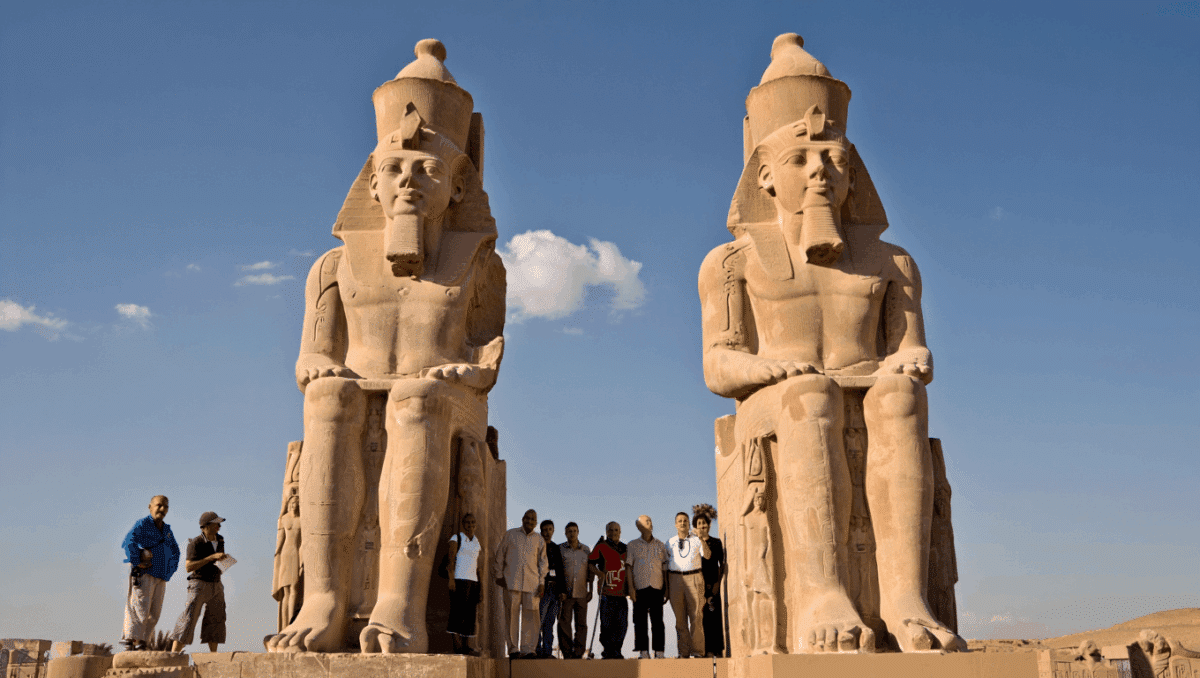
The vast forms of two ancient kings have returned to Luxor’s skyline after a careful, decades-long revival. Tourists and researchers watched as alabaster giants that had lain in fragments for more than a millennium were lifted, rebuilt and set upright again—an archaeological comeback that blends patient detective work with modern conservation.
The project, centered on statues of Amenhotep III, reconnects a site once shattered by seismic violence with a much older royal vision. The restored works now stand along the Nile’s west bank, drawing fresh attention to Egypt’s ongoing efforts to preserve and present its past for the world.
Back on the West Bank: towering restorations reshape Luxor’s landscape
The two newly reassembled figures rise more than 30 feet and mark the reappearance of monumental statuary at a mortuary complex long associated with Amenhotep III. Carved from Egyptian alabaster quarried at Hatnub, the sculptures represent the pharaoh in the traditional royal pose, gazing east and wearing the striped nemes headdress. Their presence restores part of an ancient visual program once aimed at linking the ruler to divinity and the rising sun.
The Growing Demand for Data-Driven Decision Making in Silicon Valley
He quit, ran out of money, and begged to come back — here’s how his boss reacted
Visitors and local observers noted the scale of the undertaking: aligning heavy stone fragments, recreating lost elements where necessary, and lifting the statues into position without compromising the original material. The project reintroduces a dramatic focal point to Luxor’s tourist and archaeological circuit.
Who was Amenhotep III and why these Colossi matter
Amenhotep III ruled during the 18th Dynasty in the 14th century BCE, presiding over one of ancient Egypt’s most prosperous and artistically flourishing eras. His mortuary temple once boasted dozens of grand sculptures and architectural elements intended to commemorate his reign and perpetuate his cult.
- Political and religious significance: These statues were not mere portraits; they were part of a funerary landscape designed to project royal power and divine association.
- Artistic achievement: The size and workmanship of the alabaster pieces reflect technical sophistication in quarrying and carving.
- Continuity of memory: Reassembling such works reconnects modern viewers with ancient rituals, iconography and statecraft.
From rubble to re-erection: the archaeology and teams behind the work
The restoration traces back to a collaboration formed in the late 1990s, when an Egyptian-German mission began surveying the mortuary complex. Led by noted Egyptologist Hourig Sourouzian, the international team cataloged fragments, tested conservation approaches and planned how to recompose the original images where possible.
Thirty years of methodical fieldwork and conservation science
The process combined archaeological documentation, stone analysis, structural engineering and carefully selected conservation materials. Specialists:
- Recorded the exact location and orientation of each fragment;
- Matched fragments to reconstruct the intended poses and proportions;
- Applied consolidation treatments to fragile surfaces and joints;
- Used lifting systems designed to protect original stone during reassembly.
In a formal announcement, the Supreme Council stressed that restoration efforts followed international best practices. The work used materials compatible with the alabaster and relied on the latest scientific methods to protect both the stone and the statues’ long-term stability.
Condition reports: what remains and what was rebuilt
Conservators found that the two figures survived in complementary ways. One statue retained a more complete torso and head—its facial features largely intact and the cobra (uraeus) on the forehead of the nemes still visible. The other preserved both legs, which filled gaps where the first statue had lost lower limbs. Together, the fragments allowed teams to recompose the pair with a high degree of historical fidelity.
- Right-hand figure: more intact head and torso, facial features preserved, including the nemes ornamentation.
- Left-hand figure: better-preserved lower limbs, helping to restore balance to the pair when reassembled.
Engineers and conservators paid special attention to joining ancient surfaces while minimizing new interventions. Where replacement materials were required for structural support, they were chosen to be reversible and visually compatible.
How an ancient earthquake shaped the task
Historical and geological evidence point to seismic activity around 1,200 years ago as a major cause of the statues’ collapse. Over the centuries, scattered fragments were buried, weathered by sand and soot, and in some cases reused or moved. That long interval of disruption made the reconstruction a complex jigsaw, requiring careful stratigraphic reading and cross-referencing with earlier records.
Archaeologists relied on older excavation notes, photographs, and comparative studies of similar statuary to ensure that reassembly honored the original compositions and iconographic details.
Broader discoveries and what’s next for Luxor archaeology
The Colossi reinstallation complemented a series of finds and conservation projects across Luxor in recent years. Teams working in the area have also:
- Unearthed ancient tombs dating back more than 3,000 years;
- Revealed finely preserved murals after careful cleaning of centuries of sand and smoke;
- Negotiated repatriations and museum collaborations for artifacts removed in past centuries.
These efforts are part of a larger cultural-heritage strategy that pairs archaeological research with museum displays and tourism planning, aiming to present Egypt’s antiquities with both scientific rigor and public accessibility.
You might also like:
- 3,200-year-old tomb found in Luxor dates to Ramses era
- Ancient Egyptian crypt in Luxor with 22 singing priests unsealed for first time
- Egypt sun temple uncovered: 4,500-year-old site reveals ancient sun worship
- Pharaoh’s daughters were skilled archers 4,000 years ago, new study finds
- 3,500-year-old looted Egyptian stone bust returned by the Netherlands after lavish museum opening

Michael Thompson is an experienced journalist covering U.S. and global news. With ten years on the front lines, he breaks down political and economic stories that matter. His precise writing and keen attention to detail help you grasp the real‑world impact of every event.


I remember learning about Amenhotep III in school! These Colossi rising up again after 30 years is like history coming back to life. Makes you wonder what stories these statues could tell if they could talk, right?
Man, these colossal statues coming back to life after 30 years? Thats some serious dedication. Imagine the stories they could tell if they could talk. Wonder what the pharaoh would say about all the fuss!
Man, these colossal statues in Luxor coming back to life after three decades? Its like a history-themed soap opera! Wonder if the pharaohs left any hidden messages in there… Or maybe just a recipe for a killer ancient dish!
Man, these statues in Luxor coming back to life after three decades? Its like a real-life time travel gig! Imagine witnessing the ancient Pharaohs legacy stand tall again. History buffs, eat your heart out!
Man, these statues in Luxor waking up after three decades? Its like a legit time travel show! Picture being there when the ancient Pharaohs legacy rises again. History buffs, prepare to lose your minds!
Man, those Luxor statues got a glow-up after 30 years! Amenhotep IIIs giant stone buddies be flexin again. Cant imagine the sweat put into restoring those colossal bad boys. Worth a visit, fo sho.
Man, seeing those Luxor statues back up after 30 years? Its like a history buffs dream come true! The patience and skill it takes to restore such ancient wonders, gotta give props to the teams behind it all.
I remember visiting Luxor as a kid and these statues were just – bam – colossal! Glad theyre standing tall again after all that restoration work. Hats off to the teams for preserving history!
Man, these colossal statues coming back to life after three decades? Its like a history reboot, but for real, right in front of our eyes! Makes you wonder what other ancient wonders could get a facelift.
Dang, these statues waking up after a three-decade nap got me thinking too, man! Like, what if the Pyramids suddenly started blasting some ancient beats? Or the Colosseum turned into a giant disco ball? Imagine the chaos, bro! Its like history hitting the refresh button, but with a wild twist! Wonder where this reboots gonna take us next…
I remember seeing those colossal statues in Luxor when I was a kid. Took em 30 years, but hey, better late than never, right? Cant wait to visit and see those bad boys stand tall again!
Man, these colossal statues rising again after all these years? Thats some next-level restoration work! Makes you wonder about the stories these monuments could tell if they had a voice, right?
Geez, those colossal statues in Luxor are like the OG influencers of ancient Egypt, right? Standing tall after 30 years of restoration, talk about timeless beauty. Wonder if they had a skincare routine back then!
Man, those colossal statues coming back to life in Luxor after three decades? Its like history hitting the refresh button! Can you imagine the stories those ancient stones could tell if they had mouths? Crazy, right?
Imagine if those ancient stones could actually talk, right? Itd be like getting a front-row seat to the ultimate history podcast! Today on Stones and Stories: Tales from Luxors Colossal Statues. Bet theyd spill the tea on all the drama and secrets from back in the day. Time to grab some popcorn and tune in to the stone-age gossip show!
Man, those Luxor statues coming back to life after all that time? Its like a history remix, bringing the past into the present. Wonder what stories those colossal pharaohs could tell after their makeover.
I remember learning about Amenhotep III in school! These colossal statues bring history to life. Its like time-traveling back to ancient Egypt, standing in awe of the past. Such meticulous restoration work deserves a round of applause!
Man, aint it crazy how those ancient statues can make you feel like youre right there in the middle of Pharaoh land? Its like a time machine to Egypt! And yeah, big props to the restoration crew for keeping history alive, one statue at a time. Cheers to that!