
Show summary Hide summary
- Ziggurat of Ur: why this ancient temple still matters
- What the current preservation project includes
- Recreating 5,000-year-old brick: materials and methods
- Past restorations and why authenticity matters
- Environmental threats: why the northern face is prioritized
- How Ur fits into a wider global preservation effort
Iraq has launched a focused conservation campaign at the ancient Ziggurat of Ur to shield the millennia-old monument from accelerating weathering and shifting climate patterns. The work aims to stabilize exposed original masonry and keep one of the world’s earliest urban landmarks intact for future generations.
Built in the early 2nd millennium BCE and standing among the best-known examples of Sumerian architecture, the Ziggurat of Ur draws global attention not only for its antiquity but for the delicate challenge of preserving mudbrick structures in a changing environment.
Ziggurat of Ur: why this ancient temple still matters
The Growing Demand for Data-Driven Decision Making in Silicon Valley
He quit, ran out of money, and begged to come back — here’s how his boss reacted
Located in southern Iraq, the Ziggurat of Ur is a UNESCO World Heritage Site and one of the oldest surviving monumental structures from early urban civilization. Archaeological evidence places its major construction phase in the 21st century BCE. At its peak, the platform measured roughly 210 by 148 feet and may originally have reached nearly 100 feet high, though the exact original height remains subject to scholarly debate.
Historically, the stepped platform served as a temple complex dedicated to the moon god—identified in ancient sources as Nanna or Sin—and formed the spiritual center of a broad settlement that expanded dramatically under powerful Sumerian dynasties.
What the current preservation project includes
The Iraqi authorities have allocated approximately $382,000 to conserve the exposed upper layers of the ziggurat. The program focuses on halting erosion, repairing damaged bonds between bricks, and replacing vulnerable surfaces with materials that closely match the originals.
Key targets and priorities
- Stabilizing the northern facade, which has suffered heavy wind and sand abrasion;
- Rebuilding and protecting sections where ancient mudbrick is exposed;
- Using historically appropriate techniques and materials rather than modern, incongruous substitutes.
Recreating 5,000-year-old brick: materials and methods
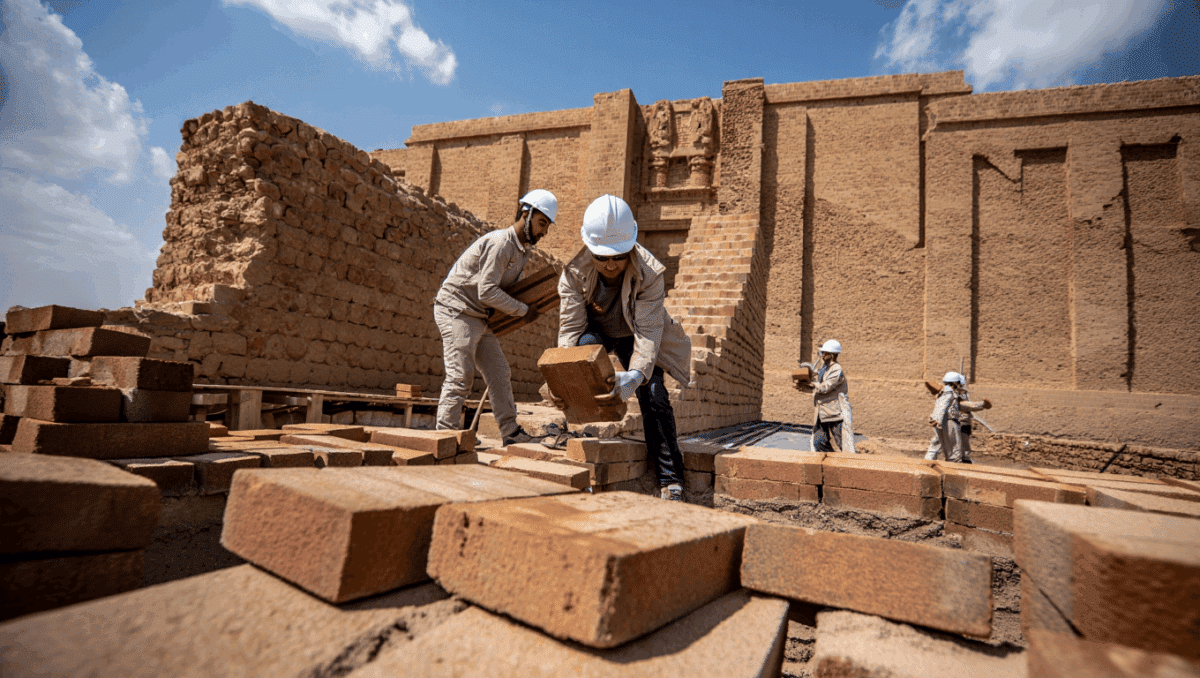
Unlike many large restorations that rely on contemporary mass-produced bricks, the conservation team at Ur is striving for authenticity. Specialists sampled original paving bricks and developed replicas that match the chemical composition and physical properties of the ancient units. Clay for new mudbrick has been sourced from environments analogous to the original site and prepared by hand on location.
These traditional methods aim to ensure new bricks behave like the old ones under seasonal temperature swings and exposure to wind-blown sand, reducing the risk that modern repairs will cause additional stress or accelerated decay.
Typical steps in the onsite reconstruction
- Documentation and sampling of surviving brick layers;
- Laboratory analysis to match mineral and organic components;
- Onsite production of air-dried mudbrick using locally sourced clay;
- Careful replacement and repointing to integrate new bricks with existing structures;
- Protective measures to shield vulnerable faces from future sand and wind erosion.
Past restorations and why authenticity matters
The ziggurat has a long conservation history. Repairs were undertaken in antiquity—most notably under the Neo-Babylonian ruler Nabonidus in the 6th century BCE—and more recently during the 20th century. Some of the visible facades and staircases were rebuilt in the late 20th century, a project associated with Saddam Hussein’s regime. Those later interventions helped make the monument visually imposing but did not cover all of the original brickwork and sometimes relied on materials that differ from the ancient fabric.
By contrast, the current approach emphasizes matching material behavior and texture, so interventions age together with the original construction rather than standing out or causing unintended damage.
Environmental threats: why the northern face is prioritized
The ziggurat’s northern side has borne the brunt of sandblasting and wind-driven decay in recent decades, becoming a primary focus for the conservation team. Increased desertification and changes in precipitation patterns linked to regional climate trends have amplified the rate of surface loss.
Wind erosion, sand accumulation, and salt crystallization are the chief mechanisms undermining mudbrick platforms like Ur’s—problems that require both immediate repairs and lasting, material-sensitive solutions.
How Ur fits into a wider global preservation effort
Across low- and middle-income nations, cultural heritage teams face similar dilemmas: balancing limited budgets with the need to protect ancient materials from modern threats. While some projects adopt conspicuous modern materials, others—like the team at Ur—prioritize historically compatible techniques. This trend underscores a growing conservation philosophy that combines scientific analysis with traditional craft.
Examples worldwide show a spectrum of approaches, from large-scale stone lifting and reconstruction projects to subtle in-situ repairs that emphasize materials science and environmental adaptation. In Ur’s case, the choice to reproduce ancient brick chemistry and to hand-craft replacement materials reflects an effort to preserve both the monument’s appearance and its long-term structural behavior.

You might also like:
- 143-year-old shipwreck resurfaces on New Jersey beach
- Historic train station converted into inn by couple after 30-year restoration
- Great Pyramid of Giza could be older than believed, new study finds
- London building materials diverted from landfill for reuse
- Luxor colossal statues of an ancient pharaoh stand again after 30 years of restoration

Michael Thompson is an experienced journalist covering U.S. and global news. With ten years on the front lines, he breaks down political and economic stories that matter. His precise writing and keen attention to detail help you grasp the real‑world impact of every event.


Man, they’re really going all out with those bricks, huh? Gotta hand it to Iraq for keeping that ancient vibe alive. Wonder if theyll start wearing loincloths next!
Man, those Iraqis are really stepping up their preservation game! Using bricks that match the original ones from 5,000 years ago for the Ziggurat of Ur? Thats dedication to history right there. Cant wait to see the final result!
Man, talk about dedication! Matching those bricks to the original ones from 5,000 years ago? Thats like a time-travel level of commitment! Major props to Iraq for preserving that ancient gem. Hope they nail it!
Dang, talk about time-travel vibes! Matching up those ancient bricks like its a blast from the past! Iraqs dedication deserves a standing ovation for preserving that historical treasure. Lets hope they knock it outta the park!
Man, these folks in Iraq are playing the long game with that Ziggurat of Ur preservation. Matching 5,000-year-old bricks? Thats dedication! Cant even keep my socks paired for that long. Hats off to em!
I remember when I tried to build a tiny version of the Ziggurat of Ur in school using Legos. Now, seeing Iraqs effort to preserve the real deal with matching bricks is like a full-circle moment. Hope they nail it!
Man, those Iraqi craftsmen are out there killin it with the Ziggurat of Ur restoration! Matching 5,000-year-old bricks? Thats some dedication! Cant wait to see this ancient temple shine like new again.
Dude, those Iraqi crafters are straight-up legendary! Rebuilding the Ziggurat of Ur with ancient bricks? Thats some serious commitment right there. Can you imagine the stories those stones could tell if they could talk? Mad props to those folks for giving this ancient gem a fresh new glow.
Man, those folks in Iraq aint playin around with history! Matching bricks for the Ziggurat of Ur? Thats some dedication. Makes you think how epic ancient architecture still got us buzzin today.
For real, right? Talk about putting in the elbow grease for some ancient LEGO! Those Iraqis are on another level with their dedication to preserving history. Makes you wonder if folks centuries from now will be geeking out over our skyscrapers like we do over these Ziggurats. Timeless vibes, man.
Man, those Iraqis are doing it right with those ancient bricks! Preserving history like a boss. Hope they get the recognition they deserve for this epic restoration work. Props to them!
Man, those ancient builders knew their stuff! Using the same bricks after 5,000 years? Thats some next-level preservation game. Imagine if our modern buildings lasted that long… Wed have a lot less construction work, thats for sure.
Man, those Iraqis dont mess around with history! Using bricks just like the ones from 5,000 years ago to restore the Ziggurat of Ur? Thats some serious dedication to preserving ancient glory. Hope they get it right!
I remember the first time I saw the Ziggurat of Ur in pictures. It was like something out of a fantasy movie, but real. Knowing theyre using the original bricks for preservation? Thats like time travel, man.
Man, those bricks in the Ziggurat of Ur preservation are like time travelers! Matching the 5,000-year-old originals? Thats some serious dedication. Hope they nail it and keep that ancient vibe alive!
Man, those Iraqis aint playin with history! Using old-school bricks for the Ziggurat of Ur? That’s some legit dedication right there. Imagine the craftmanship back then, 5000 years ago. Crazy impressive!
Dude, totally feelin ya on that! Like, imagine hustlin 5000 years ago, under that blazing sun, puttin together those massive bricks like its no big deal. Mad respect for the OG builders, man. That ziggurat aint messin around!
Man, talk about dedication! Using original bricks to preserve the Ziggurat of Ur is like stepping back in time. Hope they get it right, cant have an ancient wonder falling apart on us!
I mean, using original bricks for the Ziggurat of Ur? That’s some serious commitment to history, dude. Gotta admit, its pretty awesome seeing them put in the effort to keep that ancient wonder intact. Cant have it crumblin on us, right? Hope they nail it!