
Show summary Hide summary
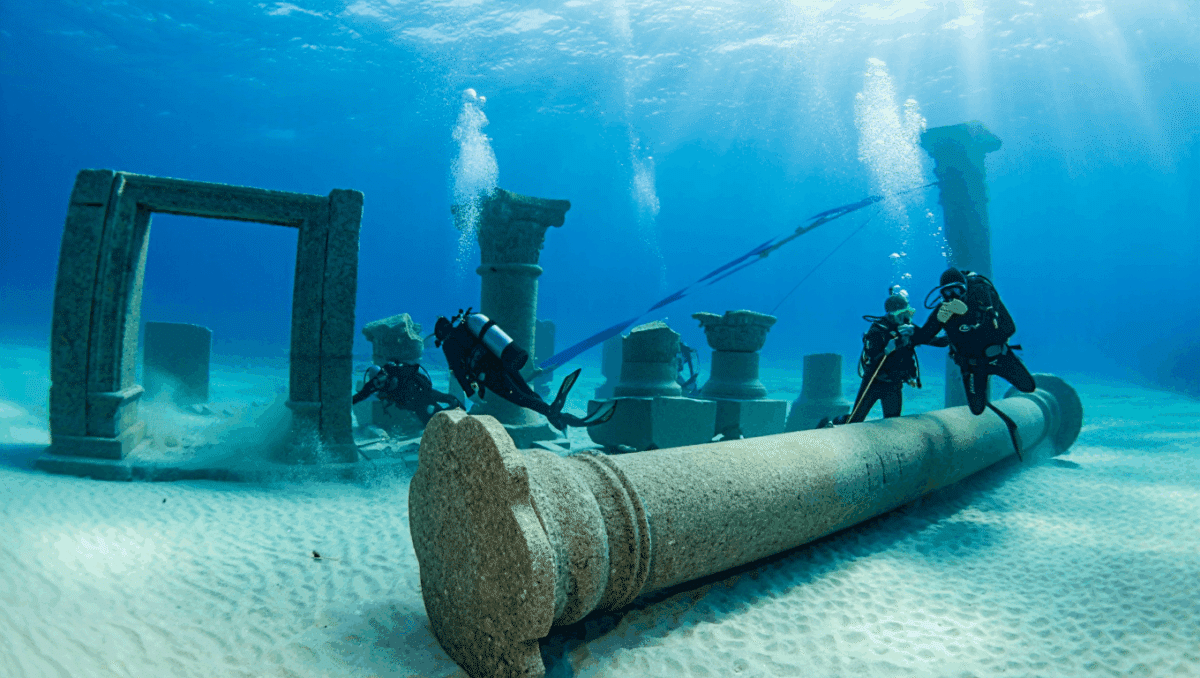
Divers have hauled 22 massive granite stones from the seabed of Alexandria’s ancient harbor, giving archaeologists fresh material to study one of antiquity’s most legendary monuments. The recovered pieces — columns, frames and heavy lintels that once formed the Great Lighthouse — are being digitally documented so researchers can virtually reconstruct how the structure was built and how it eventually collapsed.
The effort blends careful underwater recovery with cutting-edge photogrammetry and 3D modeling, offering a rare chance to examine tool marks, weathering patterns and stone joins without permanently removing large artifacts from the sea.
Underwater recovery: what was brought to the surface and why it matters
The Growing Demand for Data-Driven Decision Making in Silicon Valley
He quit, ran out of money, and begged to come back — here’s how his boss reacted
Teams from France’s National Center for Scientific Research (CNRS) and Egypt’s Center for the Studies of Alexandria (CEAlex) coordinated the project. Over more than a decade of survey and dives, they cataloged thousands of remains scattered across the harbor floor and selectively raised the largest, most informative elements for study.
- 22 massive granite blocks were lifted for analysis; each weighed multiple tons and included upright pillars, structural frames and heavy lintels that once framed entrances.
- The wider survey, begun years earlier, identified roughly 3,000 larger blocks and an additional 5,000 fragments spread across about four acres of seabed.
- Because of conservation rules and the material risks of long-term immersion, many of the biggest stones were photographed and then returned to their original positions.
Every stone that was raised underwent exhaustive photographic documentation. High-resolution imagery feeds a photogrammetry database, enabling researchers to reconstruct each artifact in three dimensions with millimeter-scale accuracy. That digital archive preserves surface details — from rough quarry faces to tiny chisel marks — before any change can occur during drying or handling.
Turning stones into a digital lighthouse: techniques and team
Isabelle Hairy and her CNRS colleagues led the virtual reassembly effort, using the photogrammetric models as building blocks for a full-scale digital reconstruction. The approach lets archaeologists test thousands of hypothetical configurations without risking damage to the originals.
Digital modeling accomplishes several key tasks:
- Aligning individual pieces by matching tool marks and fracture patterns.
- Testing mechanical fits to determine which blocks likely sat next to each other.
- Simulating failure scenarios — for instance, applying modeled earthquake forces to see which joints would fail first.
These simulations are not just academic exercises. They help reconstruct the lighthouse’s structural logic and provide insight into how seismic events over centuries finally toppled what the ancients called a wonder.
What the stonework tells us about culture and reuse
Analysis of decorative imagery and carving techniques reveals a mix of cultural influences. Several recovered blocks carry Egyptian motifs while exhibiting Hellenistic workmanship, reflecting the Ptolemaic era’s blending of traditions. Intriguingly, the team suspects some granite elements were quarried long before the lighthouse was built — possibly taken from the Old Kingdom site at Abu Rawash — which would mean parts of the monument reused material that was already millennia old.
- Hellenistic carving methods applied to Egyptian iconography indicate cross-cultural craftsmanship under the Ptolemies.
- Possible reuse of ancient monoliths suggests builders repurposed earlier stones, extending the site’s layered history.
Historical accounts emphasize the lighthouse’s monumental scale and impact on sailors. Medieval travelers struggled to convey its size and complexity; one visitor reported that descriptions fell short and that its internal stairways, rooms and passageways made it easy to become disoriented — testimony to the structure’s sheer scale and intricacy.
Why some stones were returned and the limits of recovery
Egyptian conservation rules place strict limits on removing submerged artifacts. Authorities do not allow recovery of items weighing more than 100 kilograms (about 220 pounds) to prevent irreversible damage when salt-saturated stone is suddenly exposed to oxygen. Salt crystals that have grown within fissures while submerged can expand and cause catastrophic flaking and loss during drying.
Consequently, although the largest elements were documented in detail, the most massive monoliths were lowered back to the seabed after recording. This compromise preserves the physical artifacts in situ while creating a digital surrogate that scholars and the public can study.
From lab to public imagination: virtual displays and earthquake forensics
The assembled 3D model offers multiple paths for interpretation and outreach. With precise digital joins and faithful surface textures, the virtual lighthouse could:
- Serve as the basis for immersive museum displays or augmented reality experiences in Alexandria’s harbor area.
- Allow engineers and seismologists to run more realistic collapse scenarios by applying forces and constraints to the model.
- Help curators plan future conservation and in situ protection by identifying which fragments are most vulnerable.
With more pieces recovered and cataloged over time, the digital reconstruction may improve further — potentially enabling projections or holographic renderings that let visitors visualize how the lighthouse once stood over the Mediterranean, guiding ships for centuries before a series of earthquakes reduced it to ruins in the medieval period.
You might also like:
- Roman stone-lined basin discovered predates concrete, reveals advanced engineering
- Britannic bell, other artifacts recovered by deep-sea divers from Titanic’s sunken sister ship
- Shipwrecks of Caribbean pirates found and filmed for the first time
- 500,000-year-old wooden tools are the oldest ever discovered
- Mammoth tusk patterns reveal prehistoric humans made unique cave art, study finds

Michael Thompson is an experienced journalist covering U.S. and global news. With ten years on the front lines, he breaks down political and economic stories that matter. His precise writing and keen attention to detail help you grasp the real‑world impact of every event.


Man, the Lighthouse of Alexandria saga feels like an epic movie plot. Imagine those ancient blocks unveiling secrets of construction! Its like a historical treasure hunt, but with giant stones and underwater mysteries. Cant wait for the next reveal.
I remember readin bout the Lighthouse of Alexandria in school! Crazy how theyre still findin stuff from back then. Makes ya wonder what else is hidden deep down there, huh? Excitin times were livin in!
Man, finding those ancient blocks is like uncovering a history book written in stone! Its wild how those pieces shed light on the construction of the Lighthouse of Alexandria. Makes you think about the mad skills our ancestors had, huh?
Man, I always get hyped when they dig up ancient stuff. The Lighthouse of Alexandria? Thats some real-life history unraveling right there. Wonder what other secrets those old blocks are hiding. Time to play detective!
Man, those ancient builders really knew their stuff, huh? Like, raising those massive blocks for the Lighthouse of Alexandria? Thats some next-level engineering! Makes you wonder what other mind-blowing secrets are still waiting to be uncovered down there.
Totally, right? Those ancient builders were on a whole other level with their engineering game! Imagine the sweat and muscle it took to hoist those colossal blocks for the Lighthouse of Alexandria. Its mind-blowing to think about what else is hidden beneath our feet. Like, what other jaw-dropping wonders are just waiting to be dug up? Who knows what other ancient marvels are lurking down there, ready to blow our minds!
Man, diving into the mysteries of the Lighthouse of Alexandria feels like uncovering a treasure trove! Those ancient blocks are like time travelers, shedding light on their construction secrets. Cant wait to see what tales they have to tell.
Man, those ancient folks really knew how to build stuff. The Lighthouse of Alexandria is like the OG skyscraper, standing tall with its ancient blocks. Can you imagine the stories those stones could tell if they could talk?
Man, those ancient builders really knew how to make a statement with the Lighthouse of Alexandria. Can you imagine the sweat and tears that went into stacking those massive blocks? Its like the original skyscraper of the ancient world!
Man, these ancient builders were on another level with the Lighthouse of Alexandria! Bringing those massive blocks up from the depths? Thats some serious dedication. I can barely haul my laundry up the stairs, yknow?
Dang, those ancient builders were next-level with that Lighthouse of Alexandria, huh? Draggin massive blocks around like its no big deal. I feel ya, buddy. I struggle just luggin my laundry up a flight of stairs, and theyre out there playin real-life Tetris with giant rocks. Talk about some serious hustle, man!
I remember reading about the Lighthouse of Alexandria in my history class! Its fascinating how theyre recovering those ancient blocks. Makes you wonder what stories those stones could tell if they could talk, right?
Man, reading about the Lighthouse of Alexandria always gets me hyped! Imagine the ancient engineers lifting those massive blocks… Talk about dedication and skill. Its like a real-life puzzle that keeps on giving!
Heck yeah, man! Those ancient engineers really knew how to flex their skills back in the day. Its like watching a history documentary on steroids! The Lighthouse of Alexandria is like the OG version of those crazy intricate Lego sets, but on a colossal scale. Respect to those dudes for playing the ultimate game of Jenga with giant stone blocks!
Man, hearing about those ancient blocks from the Lighthouse of Alexandria is wild! Its like a historical puzzle coming together. Makes me wonder what other ancient secrets are waiting to be unearthed. Exciting stuff!
Absolutely, mate! Uncovering those ancient blocks from the Lighthouse of Alexandria is like diving headfirst into a history mystery. Who knows what other mind-blowing secrets are just waiting to be dug up? Its like being Indiana Jones without the hat and whip, innit? Gotta love that rush of excitement when the past comes alive!
Man, reading about the Lighthouse of Alexandria makes me feel like Im uncoverin a hidden treasure! Those ancient blocks spillin secrets about how they built that marvel back in the day. Its like time travel with a touch of archaeology!
Dude, totally get what you mean! Its like digging up ancient juju, right? Those old stones got stories to tell, man. Its like were time-hopping, exploring the OG blueprints of epicness. Makes you wonder what other ancient goodies are just waiting to be unearthed, huh?
Man, reading about the Lighthouse of Alexandria feels like time-traveling back to an ancient construction site! Those raised blocks shedding light on the building process are like puzzle pieces of history. Cant wait to see what else they uncover underwater!
Man, imagining those ancient peeps hoistin those huge blocks for the Lighthouse of Alexandria — crazy! Wonder what theyd think of our tech today. Bet theyd be like, Whaaat? No way, dudes! Just wild how they built that thing back in the day.
For sure, man! Imagine those ancient builders, luggin those massive blocks around like its a walk in the park. Bet theyd be trippin over our tech today, like, What in the world, dudes?! Its mind-blowin how they pulled off the Lighthouse of Alexandria back then. Just goes to show, our ancestors were no joke when it came to engineering marvels!
Man, these ancient builders really knew how to make a statement with the Lighthouse of Alexandria. Talk about impressive craftsmanship! Makes me wonder what other architectural marvels are still waiting to be uncovered. Time to grab a shovel and start digging!