
Show summary Hide summary
- What the ISS experiment actually did and why it matters
- How microbes free metals from rock — the science of bioleaching
- Parallel Earth-based work and international collaboration
- Why asteroid and lunar mining are becoming a strategic focus
- Industry interest and emerging technologies for space resource recovery
- Hurdles and the research path ahead
- What to watch next in space resource science
Last week, researchers aboard the International Space Station proved that tiny organisms can pull high-value metals out of meteorite material — a development that could reshape how we think about resource extraction in space. Using meteorite fragments and microbial cultures, astronauts and scientists demonstrated that living systems can selectively recover platinum-group metals that are in growing demand for spacecraft and electronics.
This is not just a laboratory curiosity. With missions pushing humans farther from Earth, harvesting materials where they already exist — on asteroids, the Moon, or in orbital debris — could drastically cut costs and open new supply chains for deep-space exploration.
What the ISS experiment actually did and why it matters
The Growing Demand for Data-Driven Decision Making in Silicon Valley
He quit, ran out of money, and begged to come back — here’s how his boss reacted
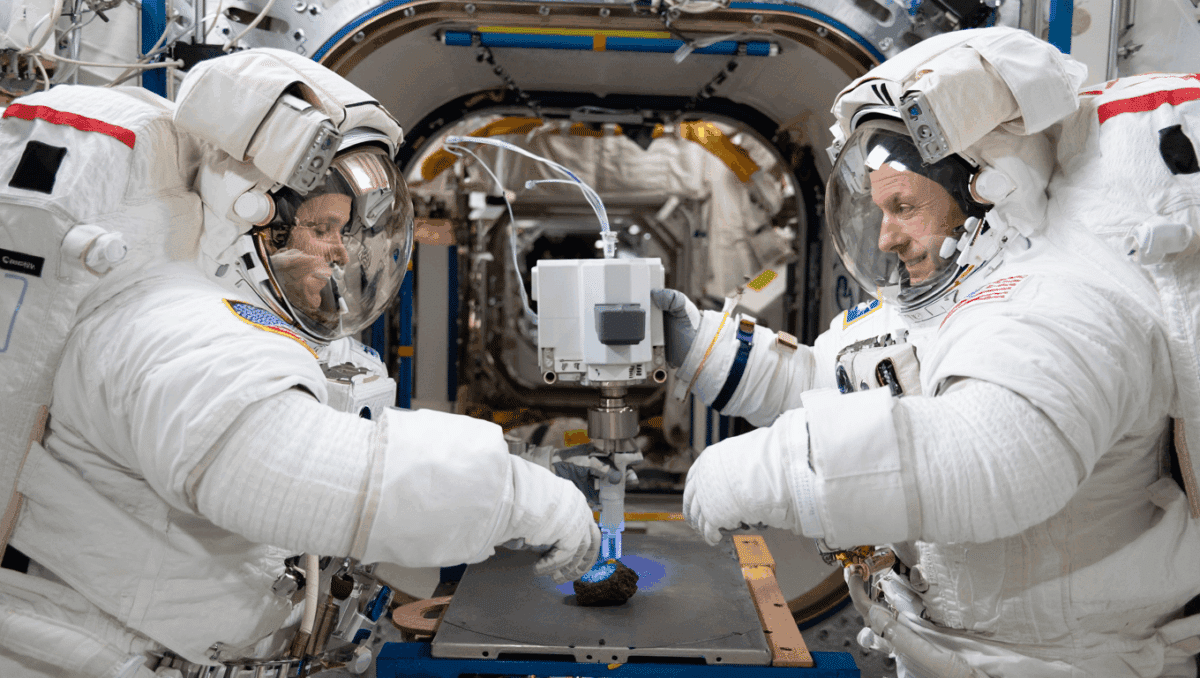
Onboard the ISS, NASA astronaut Michael S. Hopkins ran experiments on L-chondrite meteorite samples, exposing them to microbes to see whether the organisms could extract platinum and palladium. These metals are critical for electronics, catalytic systems, and a range of aerospace technologies. The success of the tests points to a possible future where spacecraft are partly manufactured or repaired using materials harvested off-Earth.
Key outcomes from the flight test
- Microbial extraction succeeded: Both fungal and bacterial strains mobilized platinum and palladium from meteorite material.
- Microgravity helped: The fungus Penicillium simplicissimum showed enhanced uptake and release of these metals in microgravity compared to Earth tests.
- Chemical leaching lagged behind in space: Nonbiological solutions that extract metals without microbes were less effective under microgravity conditions.
How microbes free metals from rock — the science of bioleaching
Microbial metal recovery, often called bioleaching, relies on organisms that produce organic acids and other compounds which bind to metal atoms embedded in mineral matrices. When the acid-bearing microbes contact the rock, they help solubilize the target elements. That mineral-rich solution can then be separated and processed to recover the metals.
In these experiments, microbes secreted carboxylic acids that chemically attached to platinum-group elements. When placed in a liquid medium, those metal-laden acids came away from the solid meteorite, effectively transferring the metals into solution where they could be isolated.
Parallel Earth-based work and international collaboration
While the ISS team completed tests in orbit, university teams on Earth ran companion experiments. Researchers from Cornell and the University of Edinburgh published findings from parallel trials using the same microbial species and meteorite types. Those coordinated studies allowed scientists to compare outcomes across gravity regimes and refine their understanding of how different organisms and extraction methods perform.
- Different microbes behave differently: bacterial strains and fungal strains each showed distinct patterns of extraction depending on the specific metal.
- Gravity affects efficiency: microgravity boosted the fungal performance in this case, but results vary by organism and element.
- Extraction rates are metal-dependent: platinum and palladium responded differently to the same procedures.
Rosa Santomartino, a Cornell professor and lead author on the study, emphasized that extraction performance shifts significantly based on the metal, the microbe in use, and the gravity environment — a complexity that will guide future research.
Why asteroid and lunar mining are becoming a strategic focus
Elements heavier than iron are forged in stars and distributed by stellar explosions. These same elements accumulate in asteroids and planetary debris, often trapped in primitive rock types like L-chondrites. For long-duration space missions, sourcing raw materials off-world could be far cheaper and more sustainable than hauling everything from Earth.
Practical benefits include:
- Reduced launch mass and cost by producing components in situ.
- Access to rare and precious metals useful in electronics, catalysis, and future manufacturing in space.
- Opportunities to process micrometeorites and orbital debris into usable feedstock.
Industry interest and emerging technologies for space resource recovery
Several private companies are already developing hardware and methods to harvest asteroid resources. One example is TransAstra, which shifted from autonomous lander prototypes to technologies aimed at capturing and extracting materials in space. Their approaches include concentrating sunlight to heat and melt asteroid material and using capture bags to collect small particles and debris for later processing.
These engineering solutions could pair with biological methods like bioleaching to create hybrid systems: mechanical collection and initial concentration in tandem with microbial extraction to recover specific elements efficiently.
Hurdles and the research path ahead
Despite promising early results, many challenges remain before microbe-based mining becomes operational in space:
- Scalability: Laboratory successes need to be translated into systems that can handle larger volumes and harsher environments.
- Control and containment: Working with living organisms in spacecraft requires strict biosafety and contamination management.
- Variable performance: Extraction efficiency depends on the mineralogy, the target element, and which microbe is used; optimizing those pairings will take more testing.
- Processing chain: Once metals are solubilized, efficient separation, purification, and manufacturing steps must be developed for space conditions.
Related terrestrial research
Complementary studies on Earth are exploring how fungi and bacteria can reclaim metals from electronic waste and industrial byproducts — a field sometimes described informally as “mushroom mining.” Those terrestrial experiments not only offer techniques for recycling but also help identify microbial strains and metabolic pathways that could be adapted for off-world applications.
What to watch next in space resource science
- Further ISS and orbital experiments comparing more microbes, meteorite types, and gravity conditions.
- Prototype demonstration missions that combine collection hardware with biological extraction units in orbit or at small bodies.
- Regulatory and planetary protection frameworks that will govern biological activity beyond Earth.
As researchers refine both the biology and engineering, recovering platinum-group metals from asteroids could move from a laboratory milestone to a practical capability supporting missions to the Moon, Mars, and beyond. Bioleaching in space has emerged as a promising route to unlock off-world resources, but turning the concept into routine operations will require sustained effort across science, technology, and policy domains.
You might also like:
- E-waste vaporization recovers precious metals at 13x lower cost, study finds
- In 2011, a collector bought a Moroccan meteorite—it turned out to be proof of thermal water on Mars
- NASA may have found life on Mars 50 years ago and accidentally killed it
- asteroid collision observed: astronomers see debris cloud and brightness changes
- Teen discovers coconut fungi can filter plastic and sunscreen from ocean, wins science fair

Michael Thompson is an experienced journalist covering U.S. and global news. With ten years on the front lines, he breaks down political and economic stories that matter. His precise writing and keen attention to detail help you grasp the real‑world impact of every event.


Man, space is getting wild these days! Mining meteorites for precious metals on the ISS? Thats some sci-fi stuff right there. Imagine if they strike gold up there…literally! Wonder how much bling theyll bring back.
Dang, mining meteorites on the ISS? That’s like sci-fi come true! Wonder if they found space diamonds or cosmic gold up there. Next thing you know, we’ll have astronauts with bling helmets!
Man, mining in space? Thats some sci-fi stuff right there! Imagine dodging meteorites for gold and platinum. Sounds like a wild ride, but hey, if it helps us down here on Earth, count me in!
I mean, mining meteorites for metals in space? Thats like something out of a sci-fi flick! Cant wait to see what crazy advancements come out of this ISS experiment, like, are we gonna have space jewelry next or what?
Man, mining meteorites on the ISS? Thats like a sci-fi dream come true! Imagine being up there, chippin away at rocks from space for precious metals. Cant wait to see where this cosmic experiment leads us next!
I remember watching sci-fi flicks where theyd mine asteroids for minerals like its no big deal. Now, hearing about meteorites being mined for metals on the ISS… Feels like reality catching up with fiction, huh? Time to invest in space pickaxes!
Man, imagine mining meteorites for precious metals on the International Space Station. Thats some next-level stuff! Wonder if theyll find space gold or cosmic silver. Bet the aliens are jealous!
Man, imagine mining meteorites for gold and platinum on the ISS! Like, space miners striking it rich up there. Wonder if they wear spacesuits blinged out with cosmic bling. Bet the aliens are jealous.
Man, talk about out-of-this-world hustle! Who knew wed be mining meteorites for gold up in the International Space Station? Forget digging in the dirt, were leveling up to space rocks now. Next stop: asteroid bling!
Man, talk about out-of-this-world mining! Imagine digging up meteorites on the ISS for precious metals. Its like a sci-fi dream come true. Wonder if they found space gold or cosmic silver up there. Wild stuff!
I used to think space was just for stargazing, but now theyre mining meteorites for metals on the ISS? Thats like science fiction coming to life! Wonder if theyll stumble upon extraterrestrial bling up there.
I remember when I tried to impress my science teacher with a rock collection. Now theyre mining meteorites for metals on the ISS? Crazy how far weve come. Wonder if they found any space diamonds yet…
I once saw a sci-fi flick where they mined asteroids for minerals. Now its happening for real, but on the ISS? Thats some next-level stuff! Wonder if theyll find space gold or alien tech up there.
Ive always been captivated by space and the endless possibilities it holds. The idea of mining meteorites for precious metals on the ISS sounds like something straight out of a sci-fi movie! Cant wait to see how this experiment unfolds.
Man, mining meteorites on the ISS? Thats some sci-fi level stuff! Imagine being up there, cracking open space rocks for precious metals. The future is now, folks! Wonder if they found any alien bling up there…
Man, if we could mine meteorites for precious metals on the ISS, why cant we have asteroid mining down here on Earth already? The possibilities are endless! Its like sci-fi come to life, but for real.
Dude, totally feel ya on that! Its like were out there in space, zipping around, snatching up metals from meteorites, but when it comes to mining asteroids here on Earth, its all like, Nah, not today. Its a wild ride of sci-fi meets reality, but with a twist of Why not, Earth? Like, are we missing the intergalactic memo or what? The cosmic possibilities are just dangling out there, begging for a human touch!