
Show summary Hide summary
- What Viking actually did on Mars: a quick refresher
- Perchlorate and the case for a mistaken null result
- BARSOOM: the hypothetical Martian microbe some scientists propose
- Why adding water might be lethal for desert‑adapted microbes
- What scientists recommend for future Mars missions to search for life
- Broader implications for astrobiology and mission planning
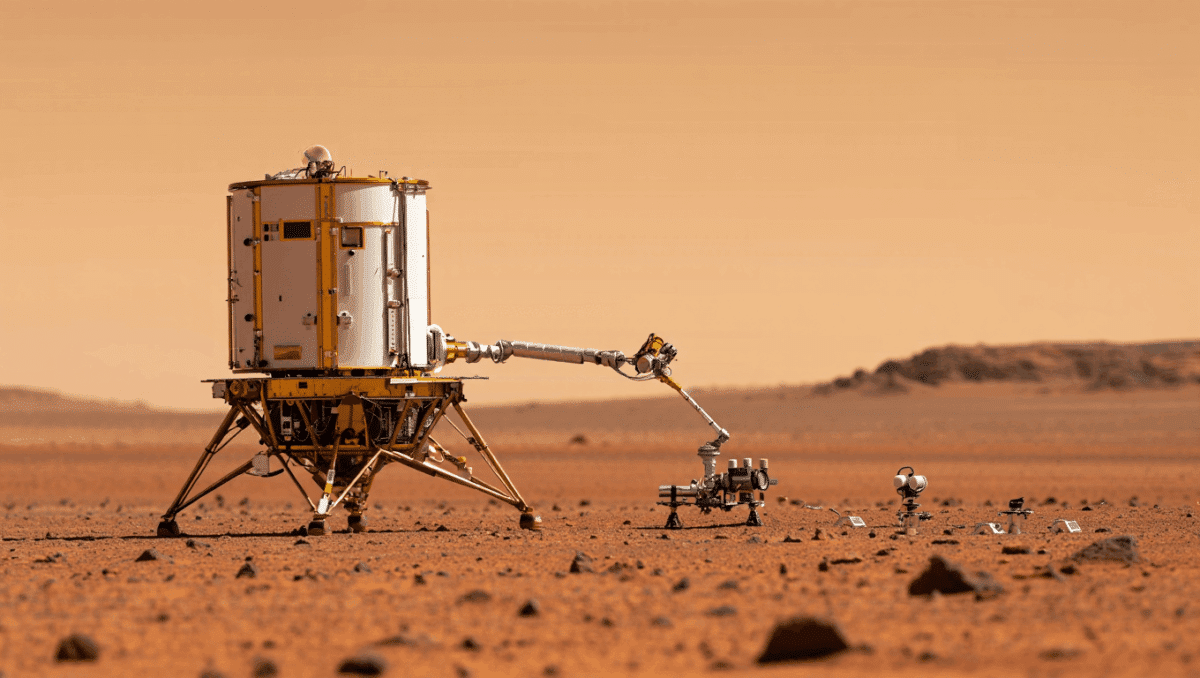
Forty-eight years after Viking set down on the rust-colored plains of Mars, scientists are reopening one of the mission’s most provocative mysteries: did those landers detect life, and did our own experiments unintentionally extinguish it? A new paper in the journal Astrobiology argues that the Viking labeled‑release tests produced results consistent with microbial metabolism — and that the way those tests were performed may have destroyed the organisms they stirred up.
The debate reaches beyond historical curiosity. If Viking did encounter life, the implications guide how we design instruments and handle Martian soil moving forward. The researchers behind the recent paper urge a careful reappraisal of the original data and new mission planning that avoids repeating what might have been the same fatal mistake.
What Viking actually did on Mars: a quick refresher
The two Viking landers carried a suite of experiments meant to detect organic molecules and biological activity. One experiment, called the labeled‑release test, added a nutrient solution containing carbon atoms tagged with a radioactive tracer to samples of Martian soil and then monitored the atmosphere for radioactive carbon dioxide — a possible sign of metabolic conversion.
The Growing Demand for Data-Driven Decision Making in Silicon Valley
He quit, ran out of money, and begged to come back — here’s how his boss reacted
- The first labeled‑release run produced a prompt, measurable emission of radioactive gas — exactly the type of signal researchers expected if microbes metabolized the nutrients.
- Subsequent injections of the nutrient or changes to the test produced weaker or inconsistent responses, introducing ambiguity.
- Other Viking instruments, particularly the gas chromatography‑mass spectrometer (GC‑MS), reported little or no organic material, which helped convince the team that the positive signal was likely chemical, not biological.
Perchlorate and the case for a mistaken null result
One of the reasons Viking’s team favored a nonbiological explanation was the apparent lack of organics detected by the GC‑MS. For decades, scientists suspected that reactive soil chemistry might destroy organic molecules during sample processing. Later missions confirmed that Martian regolith contains perchlorate salts — powerful oxidants that react when heated.
Laboratory experiments on Earth showed that heating perchlorate‑bearing samples can both destroy organic compounds and produce chlorinated organic byproducts — the very chemical signatures Viking observed and at the time attributed to contamination or terrestrial sources. These insights mean Viking’s GC‑MS may have missed organics that were simply altered or eliminated by the instrument’s heating steps.
BARSOOM: the hypothetical Martian microbe some scientists propose
The new Astrobiology paper lays out an alternative interpretation: the labeled‑release experiment detected living organisms that used stored oxygen or similar strategies to respire, and which could lie in a low‑activity state near the surface. The authors coined a working name for this putative lifeform — BARSOOM (Bacterial Autotroph Respiring with Stored Oxygen On Mars) — as a shorthand for the metabolic model they think best fits the data.
Key elements of the BARSOOM hypothesis
- These microbes would be adapted to extreme dryness and oxidizing soil chemistry, surviving in a semidormant state that minimizes metabolic activity.
- When exposed to liquid water and nutrient solution, a brief spike of metabolic activity could produce the labeled carbon dioxide Viking observed.
- Rapid hydration or conditions created by the experiment could then trigger biochemical or osmotic damage, leading to the loss of subsequent responses.
Why adding water might be lethal for desert‑adapted microbes
On Earth, certain organisms adapted to hyperarid environments show surprising vulnerability to sudden rehydration. Cell structures that stabilize desiccation tolerance can be disrupted when water floods back in too quickly, producing oxidative stress or osmotic shock. The researchers propose a similar mechanism could have occurred in Viking’s soil samples: the initial nutrient drizzle provoked life to respond, then the environment created by further handling or heating destroyed those same organisms.
That possibility reframes Viking’s mixed results not as contradictory failures, but as a plausible sequence of detection followed by inadvertent elimination.
What scientists recommend for future Mars missions to search for life
If we prioritize not killing what we seek, mission designs must change. The paper and other experts suggest several practical adjustments:
- Reduce or eliminate aggressive sample heating when testing for organics to avoid destroying delicate molecules.
- Favor noninvasive or minimal‑contact assays that look for metabolic indicators at ambient temperatures and humidity.
- Develop protocols that account for potential water‑sensitivity, including staged hydration or microfluidic approaches that mimic slow moisture increases.
- Use multiple, independent detection methods to cross‑validate biological signals and distinguish them from abiotic chemistry.
- Carry out more laboratory work with Mars‑analog soils and extremophile organisms to map likely responses before fielding instruments on another planet.
Broader implications for astrobiology and mission planning
Revisiting Viking’s data with modern knowledge of Martian chemistry forces a fresh look at a mission long considered conclusive. The new interpretation doesn’t settle the question, but it does change the stakes: if biological signals were present and then erased by our own procedures, future missions must be engineered to be both sensitive and gentle.
Scientists pushing this idea want the Mars community and space agencies to treat the Viking legacy as less of an endpoint and more of a set of lessons — lessons that could determine whether the next generation of landers finally confirms life on Mars or unknowingly repeats the same missteps.
You might also like:
- In 2011, a collector bought a Moroccan meteorite—it turned out to be proof of thermal water on Mars
- Will-o’-the-wisps origins: scientists may have found how they form and how life began
- Mars volcanoes may have erupted during dinosaurs’ final days, new study suggests
- 6 million pounds of compost delivered to NYC gardeners in 2025 as part of an organic waste program
- Titan alien life: could Saturn’s moon harbor signs of life?

William Anderson is a multimedia producer specializing in videos, podcasts, and interactive galleries. With five years of immersive content creation, he turns information into a rich audio‑visual experience. His storytelling skills draw you directly into the heart of every story, on any platform.


Man, imagine if those Martian microbes were all like, Hey, NASA, we come in peace! and then NASAs out here like, Oops, my bad, and accidentally zapped em. Space drama, for real.
Man, imagine the drama if we really offed Martian life by mistake? Like a sci-fi plot gone wrong. But hey, who knew Viking was the OG exterminator, huh? NASA out there playing God without even knowing it. Wild.
Man, NASA be out here playin cosmic hide and seek with Martian life? Thats some next-level space drama. Imagine if those little Mars critters are still salty about getting ghosted by the Viking landers. Talk about a missed connection!
Yo, for real! NASA out there playing intergalactic games! Those Martian critters probably feeling like they got stood up at prom by those Viking landers. Can you imagine the drama if theyre still holding a grudge? Talk about cosmic ghosting!
Man, imagine if weve been Martians neighbors all along and didnt even know it! NASAs got some explaining to do. Poor lil Martian microbes, we hardly knew ye. Wonder what theyd think of our Earth mess.
Man, if NASA really offed Martian life like that, its like a sci-fi tragedy. Can you imagine the headlines? Humans: the universes accidental serial killers. Messed up, man. Whoopsies on the oops, we killed E.T. front.
Man, if NASA really did find life on Mars 50 years ago and then oopsie-daisied it away… thats one giant alien oops, huh? Imagine the headlines back then! We come in peace… oops, sorry about that microbe!
Man, imagine the drama if NASA had a lil Martian friend all those years back! Oops, my bad, little green guy! I bet theyd have some serious explaining to do. Headlines wouldve been outta this world! Wonder if theyd have sent a sorry card to Mars…
Man, if NASA did bump into Martians, thats like the ultimate oopsie! Can you imagine being the intern who accidentally squished Martian microbes under a microscope? Mission Control, we have a problem…
Man, NASA be playin us like a fiddle! Finding life on Mars, then oops, accidentally hitting the cosmic delete button? Classic NASA move. Hope they at least left a sorry note for the Martians.
Man, if NASA actually found life on Mars and then oops, killed it by mistake… Thats like the biggest plot twist ever. Imagine the aliens being like, We come in peace, and were like, Sorry, our bad. Crazy stuff, right?
Man, if NASA actually found life on Mars and then oops, killed it by mistake… Thats like the biggest plot twist ever. Imagine the aliens being like, We come in peace, and were like, Sorry, our bad. Crazy stuff, right? Its like a sci-fi movie gone wrong, but in real life. Whoopsie daisy, right?
Man, NASA be playin with our feelings! Finding life on Mars and then oops, accidentally pullin the plug? Thats a rollercoaster ride of emotions right there. Next time, handle with care, NASA!
Man, NASA be playin with our emotions! Imagine findin life on Mars and then oops, killin it accidentally. We need a Martian soap opera for this drama! Cant believe we mightve missed out on some alien buddies 50 years back.
Oh, man, imagine if there were little Martian buddies chilling 50 years ago, and we accidentally wiped em out? NASAs got some explaining to do! Poor Mars critters, never stood a chance.
Man, NASA be like that one friend who accidentally kills your houseplant while youre away. Except, its Martian life. Viking was out there playin cosmic Sims and oops, there goes the neighborhood!
Man, imagine if we had little Martian buddies this whole time? NASA, what were you thinking? Accidentally offing alien neighbors, oops. Next time, maybe send a Welcome to Mars card first, huh?
Man, imagine if we had little Martian buddies this whole time! NASA, you sneaky devils… First, we gotta make sure to keep any space critters safe this time around. Lets not repeat history, folks.
Man, talk about a plot twist! NASA out here playing accidental villain in a sci-fi flick on Mars? Gotta hand it to those little Martian microbes for surviving us humans. Whoopsie daisy, right?
Man, if NASA actually had Martian neighbors 50 years ago and accidentally offed them, thats a whole new level of interplanetary oopsie. Imagine the awkwardness if we ever meet alien life for real now!
Man, NASA could be hiding the craziest stuff, like Martian life! Imagine if they crushed alien microbes by mistake. Thats one intergalactic oopsie. I bet those scientists were like, Oops, my bad, little green buddies.