
Show summary Hide summary
- How the laser link actually worked: the relay between Earth and Psyche
- Numbers that matter: distance, speed and volume
- Why optical communications can outperform radio for deep-space missions
- Operational lessons: tracking, timing and teamwork
- Voices from the program: why the achievement matters now
- Other recent NASA highlights and context
- What comes next for DSOC and space laser communications
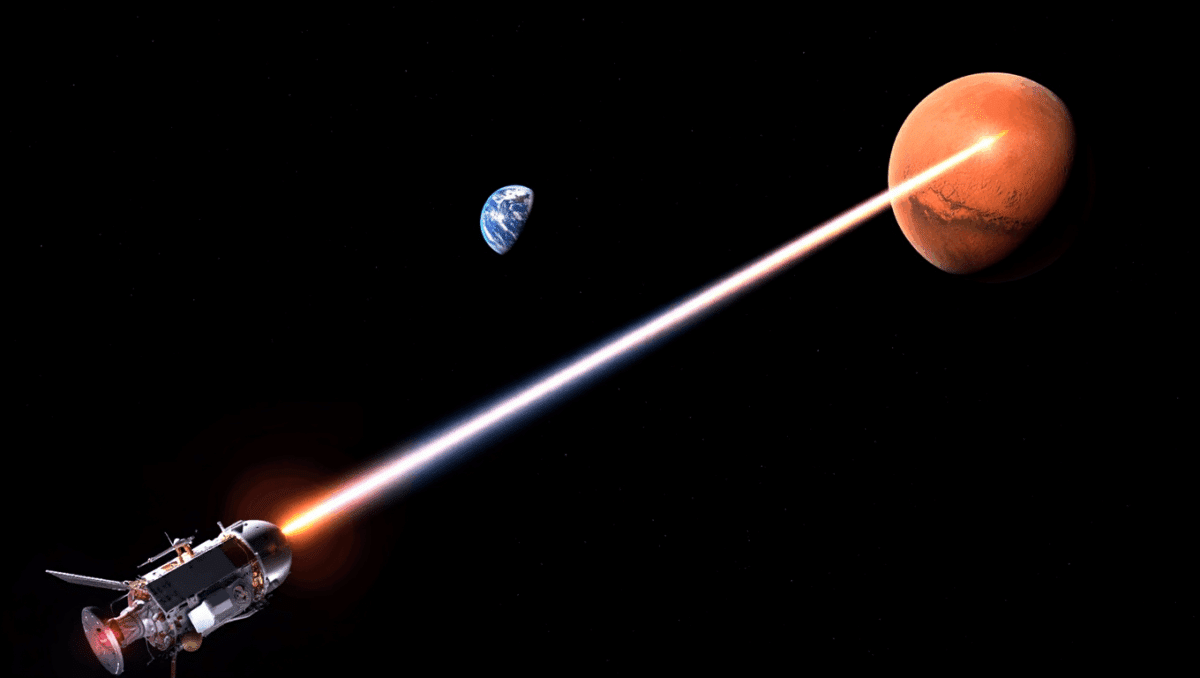
NASA has just demonstrated a major leap in space communications: a laser link that downlinked massive amounts of data from well beyond Mars. The test, part of NASA’s Deep Space Optical Communications (DSOC) initiative, proved that lasers can deliver broadband-level speeds across interplanetary distances — a capability mission planners say will be critical for future exploration.
In the experiment, a laser-equipped transceiver on the Psyche spacecraft exchanged light-based signals with two Earth-based observatories, transferring a cumulative total of data previously impossible with standard radio systems. The achievement points toward a future where high-definition video, complex scientific datasets, and even near-real-time communications could travel across the solar system.
How the laser link actually worked: the relay between Earth and Psyche
The Growing Demand for Data-Driven Decision Making in Silicon Valley
He quit, ran out of money, and begged to come back — here’s how his boss reacted
The setup used a two-way optical relay. From the ground, NASA’s Jet Propulsion Laboratory at Table Mountain aimed a powerful laser at Psyche, which is currently hundreds of millions of miles from Earth. Psyche’s DSOC transceiver locked onto that incoming beam, then returned its own laser signal back to Earth, where Caltech’s Palomar Observatory recorded the downlink.
Key components of the optical system
- DSOC transceiver mounted on the Psyche spacecraft — sends and receives the laser pulses.
- Table Mountain facility (JPL) — initiated the uplink laser to Psyche.
- Palomar Observatory — captured and decoded the faint return beam.
Those pulses are modulated much like an advanced form of Morse code: tiny, precisely timed variations in light that encode digital data. The challenge is not just the faintness of the signal but also the precise pointing required as both Earth and Psyche move at high speeds through space.
Numbers that matter: distance, speed and volume
The campaign’s totals and peak performance are striking:
- 15 terabits of data successfully downlinked during the mission’s test campaign.
- The final passes reached Psyche at about 307 million miles from Earth — a distance well beyond Mars’ orbit.
- Earlier demonstrations included sending an ultra-HD video of “Taters” the cat from some 19 million miles away at roughly 267 megabits per second.
- DSOC conducted a total of 65 passes to exercise and validate the technology.
Why optical communications can outperform radio for deep-space missions
Traditional radio-frequency links are reliable but increasingly constrained by bandwidth limits. Laser-based optical communications use much higher carrier frequencies, allowing far greater data throughput for a given transmitter size and power.
Practical benefits for explorers and scientists
- Higher data rates — enabling large scientific instruments to send back richer datasets.
- Lower mass and power for equivalent or better performance compared with some RF systems.
- Potential to support live or near-live high-resolution imagery from lunar and Martian habitats.
NASA officials emphasize that adding optical links to the agency’s communications toolkit will not replace radio systems entirely but will augment them to meet growing demands from crewed and robotic missions.
Operational lessons: tracking, timing and teamwork
Maintaining a reliable laser connection across hundreds of millions of miles required extremely precise pointing, high-stability clocks, and coordinated software on the ground. DSOC’s ground software team and mission engineers had to compensate for spacecraft motion, atmospheric disturbance, and the time delay of light-speed signals.
- Accurate pointing from both ground transmitters and the flight transceiver was essential.
- Decoding the return beam demanded sensitive detectors and advanced error-correction algorithms.
- End-to-end testing through dozens of passes helped validate operations under varied geometric and atmospheric conditions.
Voices from the program: why the achievement matters now
Program leads note that the DSOC demonstrations address current bottlenecks in how much data deep-space missions can deliver back to Earth. As missions carry more capable instruments and future human explorers expect broadband-like services, optical links offer a path to meet those expectations.
Engineers say this capability will be pivotal for sending high-resolution science products and crew-generated media from lunar bases and Mars expeditions back to Earth without months-long delays or severe down-sampling of content.
Other recent NASA highlights and context
- Satellites are now being used to monitor vegetation responses that can foreshadow volcanic unrest.
- NASA’s Lucy mission returned humanity’s first imagery of a strangely shaped, peanut-like asteroid.
- New solar missions are providing unique perspectives on the Sun-Moon system and the solar wind environment.
What comes next for DSOC and space laser communications
With the DSOC campaign complete, NASA will analyze the voluminous telemetry and operational data gathered during the 65 passes to refine hardware, pointing strategies, and ground-station processing. Lessons from this test are expected to influence upcoming mission designs that require high-volume data return.
NASA has published an explainer video that walks through the experiment’s setup and outcomes for viewers who want a closer, visual look at how lasers are poised to change deep-space communications.
You might also like:
- In 2011, a collector bought a Moroccan meteorite—it turned out to be proof of thermal water on Mars
- NASA moon mission 2026: first crewed lunar mission in 50 years
- NASA moon base details: plan to prepare humanity for next phase of exploration
- NASA postpones ISS spacewalk after astronaut medical issue
- Hubble telescope nearing end of life: what to expect

Michael Thompson is an experienced journalist covering U.S. and global news. With ten years on the front lines, he breaks down political and economic stories that matter. His precise writing and keen attention to detail help you grasp the real‑world impact of every event.


Man, back in my day, we barely had dial-up internet, and now NASAs firing terabits from beyond Mars? Mind officially blown. Cant wait to see what other space-age tech they come up with next!
Man, I remember when we thought sending a text message was high tech. Now NASA beaming terabits from Mars? Mind officially blown! Cant wait to see how this laser wizardry shapes the future of space comms!
Dang, right? I mean, back in the day, texting felt like we were pushing boundaries, and now NASAs out here with their laser beams like, Hold my space beer. Its wild to see how far weve come. Who knows, maybe in a few years, well be sending memes to Martians or something! Exciting times, for sure.
Man, I remember when we had to rely on old-school radio signals for space comms. Now NASAs out here slinging terabits with lasers from beyond Mars! Were living in the future, folks. Cant wait to see whats next.
Dude, totally feel ya on that! Remember when we thought a walkie-talkie was high-tech? Now NASAs all like, Laser beams, baby! Its straight out of a sci-fi flick, innit? Wonder if well be teleporting next…
Man, NASA really stepping up their game with these laser communications! Cant believe were sending terabits from beyond Mars now. The future is here, folks. Wonder what other mind-blowing tech they got up their sleeves next.
Man, I remember when space comms were all crackly radio signals. Now NASAs out here zappin terabits with lasers beyond Mars. Imagine the memes we couldve sent aliens back in the day!
Dang, laser tech be flexin hard these days, innit? NASA out there, shootin terabits across space like its no biggie. Cant wait for sci-fi vibes to be our reality, man!
Man, remember the days when a text took ages to send, and now NASAs out there slinging terabits like it’s nothing? This laser link to Psyche is pure sci-fi becoming reality! Cant wait for the future tech itll bring down to Earth.
Oh man, totally feel you on that ancient text struggle! Its wild how weve gone from waiting eons for a simple hey to NASA flexing their tech muscles with terabits left and right. The idea of a laser link to Psyche sounds straight outta some sci-fi flick, right? Cant help but wonder what kind of mind-blowing gadgets and gizmos theyll bring back to us Earthlings. The futures looking pretty darn exciting!
Man, remember when dial-up was all the rage? Now NASAs out here sending terabits from Mars like its NBD. The future is wild, yall. Cant wait to see whats next!
Dang, NASA stepping up their game with that laser tech! Reminds me of that sci-fi flick where they zap messages through space. Imagine getting your texts beamed from Mars, wild!
Man, lasers in space?! Reminds me of that sci-fi flick I watched with aliens and pew-pew lasers. But hey, NASAs for real, beamin data from Mars like its no biggie. Impressive stuff, space tech is wild!
Man, remember when we had to wait ages for a simple text message to reach Mars? Now were talking terabits of data zipping past the Red Planet like its nothing. NASAs laser game is on point! Who needs snail mail in space anymore?
Man, I remember when we struggled with dial-up internet, now were shooting terabits from Mars! NASAs laser tech is like sci-fi come true. Cant wait to see where this optical communication breakthrough takes us next!
Man, totally feel you on that! Dial-up days feel like ancient history now. Imagine trying to load a single webpage back then… the struggle was real! But yeah, NASAs laser tech game is on another level. Its wild how far weve come. Cant help but wonder whats next in the optical communication saga. The futures looking pretty darn exciting!
Man, back in my day, wed be lucky to get a text through, let alone terabits! NASAs laser tech is blowing my mind. Gotta hand it to them, stepping up the deep-space comms game big time!
Man, I remember the days when space comms were like two tin cans and a string. Now NASAs out here beamin terabits through the cosmos! Cant wait to see what else they pull off with this laser tech. Skys not the limit anymore!
Bro, tell me about it! Its like we went from walkie-talkies to the freakin Starship Enterprise in the blink of an eye! NASAs on some next-level stuff now, aint they? Im low-key excited to see what kind of sci-fi magic theyll pull off next with those laser beams. The sky aint just the limit anymore, its like a whole new playground up there!
Man, NASAs laser game is outta this world! Sending terabits from Mars? Thats some sci-fi stuff right there. Cant wait for these tech leaps to bring us closer to the mysteries of space. Major respect for the minds behind this.