
Show summary Hide summary
- Replacing a century-old viaduct while trains keep rolling
- How giant gantries and prefabrication sped up the work
- Project phases, milestones, and what’s been completed so far
- Financial and commuter benefits from a disruption-minimizing strategy
- Engineering details and the human side of big lifts
- Where this method is proving useful beyond Park Avenue
- Other headline-making infrastructure projects to watch
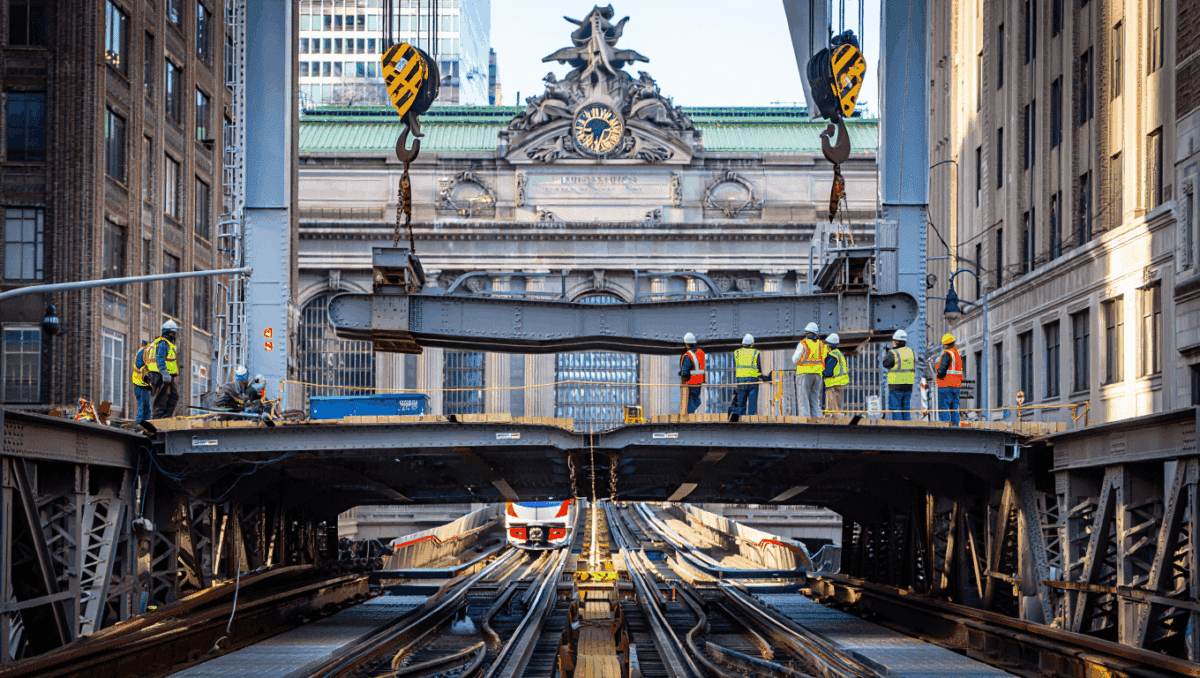
New York City is quietly replacing a 132-year-old rail structure above Park Avenue without halting the flow of commuters into Grand Central. Using a bold combination of massive gantry cranes and factory-built bridge segments, crews have managed to keep trains running while ripping out a century-old superstructure — and they’ve done it with astonishing cost and time savings.
The Metropolitan Transportation Authority tapped Halmar International to lead the multi-year overhaul, and the contractor’s unconventional sequencing and equipment choices have produced headline numbers: tens of millions saved and schedule gains measured in years rather than weeks. Here’s a closer look at the techniques, timeline, and why this project is attracting attention from engineers and commuters alike.
Replacing a century-old viaduct while trains keep rolling
The structure often referred to as the Park Avenue Viaduct — not to be confused with the nearby automobile viaduct at Pershing Square — carried Metro-North trains into Grand Central for more than a century. At peak, roughly 750 trains a day passed over the aging span, so any replacement plan had to avoid major service interruptions.
The Growing Demand for Data-Driven Decision Making in Silicon Valley
He quit, ran out of money, and begged to come back — here’s how his boss reacted
The MTA’s contract with Halmar launched in October 2023 as a multi-phase effort running through the summer of 2027. Rather than closing tracks for long stretches, the team staged work so that rail service could continue on some tracks while others were removed and rebuilt. That strategy, paired with preassembled bridge modules, has delivered remarkable results: the contractor is currently operating about $93 million under budget and an eye-popping 51 months ahead of the original schedule for some sections.
How giant gantries and prefabrication sped up the work
Halmar leaned on a technique more common at ports than on Manhattan avenues: a gantry crane system positioned to straddle the entire rail corridor. The gantry’s reach let crews lift out large slabs of old concrete and steel and set new sections into place with minimal on-track downtime.
- Each prefabricated module arrived preassembled with essentials such as track fasteners, third-rail attachments, guardrails, and walkways.
- Individual replacement pieces weighed about 190,000 lbs, requiring a purpose-built lifting device.
- MiJack — the gantry manufacturer — produced the largest gantry it has ever built so the machine could span the viaduct completely and operate over active track.
By working mostly on nights and weekends, crews completed the first major run of installations in a tight series of rotations: over the course of 19 weekends they placed 128 modules between East 115th and East 123rd Streets, installing about 8,240 feet of new track surface on the rebuilt structure.
Why the gantry approach mattered in an urban setting
Gantry cranes differ from conventional tower or mobile cranes because they sit above the work corridor, moving along rails or treads to position loads. For the Park Avenue project, that configuration brought three main advantages:
- Precision placement of large, finished bridge components with minimal impact on sidewalks and street crossings below.
- Ability to load removed material directly onto flatbeds for rapid removal from the work zone.
- Maintenance of at least partial rail service during most operations, limiting commuter disruption.
The gantry’s hydraulic systems allowed the legs and lifting beams to lower, secure a module, raise it clear of the rail corridor, and travel to the next drop point, functioning much like a movable bridge builder.
Project phases, milestones, and what’s been completed so far
Work was divided into multiple segments to keep the corridor operational and to concentrate resources where they could be most effective. Key milestones include:
- Phase 1: Removal and replacement between East 115th and East 123rd Streets — completed in record time and finishing roughly 21 months ahead of schedule.
- Phase 2: Began in March 2024, covering East 127th to East 132nd Streets, using the same gantry-and-prefab method.
- Final phases: Slated to continue through the contract timeline, with targeted wrap-ups for specific stretches expected next April.
Because many elements arrived ready for track installation, the on-site assembly window for each module was dramatically shorter than would be the case with cast-in-place construction.
Financial and commuter benefits from a disruption-minimizing strategy
Keeping rail operations moving while replacing a nearly 132-year-old structure delivered both public convenience and fiscal advantages. The biggest wins so far:
- Substantial cost savings: Halmar’s approach has placed the project roughly $93 million under budget to date.
- Time savings: Faster installs and off-site fabrication accelerated completion of initial segments by multiple years.
- Less commuter impact: Maintaining two of four tracks during most operations meant Metro-North service could continue without wholesale closures.
Transit agencies often face trade-offs between speed, cost, and rider inconvenience. This project demonstrates how upfront planning, modular construction, and specialized lifting equipment can tip that balance toward faster delivery with fewer service interruptions.
Engineering details and the human side of big lifts
The replacement process blended heavy machinery with careful choreography. Crews first cut away the old superstructure in large, manageable pieces. Those pieces were immediately lifted onto flatbeds by the gantry, moved offsite, and replaced with the new modules that were lowered like giant planks into place.
On the human side, field teams coordinated closely with rail dispatchers and city agencies to keep sidewalks, street crossings, and emergency access open while work proceeded overhead. Safety, logistics, and community impact planning were as critical as the engineering itself.
Where this method is proving useful beyond Park Avenue
Gantry-assisted, prefabricated construction is gaining traction for urban rail and bridge projects because it concentrates risky, noisy tasks into short time windows and moves the longest-duration work into factories. Benefits include:
- Cleaner, safer on-site conditions during active hours.
- Higher quality control for elements made in controlled environments.
- Repeatable processes that can reduce labor costs and schedule uncertainty.
Engineers and transit planners watching the Park Avenue replacement are noting how port-style equipment, when adapted thoughtfully, can reshape how cities rebuild aging infrastructure without paralyzing daily life.
Other headline-making infrastructure projects to watch
- Major Alpine tunnel connecting Austria and Italy nears completion and is expected to change cross-border rail travel.
- A uniquely complex bridge design in Miami is advancing with distinct structural features that have engineers calling it one of the most unusual builds worldwide.
- A new, record-breaking high bridge in China is set to dramatically shorten a notorious canyon crossing.
- An ambitious undersea rail tunnel project in Europe aims to set multiple records while cutting hours off international journeys.
WATCH a time-lapse video of the work in progress…

You might also like:
- India’s first bullet train launches as Japanese engineers modernize massive railway
- Theodore Roosevelt National Park scenic road repaired after 6 years
- “It’s freedom”: for two years, this teenager has slept, eaten, and done laundry on trains
- Colorado wildlife overpass, North America’s largest, opens to help animals cross highways safely
- From Passion to Profession: How a Lifelong Love for Trains Led to a Dream Career

Michael Thompson is an experienced journalist covering U.S. and global news. With ten years on the front lines, he breaks down political and economic stories that matter. His precise writing and keen attention to detail help you grasp the real‑world impact of every event.


I remember when they fixed that bridge in my hometown, total chaos for months! Kudos to NYC for keeping the trains running smoothly AND saving some serious cash. Impressive stuff, gotta give credit where its due!
I feel ya, buddy! Bridges under construction can turn a town upside down. NYCs got some serious hustle keeping things on track. Must be a wild ride behind the scenes, right? Kudos to those unsung heroes making it all happen!
Man, that bridge replacement in NYC? Impressive stuff! $93M under budget? Thats like finding a twenty in your jeans, but times a million! Trains running, gantries up — hats off to those folks!
Man, imagine the chaos if they shut down those trains! Props to the crew for pulling off this bridge replacement under budget. Efficiency in action, folks. Now, whats the next big urban project?
I remember when they fixed the bridge near my old place. It was a mess! Trains delayed, noise non-stop. But hearing this NYC project went smooth? Impressive stuff! Maybe they should give lessons to my town!
Man, imagine a bridge replacement goin smoothly in NYC, under budget? Whats next, unicorns on the subway? But hey, good vibes for the crew; keepin the trains runnin is a whole other level of juggling.
Man, I remember when they fixed the bridge in my hometown. Took forever and cost a fortune. Wish they had those giant gantries back then! Maybe we wouldnt have had to endure all those detours and traffic jams.
Man, back in my day, infrastructure projects were a mess. But $93M under budget and trains still chuggin along? Thats some next-level wizardry right there. Cant help but be impressed.
Man, I remember when they fixed that bridge back in the day. Took forever! Glad they got it done quicker this time. Maybe they finally realized efficient work saves money and nerves.
Man, talk about efficiency! NYC bridge replacement under budget AND trains kept running? Thats like fixing a car while its still speeding down the highway. Impressive stuff. Wonder if theyll apply that magic elsewhere.
Man, back in my day, a bridge replacement was a whole saga! This gantry thing sounds like a game-changer. 93 million under budget? Thats wild! Theyre making magic happen over there, huh?
Man, Ive seen construction projects go over budget more times than I can count! But hey, kudos for getting it done under budget, NYC! And keeping those trains running smoothly? Impressive stuff!
Man, NYC really pulled a rabbit outta the hat with this one, huh? Construction jobs are like a box of chocolates – you never know what youre gonna get! But seriously, hats off to the Big Apple for keepin those trains chuggin along smoothly. Who knew they had it in em?
Oh, I remember the chaos during the last bridge repairs – what a nightmare! But hey, kudos for finishing under budget! Maybe next time theyll tackle potholes too? Just a thought!
Woah, talk about efficiency! They replaced a whole bridge under budget while keeping those trains chugging along? Thats some serious multitasking right there. Maybe they should give lessons on project management.
I remember when they fixed the bridge near my block, took ages! $93M under budget? Hah! Thats a miracle! Maybe they used magic gantries or something. But hey, good news for the trains, right?
Man, back in my day, getting anything done in NYC without a massive budget blowout was like finding a unicorn in Central Park. Kudos for finishing that bridge replacement under budget! Thats some real magic right there.
Man, that bridge replacement news hits close to home. Reminds me of that time they fixed the subway station near my block in record time. Good to see projects like these can save cash and keep things moving.
Man, I totally get you! Its like a breath of fresh air when things actually get done, right? I remember when they fixed up this bus stop near my place real quick, and I was like, Whoa, miracles do happen! Its rare to see projects wrap up on time and save some cash, isnt it? Gotta admit, its a nice change from the usual delays and budget overruns.