
Show summary Hide summary
New forensic analysis of Pompeii’s battered walls has revived a surprising chapter of ancient military innovation: Roman forces may have deployed a repeating-launch weapon more than 2,000 years ago. The discovery links written descriptions from antiquity with fresh archaeological data, suggesting an early form of an automatic artillery device was used during Lucius Cornelius Sulla’s siege in the Social War.
A team led by Adriana Rossi at the University of Campania combined ballistics, engineering models and historical sources to examine distinctive impacts on Pompeii’s fortifications. Their findings, published in the journal Heritage, point to the possible physical traces of the device long known in texts as the polybolos — a multi-shot launcher credited to the Greek engineer Dionysius of Alexandria.
Distinctive damage on Pompeii walls points to an unfamiliar weapon
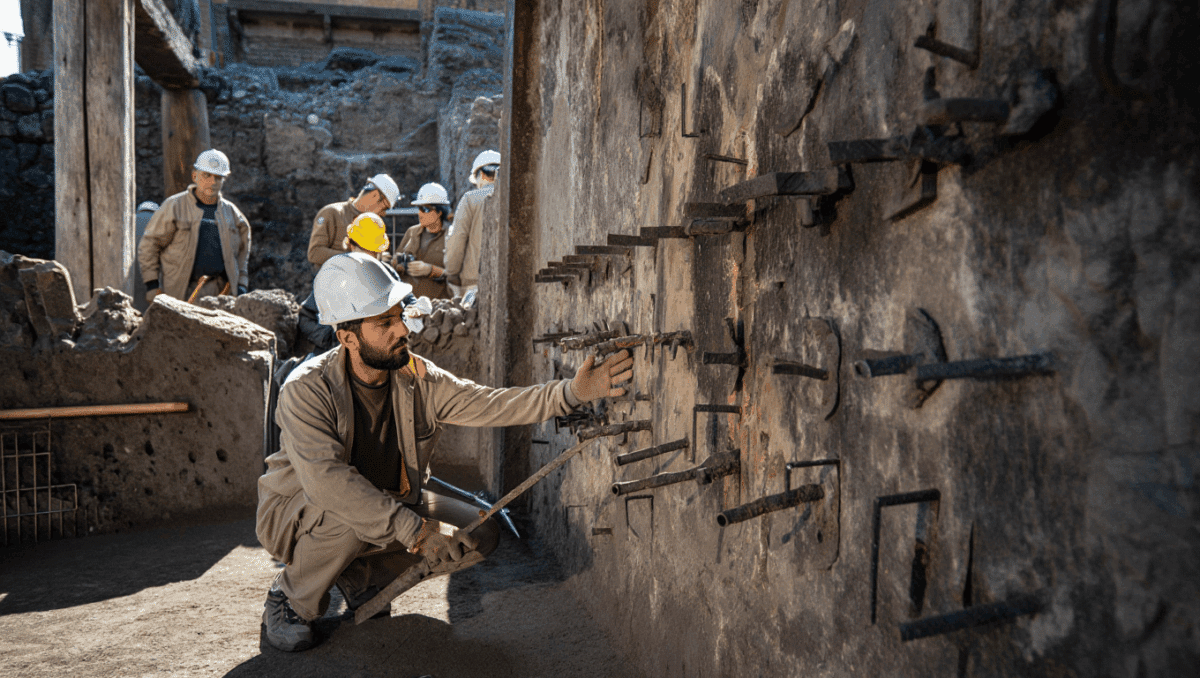
Researchers cataloged several nearby rectangular perforations in the city’s ramparts that differ sharply from the rounded pockmarks left by typical siege projectiles. Instead of the circular indentations produced by slingstones or the large stones hurled by ballistae, these marks are quadrangular, closely spaced and repeatable in pattern.
The Growing Demand for Data-Driven Decision Making in Silicon Valley
He quit, ran out of money, and begged to come back — here’s how his boss reacted
- Exact replication: Two separate wall segments display nearly identical holes arranged in tight groupings.
- Anthropic origin: The damage shows characteristics consistent with purposeful impact rather than later weathering or collapse.
- Location matters: The marks are positioned where defenders would have stood, suggesting the projectiles were aimed at personnel on the parapets.
Reconstructing the polybolos: what ancient sources and engineers say
Ancient authors describe the polybolos as a repeating missile launcher — essentially a mechanical bow that could fire many bolts in succession. Though treated in some Byzantine chronicles as a curiosity, the device has lacked direct archaeological corroboration until now.
Design features and intended effects
- The polybolos is typically depicted as a large, stationary machine with a magazine and a cranked or ratcheting mechanism to advance and release bolts.
- It fired heavy iron darts or crossbow-like bolts capable of penetrating wooden barriers and shields.
- Unlike the ballista, which aimed to demolish structures with stone shot, the polybolos appears optimized for anti-personnel use — suppressing or clearing defenders on walls and between merlons.
Historical attribution credits Dionysius of Alexandria with developing concepts behind repeating mechanisms. The new Pompeii evidence gives those literary attributions physical context and suggests Roman armies experimented with or adopted such technology during sieges.
How the research team matched marks to a repeating-weapon profile
To move beyond speculation, Rossi’s group applied a multidisciplinary toolkit combining laboratory experiments, computational modeling and textual comparison.
- Ballistic reconstruction: Simulated trajectories and impact energies for heavy bolts to see what hole shapes they would produce on ancient masonry.
- Engineering analysis: Modeling how a magazine-fed launcher would position and space repeated shots, producing clustered impacts like those observed.
- Historical cross-checks: Comparing impact patterns to descriptions of siege tactics and weapon capabilities in primary sources.
- Digital forensics: Using software to reconstruct impact scenarios and rule out alternatives such as secondary collapse or modern damage.
The combination of identical spacing and matching morphology across two wall sites made accidental explanations unlikely. According to the authors, the evidence most plausibly corresponds to a mechanical device capable of firing multiple projectiles without reloading between shots — in effect, an early ancestor of automatic firearms.
What this means for our understanding of Roman siegecraft and technology
If the polybolos left physical marks on Pompeii’s walls, it shifts how historians view Roman battlefield ingenuity. Rather than relying solely on single-shot siege engines like ballistae and catapults, some Roman commanders may have used specialized repeat-fire machines to suppress defenders and create tactical openings during assaults.
- Operational role: Deployments would focus on dislodging personnel from walls and towers rather than simply battering gates.
- Technological continuity: It highlights a lineage of mechanical innovation that stretches from Hellenistic engineers to Roman military applications.
- Archaeological strategy: The study demonstrates how careful reading of impact patterns can reveal lost technologies even when the original machines are gone.
Rossi and her colleagues stop short of declaring the polybolos definitively found, but their paper offers the strongest archaeological case yet that descriptions of a repeating Roman launcher correspond to real wartime practice.
You might also like:
- Rome’s self-healing concrete leads scientist to launch Roman-style concrete business
- Ancient Romans used feces as medicine, study confirms
- Roman stone-lined basin discovered predates concrete, reveals advanced engineering
- Roman Empire interactive map: explore ancient roads and plan your trip
- Homer’s Iliad papyrus fragment found in 1,600-year-old mummy: first literature in a burial

Michael Thompson is an experienced journalist covering U.S. and global news. With ten years on the front lines, he breaks down political and economic stories that matter. His precise writing and keen attention to detail help you grasp the real‑world impact of every event.


Man, Romans had a real knack for surprises! Imagine stumbling upon an ancient automatic weapon in Pompeii. Bet they didnt see that coming! History just keeps on revealing its secrets, huh?
I mean, whoa, imagine Romans with automatic weapons? Thats like mixing chariots with Teslas. Historys full of surprises, man. Wonder if they had ancient gun control debates too, you know?
Whoa, imagine the Romans busting out automatic weapons like its no big deal, over 2,000 years ago! Thats some next-level ancient warfare right there. Makes you wonder what else they had up their togas back in the day.
Man, can you believe it? Romans had automatic weapons back in the day. Makes you wonder what other crazy stuff they had hidden up their togas, eh? History keeps surprising us!
No way, bro! Those Romans were definitely ahead of their time with those automatic weapons. Imagine walking around with a whole arsenal under your toga! Who knows, maybe they had jetpacks hidden in there too. Historys full of surprises, man!
Man, imagine being a Roman soldier facing this automatic weapon back in the day. Crazy how ancient tech surprises us! Makes you wonder what other innovations got lost in history, yknow?
Man, the Romans were really ahead of their time, huh? Automatic weapons in Pompeii? Thats some next-level stuff. Wonder what else they had hidden up their togas back then!
Wait, hold up! Romans were packing automatic weapons? Thats some next-level history right there. Can you imagine their battles with those bad boys? Ancient warfare just got a whole lot more interesting.
Yo, hold up! Romans with automatic weapons? Thats like time-travel meets Call of Duty! Can you picture those battles? Its like Spartacus meets Rambo. Ancient history just got a serious upgrade, huh?
Yo, imagine Romans rocking automatic weapons while were struggling with basic stuff! Historys wild, man. Makes you wonder what other ancient tech we havent discovered yet. Ancient times werent all togas and sandals, huh?
I always knew those Romans were up to something wild! Can you imagine rolling up to battle with an automatic weapon back in the day? Bet they shocked their enemies big time. Historys full of surprises, aint it?
Man, imagine rocking up to a Roman battle thinkin swords and spears are all you gotta worry bout, then BAM, some dude unleashes an ancient automatic weapon on you! Historys full of surprises, huh?
I mean, who knew the Romans were packing heat like that back in the day? Automatic weapons in ancient Pompeii? This discoverys blowing my mind! Bet they had some wild battles going on.
Dude, for real, Romans werent messing around with those weapons! Can you imagine the chaos when they busted those out in battle? Probably had everyone shook. Wonder if they had the OG Rambo leading the charge or something!
Yo, crazy to think bout them Romans flexin with automatic weapons back in the day. Wonder what else they had up their togas! Ancient warfare just got a whole lot more interesting, huh?
Man, imagine Romans packing heat like its the Wild West! Crazy how advanced ancient tech was. Bet they had spaghetti western shootouts in Pompeii. History just got a whole lot cooler!
I remember learning about Pompeii in school, but Roman automatic weapons? Thats some wild history! Can you imagine the firepower they had back then? Makes you wonder what else we dont know about ancient warfare!
Dang, imagine Romans busting out some ancient automatic weapon in Pompeii! Bet they werent expecting that history plot twist. Makes you wonder what other surprises are hiding in those old ruins, huh?
Man, imagine being a Roman soldier facing an automatic weapon back in the day! Crazy to think about the advancements they had. History always finds a way to surprise us, huh?