
Show summary Hide summary
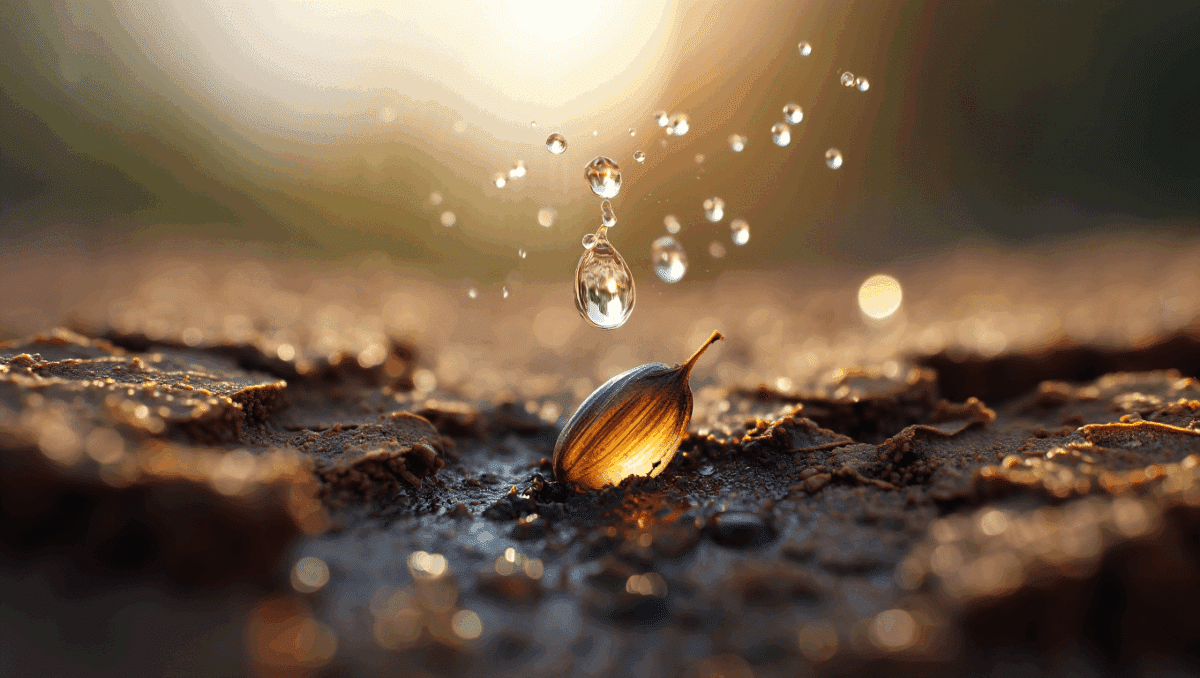
Imagine a seed tucked under a thin layer of mud or floating just beneath a puddle, and think of the first raindrops falling after a dry spell. New research from the Massachusetts Institute of Technology suggests those seeds aren’t passive bystanders: they can detect the sound waves produced by falling rain and respond by sprouting more quickly.
In carefully controlled lab tests and field comparisons, MIT scientists found that the acoustic energy generated when raindrops hit water or soil produces vibrations strong enough to nudge internal cellular structures in seeds. That subtle mechanical cue appears to help wake seeds from dormancy and speed up germination.
How raindrops turn into signals plants can sense
The Growing Demand for Data-Driven Decision Making in Silicon Valley
He quit, ran out of money, and begged to come back — here’s how his boss reacted
When a raindrop strikes a surface—whether a puddle, marsh, or packed soil—it creates pressure waves that travel through the surrounding medium. Because water and wet ground transmit pressure fluctuations more efficiently than air, the sounds produced under these conditions can be surprisingly powerful over short distances.
- Underwater pressure waves: A single drop produces larger pressure changes in water than in air, amplifying the mechanical impact on nearby seeds.
- Local vibration: Seeds positioned within a few centimeters of the impact site experience measurable oscillations in their surroundings.
- Natural comparability: Researchers confirmed laboratory droplet impacts generated acoustic patterns similar to real rain by recording puddles, wetlands, and soil during storms.
Controlled tests show faster germination in rice seeds
Design and scale of the experiments
The team submerged thousands of rice seeds in shallow trays and exposed subsets of them to simulated raindrops. By changing droplet size and drop height, the researchers mimicked light showers up through heavy downpours and captured the underwater acoustic signature using a hydrophone.
Results at a glance
- About 8,000 seeds were used across the trials to ensure robust statistics.
- Groups exposed to the rain-like sound environment germinated consistently faster than control groups kept in otherwise identical conditions.
- Germination sped up by roughly 30–40% for seeds that experienced the droplet-induced sound waves.
- Seeds closer to the water’s surface or the soil-air interface showed the greatest sensitivity to the vibrations.
By comparing lab acoustic measurements with recordings from natural rain events, the scientists determined the experiments reproduced the kinds of sound pressures seeds would encounter in real environments. That combination of lab control and field realism strengthened the link between rain acoustics and biological response.
Statoliths: tiny internal sensors that react to vibration
At the heart of the discovery are microscopic dense granules known as statoliths. These intracellular particles settle under gravity and help cells determine orientation—telling roots to grow down and shoots to grow up.
In still conditions, statoliths rest against certain parts of the cell membrane; when they move, that displacement becomes a biochemical signal. The MIT team showed that the pressure waves from falling drops are sufficient to dislodge or jostle these grains in shallowly buried seeds, generating signals that can trigger growth pathways.
That mechanism explains why seeds at optimal depths—close enough to feel the vibrations but not so near the surface that they’d dry out—might gain an evolutionary advantage by germinating when moisture is arriving.
Implications for ecology, farming, and seed science
Understanding that seeds can “hear” rain opens new possibilities for both basic ecology and practical agriculture. If seeds use acoustic cues to time germination, that behavior could influence plant community dynamics, seedling survival, and crop establishment after rainfall events.
- Ecological timing: Seeds that germinate immediately after rain may avoid competing seedlings or take advantage of brief windows of moisture.
- Agricultural innovation: Farmers and seed technologists could explore acoustic priming—using controlled sound stimulation to promote uniform germination in nurseries or direct-seeding operations.
- Conservation work: For restoration projects in arid regions, knowing which species respond to rain sounds could improve reseeding success.
What researchers want to test next
The MIT group plans to widen the inquiry beyond rice and rainfall. Early questions include which other seed types show the same sensitivity, how varying soil textures affect sound transmission, and whether other environmental noises—like wind or nearby animal activity—affect seed behavior.
- Compare responses across crop species and wild plants to map how widespread acoustic sensitivity is.
- Measure how different soil moisture and composition change the amplitude and reach of rain-generated vibrations.
- Investigate whether sustained or intermittent acoustic cues yield different developmental outcomes for seedlings.
- Explore technological applications such as acoustic seed treatments or sensors that predict germination windows.
The findings published in Scientific Reports represent the first direct experimental evidence that seeds and very young plants use natural sound vibrations as a cue to grow. As scientists continue to combine field recordings, laboratory manipulation, and cellular-scale measurements, our picture of how plants interact with their acoustic environment will almost certainly become richer—and more surprising.
You might also like:
- Seed bank’s 25-year collection safeguards plant species from extinction
- Birds feast on sunflower seeds outside kitchen window in autumn
- Microplastics in tap water filtered by miracle tree seeds, removing more than 98%
- Seed vault in Atacama Desert frozen to preserve Chile’s plant diversity
- California superbloom wildflowers in desert parks: where and how to see them

Michael Thompson is an experienced journalist covering U.S. and global news. With ten years on the front lines, he breaks down political and economic stories that matter. His precise writing and keen attention to detail help you grasp the real‑world impact of every event.


Man, imagine if we could speed up our own growth like seeds with some good tunes. Maybe I should blast my playlist at full volume and see if I sprout some new ideas too!
Hold up, so plants are like eavesdropping on rain now? MIT bringing the tea! Imagine if rice seeds are just out here, vibing to raindrops like its their favorite song. Natures got more drama than reality TV!
Dude, imagine if we could talk to plants like, Hey, seeds, here comes the rain! And bam, they sprout faster. MITs onto something, man. Next thing you know, well be having full-on conversations with our veggies.
Ive always said plants are more clever than we give em credit for! Sound waves speedin up germination? Natures got its own playlist, man. Next thing you know, well have DJ plants droppin beats in the garden!
Man, these seeds have better senses than some folks I know! Raindrops chatting with them to speed up germination? Natures got secret WhatsApp groups, I swear! Maybe I should start talking to my plants too, see if they like my jokes.
So, plants are getting in on that sweet, sweet ASMR action now, huh? Next thing you know, well have botanical relaxation playlists on Spotify. Cant wait for my rice seeds to start vibin.
Man, imagine if I could speed up my own growth just by listening to some tunes! MITs onto something cool with this study on seeds jamming to rain sounds. Maybe Ill play some tunes for my houseplants and see if they start busting a move too.
Yo, thats wild! Imagine your houseplants grooving to some beats like theyre at a club. Maybe theyll start requesting songs next. Who knows, your fern might be a secret dance prodigy waiting to shine on the plant talent show! Give it a shot and see if they turn into little green dancers.
I remember my grandma saying seeds have ears! Now it turns out they hear rain too? Next thing you know, theyll be singing in the shower! Natures full of surprises, aint it?
Man, plants got more game than I thought! Raindrops whisper sweet nothings to seeds, speeding up their wake-up call. MIT, youre cracking the code on some next-level plant romance, huh? Talk about a green thumb!
I once heard Granny say plants love a good chat, but rain sounds like a whole concert! MITs onto somethin with how seeds perk up to it. Next time Ill play some tunes for my potted pals!
Man, thats wild! Imagine your plants having their own little concert every time it rains. Maybe theyre secretly forming a band and waiting for you to join in! Rock on, potted pals!
Man, who knew seeds could jam to raindrops like that? Guess theyre really feeling the vibes. Makes you wonder what other secret parties are going on in the plant world, huh? Groovy study, man.
Aint that somethin! Who knew seeds were eavesdroppin on rain all along? Next thing you know, theyll be chattin bout sunshine and moonlight. Plants got a secret gossip network, yall!
Rain making seeds sprout faster, huh? Reminds me of that time I tried playing classical music to my veggies. Maybe theyll grow into little opera singers next! Science is wild, man.
Oh man, this studys like a symphony for seeds! Imagine rice seeds jamming out to rain sounds, getting hyped up for sprouting. Maybe I should blast some tunes next time Im planting my garden!
Man, nature is full of surprises! Who knew seeds were eavesdropping on raindrops? Next thing you know, theyll be putting up tiny umbrellas. Mother Natures got some sneaky ways to help those rice seeds grow faster!