
Show summary Hide summary
Let’s admit it: language has more power than the mightiest border. Whether forged over centuries, spread by economic punch or imposed through colonization, languages grow at their own often mind-boggling pace. It’s tricky to imagine their scale—unless, of course, you’ve got the right graphic. Spoiler: we found one that really speaks volumes. (And doesn’t require a translation manual.)
Mapping the world: don’t trust your regular map!
Hold onto your globes! The map in your head is probably lying to you—especially about the size of countries. Here’s why: the Earth is, shockingly, round. To flatten a sphere, we have to cheat a bit on the sizes to keep those comfy shapes familiar. Want the real deal? There’s a map, the Peters Projection, that stretches landmasses at the equator—so size wins over shape. Yet Peters is only one alternative; geographers have cooked up maps adjusting country sizes based on economic or demographic weight, too.
The Growing Demand for Data-Driven Decision Making in Silicon Valley
He quit, ran out of money, and begged to come back — here’s how his boss reacted
But what happens with languages? The big hitch is their speakers are scattered all over our not-so-flat world. Just slapping languages onto a country map leaves you, well, lost in translation. To represent the wild dispersion of speakers, we need to ditch the usual atlas and get more creative. Without it, true understanding skips town.
How do you measure a language’s true size?
Now, let’s clear a key confusion: the chart in question doesn’t show all speakers, only native ones. That word “native” changes the whole game. Throw in those who picked up English at school, and Shakespeare’s tongue leaps ahead of Chinese. But, come on, is that really fair? After all, we’re counting roots here, not enthusiastic students or holiday phrasebook wielders.
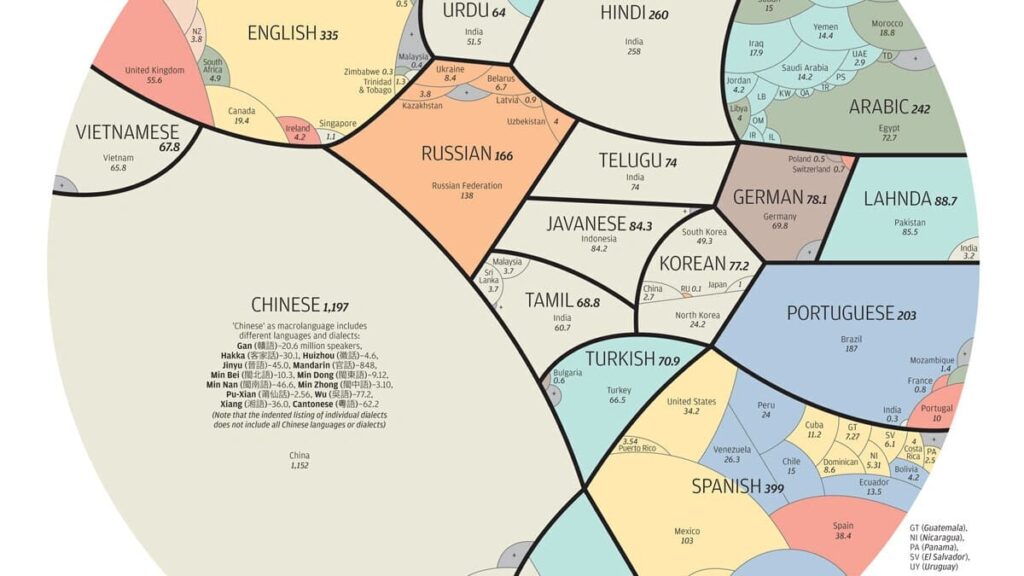
If you crave the perfect tool to measure native language communities, well, keep dreaming—it doesn’t exist. But the South China Morning Post (SCMP) created a solution: a bold circle chart mapping native speakers. VisualCapitalist runs with this version for its simplicity and striking clarity. Yes, other charts are out there, but unless you’re a hardcore linguist, you’ll probably prefer this straightforward approach. (Bonus: Each language’s color reflects its linguistic family—French, for example, sits with the Indo-European crowd.)
What the chart really shows: prepare to be surprised
When charting only native speakers, demographics reign supreme. Cast your eyes over the graphic, and — boom — the various dialects spoken in China absolutely dominate. The “Chinese” section of the chart outweighs Spanish, English, Arabic, and French combined. Beat that!
And India, with its 1.4 billion inhabitants? It’s a linguistic mosaic. Tamil alone boasts nearly 70 million speakers, mostly inside India’s borders, with Telugu and Marathi following suit. If you pooled them all under one “Indian” label, their share on the chart would be massive. Linguists resist this merger, though, because India’s languages differ from each other far more than China’s grouped dialects.
If you’re a French speaker and a tad alarmed by the small showing of French, don’t panic. Most native French speakers are in, well, France. But let’s not forget: French is also strong on the African continent. Thanks to Africa’s booming population growth, some estimates suggest French could be the world’s most widely spoken language by 2050.
- Chinese dialects, counted together, eclipse all major European languages—by a wide margin.
- India’s linguistic diversity keeps its languages separate on the chart, despite its huge population.
- French’s global share looks small now, but Africa’s population surge could rewrite that story in decades to come.
So what’s the final, and perhaps most shocking, takeaway? The real “champions” in the size race are often not the languages you hear in airports or see in blockbuster movies, but those quietly spoken in regions with immense populations and deep histories. And if you’re curious to see this chart in glorious detail, head right over to the linked high-resolution version—it’s as intuitive as it is colourful. Remember: language is more than borders or clichés—it’s the living rhythm of entire peoples.
You might also like:
- Kenyan startup’s robotic hands translate teacher’s voice into sign language for deaf students
- Think you know French expressions? Test your knowledge here
- Discover the surprising origins of insults
- Zack Polanski campaigning in Urdu: why he’s targeting Urdu-speaking voters
- India’s first bullet train launches as Japanese engineers modernize massive railway

David Miller is an entertainment expert with a passion for film, music, and series. With eight years in cultural criticism, he takes you behind the scenes of productions and studios. His energetic style guides you to the next big releases and trending sensations.


Can you believe the size of languages? Its like a linguistic rollercoaster, man! Some are tiny, others ginormous. Mind-blowing stuff, makes you wanna learn em all! Who knew words could be this wild?
Dang, right? Its like entering a linguistic circus! Some languages be all sleek and compact, while others are like a dictionary on steroids. Makes you wonder how our brains handle it all, huh? I mean, who knew words could pack such a punch? Its like an epic battle of vocabulary out there!
Hold up, this chart is a wild ride! Languages aint just words, theyre whole worlds. Like, how do you measure a languages true size? Its like trying to fit the universe into a shoebox! Mind blown.
Dude, who knew languages were like, this complex? Its like a whole universe in each one. Mind-blowing stuff. Makes you appreciate the worlds diversity, yknow? Crazy how much we still gotta learn.
I remember when I first learned that English isnt the biggest fish in the language pond. Blew my mind! This charts a real eye-opener. Cant trust maps or assumptions, huh? Gotta love a good reality check!
I remember in school, they never showed us this stuff! Crazy how languages stack up. Its like a whole new world out there, beyond what were used to. Makes you think, doesnt it?
Dude, this chart about languages? Mind-blowing. I mean, who knew there were so many ways to say hello worldwide? Now I feel small in this big ol linguistic universe.