
Show summary Hide summary
- How a $20 Print Caught Fire Online
- Buyers’ Stories: Real Experiences or Shared Narrative?
- What Experts Say: Psychology, Pareidolia, and Placebo
- Who’s Selling the Print and Where It Comes From
- How Faith Leaders and Communities Have Responded
- Practical Guide: If You’re Considering Buying One
- Marketplace Impact and the Economics of Viral Faith
- How to Evaluate Claims and Separate Story from Evidence
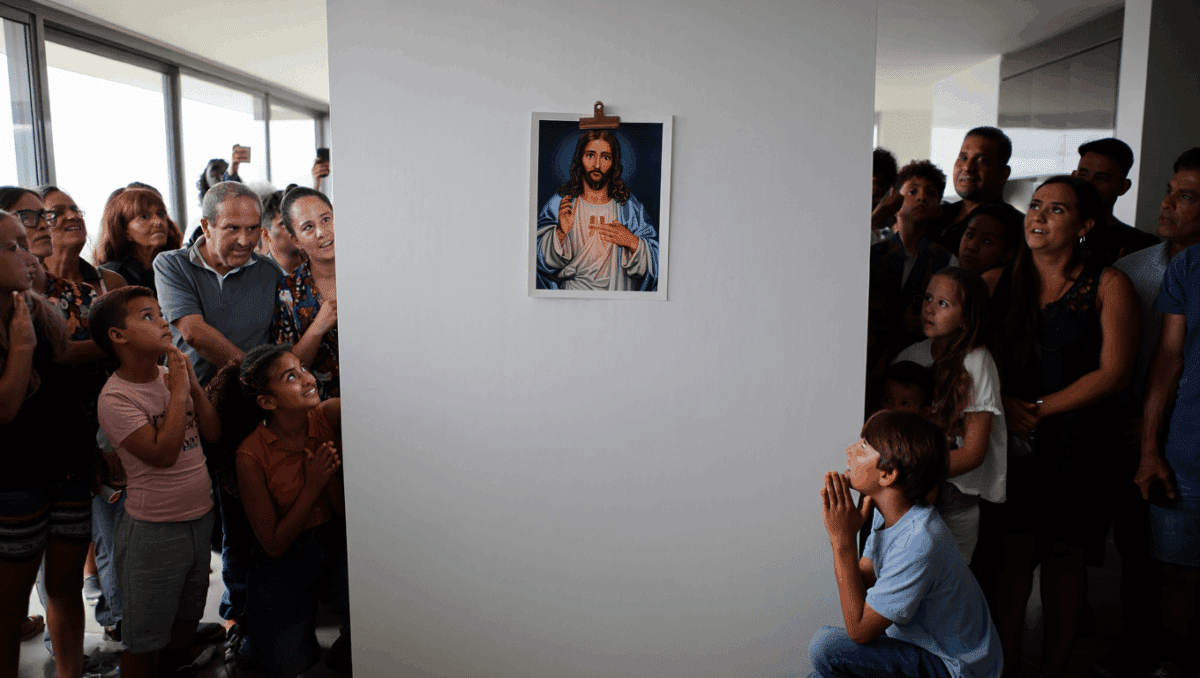
A small, inexpensive print of Jesus has become the latest internet sensation, drawing crowds, online debate, and a surprising number of buyers. What began as a casual listing has evolved into a cultural moment: people share stories of unexpected recoveries, family reunions, and emotional transformations — while skeptics point to coincidence, clever marketing, or visual tricks.
This is a look at how a $20 religious print went from a simple piece of wall art to a social-media phenomenon, what people claiming miracles say, and how experts explain the buzz. Below, you’ll find reporting on provenance, buyer experiences, scientific perspectives, and practical tips if you’re thinking of purchasing one.
How a $20 Print Caught Fire Online
What started as an unremarkable listing on a popular marketplace rapidly gained attention after a handful of posts went viral. Video snippets showed people holding the cheap print up to the light, or placing it at the bedside of an ailing relative, followed by captions claiming dramatic improvements in health or fortune.
The Growing Demand for Data-Driven Decision Making in Silicon Valley
He quit, ran out of money, and begged to come back — here’s how his boss reacted
Social platforms amplified those stories:
- Short-form videos with emotional music and before/after comparisons drew millions of views.
- Hashtags tied to faith and healing helped posts trend across communities.
- Reshare chains created a feedback loop: more views generated more testimonies, which generated more viewers.
What separates this from typical viral art trends is the mix of devotion and apparent personal testimony. For many, the item now functions as both décor and an object of hope.
Buyers’ Stories: Real Experiences or Shared Narrative?
People posting about the print fall into several categories: devout believers, curious collectors, and those who say they experienced tangible change. Their accounts range from subtle emotional shifts to claims of improved medical conditions.
Common claims include:
- Increased calm, reduced anxiety, or heightened faith.
- Unexpected reconciliations between family members after the print was placed in a home.
- Isolated reports of medical improvements attributed to prayer and the image.
Many of these stories are heartfelt and sincere. A few patterns stand out in interviews and comment threads:
- Testimonials often follow a shared format—context, crisis, intervention (the print), and turnaround.
- Video creators frequently show the print at the center of a ritual (candles, prayer, or a bedside placement).
- Follow-up posts solidify claims and fuel additional engagement.
What Experts Say: Psychology, Pareidolia, and Placebo
While some call these experiences miraculous, neuroscientists and psychologists offer alternative explanations. The brain’s tendency to find patterns and meaning—known as pareidolia—plays a role in how people interpret ambiguous visuals. More importantly, the placebo effect is a powerful force: expectation and belief can produce measurable changes in mood, pain perception, and certain health markers.
Key scientific points
- Pareidolia: The human brain is wired to recognize faces and meaningful patterns, even where none objectively exist.
- Placebo and expectancy: Belief in a treatment—whether a pill, ritual, or image—can trigger real physiological responses.
- Social reinforcement: Sharing success stories online magnifies perceived effects through community validation.
Medical professionals caution against substituting proven medical care with symbolic objects. However, many clinicians acknowledge that faith and ritual can complement treatment by improving mental well-being and adherence to therapy.
Who’s Selling the Print and Where It Comes From
The print itself is inexpensive and widely produced, often marketed as Christian décor. Listings identify it as a mass-printed image, typically sold through online marketplaces, church bookstores, and small retail vendors. Some sellers credit anonymous artisans or generic studios; others tack on a backstory to increase perceived value.
- Retail price frequently hovers around $20, though bundles or “blessed” versions fetch higher sums.
- Some vendors report spikes in sales after viral posts, prompting quick restocks and shipping delays.
- Copycat listings and low-quality reproductions have appeared as demand surged.
Questions of provenance rarely apply to mass prints, but when sellers or buyers add rituals (blessing the image, having it prayed over), the narrative shifts from commodity to relic — and people respond accordingly.
How Faith Leaders and Communities Have Responded
Reactions among clergy and faith communities are mixed. Some religious leaders embrace the renewed interest in devotional imagery, seeing an opportunity to foster prayer and community connection. Others warn against elevating an object above spiritual practice and emphasize discernment.
- Certain congregations organized viewing nights and prayer circles around the print, turning virality into communal worship.
- Other leaders issued statements cautioning against attributing miracles solely to a physical item.
- Charities and churches have used the attention to promote broader conversations about hope, health, and support services.
For many congregants, the print serves as a focal point — a tangible reminder of faith — rather than a substitute for scripture or pastoral care.
Practical Guide: If You’re Considering Buying One
If curiosity or faith leads you to purchase this print, here are practical steps to make a thoughtful choice:
- Verify seller reviews and shipping times before purchasing.
- Consider whether you want a framed or unframed version, and whether a local blessing or prayer matters to you.
- Be wary of high-priced “miracle” variants; mass-produced art rarely carries unique supernatural provenance.
- Keep medical care and professional advice as primary responses to health issues; use symbolic objects as supplemental comfort if desired.
Many buyers treat the print as a personal talisman — meaningful in private practice but not a replacement for structured support.
Marketplace Impact and the Economics of Viral Faith
The surge in interest has economic ripple effects. Sellers enjoy short-term windfalls, shipping companies handle new volume, and secondary markets emerge for “blessed” or signed variants. At the same time, increased demand invites copycats and price inflation.
Market dynamics to watch:
- Surge pricing on rare or framed editions.
- Growth of small vendors offering rituals or certificates of blessing for extra fees.
- Potential legal disputes over trademarked designs or unauthorized reproductions.
These patterns are familiar in viral merchandise cycles: attention creates demand, demand invites monetization, and the cycle feeds itself until interest stabilizes.
How to Evaluate Claims and Separate Story from Evidence
Navigating personal testimonies and viral claims requires critical thinking paired with respect for people’s experiences. Here are practical steps for readers who want to assess stories about the print’s alleged effects:
- Look for corroborated timelines and independent verification of any medical claims.
- Check whether follow-up reporting includes medical professionals or objective data.
- Distinguish between emotional healing and medical cures—both are important but different.
- Observe patterns: are claims consistent across diverse cases or clustered in specific communities?
Strong reporting and transparent sourcing help separate anecdote from evidence while respecting the deeply personal nature of belief-based experiences.
You might also like:
- AI homeless man trend sparks deepfake, safety and ethical concerns
- Trump’s war in Iran: goals, risks and what’s at stake for U.S. security
- Ultra-rare Pokemon card bought for $2 sells for $40,000 at auction
- 3 rebel nuns escape nursing home, return to abbey and win showdown with church
- Zootopia 2 sparks pet snake craze in China

William Anderson is a multimedia producer specializing in videos, podcasts, and interactive galleries. With five years of immersive content creation, he turns information into a rich audio‑visual experience. His storytelling skills draw you directly into the heart of every story, on any platform.


Ive seen folks swear by that $20 Jesus print like its the holy grail of interior decor. But come on, miracles? Maybe the real miracle is convincing people to drop cash on a picture thats one step away from a thrift store find.
I remember when my aunt swore her $20 Jesus print cured her back pain. Placebo or divine intervention, who knows? But hey, if it brings comfort, why not? Miracles or mind tricks, it’s all in the eye of the beholder.
I once bought a $20 print of a potato that looked like Elvis. Didnt make me sing better, thats for sure. Miracles? Doubt it. But hey, if it brings someone joy, why not?
I remember my cousin buying that $20 Jesus print. She swears her life turned around since. I mean, Im all for good vibes, but can a piece of paper really bring miracles? Sounds like a stretch to me.
I swear, I bought one of those $20 Jesus prints for my aunts birthday, and now she thinks its bringing her luck or something. Maybe its just mind games, but hey, if it works, who am I to judge?
I swear, that $20 Jesus print aint no different from those lucky rabbits feet folks used to carry around. Placebo effect or real deal? You tell me. *winks*
I aint saying that print will make you walk on water, but $20 for a miracle aint bad, huh? If it brings a lil extra positivity, why not? Lets see if it spreads good vibes or just burns a hole in your pocket!
Haha, $20 for a Jesus print that works miracles? Ive seen it all now! But hey, if it brings some good vibes, why not? Might as well hang it next to my lucky socks and see what happens!
I once bought a $20 Jesus print, thinking it was just decor. Next thing I know, my plants are thriving, my neighbors cat stopped yowling, and my WiFi speed doubled. Coincidence? Hmm, maybe not.
Man, I remember my aunt swears by this $20 Jesus print. Says it brought her luck. But, cmon, miracles? Sounds more like a placebo effect. Still, who am I to judge? If it gives folks hope, let em have it.
I swear, I once bought a $20 Jesus print at a garage sale, and my plants started thriving like never before. Coincidence? Maybe. But Im tempted to believe in the miracles now.
Man, thats wild! Maybe that Jesus print is secretly the MVP of plant care, who knew? Who needs plant food when youve got divine art, right? But seriously, thats some next-level green thumb magic!
You know, I once bought a $20 Jesus print at a yard sale. It fell off the wall, and I swear, my luck turned around right after. Coincidence or divine intervention? Who knows!
I remember my cousin swore his $20 Jesus print brought him luck in exams. I thought it was bogus, but now the internets on fire about it. Can a print really have that kind of power or are we just seeing what we wanna see?
Oh man, I remember Aunt Mildred buying one of those $20 Jesus prints. Swore it made her cat stop knocking over her plants. Placebo or divine intervention? Who knows, but its a real conversation starter at family dinners!