
Show summary Hide summary
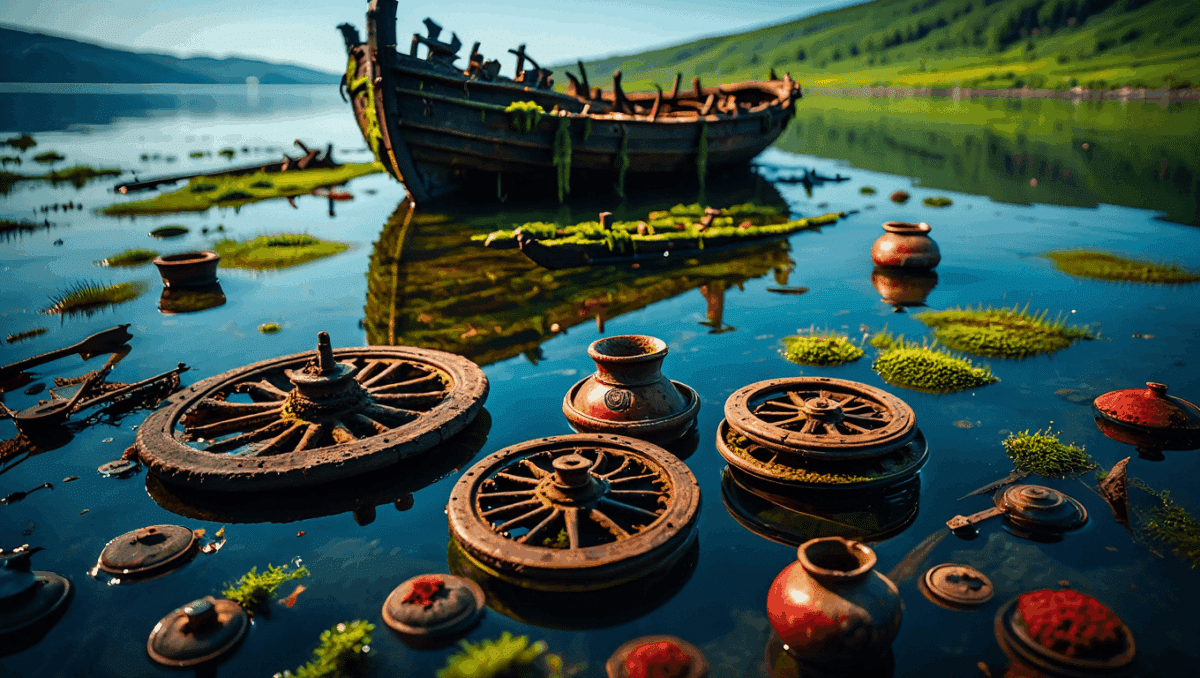
In late 2024, divers and archaeologists drew back a curtain on a 2,000-year-old cargo that had been sleeping beneath the black mirror of Lake Neuchâtel. The find — pottery, metalwork, tools and parts of a horse-drawn vehicle — reads like a short story of everyday life in Roman-era Switzerland, a snapshot of trade and military supply frozen in time.
The discovery began with aerial reconnaissance and ended with painstaking underwater recovery. Though the ship itself has not been found, the recovered goods are remarkable both for their preservation and for the window they offer into long-distance commerce and the logistics of Rome’s northern frontier.
How the underwater discovery unfolded and why it mattered
The site was pinpointed during systematic drone surveys that mapped large swaths of the lakebed. Once sonar and imagery suggested intact material on the bottom, regional authorities moved quickly. The Octopus Foundation, working alongside the Cantonal Archaeology Office of Neuchâtel, coordinated dives to secure the site before artifacts could be disturbed or looted.
The Growing Demand for Data-Driven Decision Making in Silicon Valley
He quit, ran out of money, and begged to come back — here’s how his boss reacted
Excavation dives began in March following the 2024 detection and continued in carefully controlled campaigns. Archaeologists ultimately brought up roughly 1,200 objects, a mix of fragile ceramics and sturdier metal items. Conservators emphasized the urgency: exposed, these waterlogged items can deteriorate rapidly, so recovery and stabilization had to come first.
Tools and techniques used underwater
- Drone and sonar mapping to locate promising anomalies across the lake bottom
- Targeted diver excavations for controlled retrieval of fragile objects
- Immediate conservation steps to prevent decay of wet wood, leather and ceramics
What was in the cargo: a trader’s load for Rome’s northern forces
The assortment of finds points to a civilian merchant load intended for military supply. Among the standout items were:
- Numerous ceramic vessels — plates, bowls, cups — produced across the Swiss Plateau
- Olive oil amphorae imported from Spain, demonstrating long-distance trade links
- Three swords, with one preserved inside a leather scabbard
- Metal tools including a pickaxe
- Components of a horse cart or chariot, notably including wheels
- A fibula brooch typical of the Roman Imperial period
- A waterlogged plank of wood used to help date the find
These objects together form a practical cargo: domestic tableware, foodstuffs in amphorae, tools and transport parts likely needed to keep animals and wagons on the move.
Linking the cargo to Rome’s northern frontier and ancient ports
Archaeologists working the site estimate the delivery was likely bound for the Roman garrison at Vindonissa along the Aare River, the base of the 13th Legion. Radiocarbon dating of organic materials and typological analysis of the brooch and pottery point to an early first-century CE date, roughly between 16 and 45 CE.
Vindonissa’s role was strategic: its legionnaires patrolled the frontier and guarded against incursions from Germanic groups to the north. The southern shore of Lake Neuchâtel likely hosted a bustling local port in antiquity — Eburodunum, today’s Yverdon-les-Bains — which could have been the vessel’s point of departure. The amphorae from Spain underline how connected Alpine and transalpine communities were to Mediterranean supply chains.
Conservation priorities and the open questions that remain
The Cantonal authorities described the haul as an “exceptional discovery,” rare for inland waters north of the Alps. Next steps include specialized conservation: stabilizing organic materials, desalination and slow drying protocols for wood and leather, and cleaning and consolidation of ceramics and metalwork. Once laboratories finish treatment, many items are slated for exhibition at the Museum of Archaeology of Neuchâtel.
Yet several mysteries remain unsolved:
- No hull has been identified — the absence of the boat itself complicates efforts to reconstruct the sinking event.
- The precise cause of the wreck is unknown. A sudden squall — Alpine lakes are notorious for rapid winds — could have capsized or overwhelmed the vessel, spilling its goods before the crew could salvage them.
- Questions about provenance and the full extent of the cargo linger; further surveys may reveal additional material nearby.
Conservators and archaeologists are continuing work both in the lab and on the lake, balancing quick action to protect artifacts with careful study to interpret the story they tell about trade, transport and military logistics in Roman-era Switzerland.
You might also like:
- Sunken medieval cargo ship found: largest of its kind ever discovered
- 1,500-year-old reindeer trap and hunting gear uncovered in Norway’s mountain ice
- Egypt sun temple uncovered: 4,500-year-old site reveals ancient sun worship
- 650-year-old shoe found in vulture nest with dozens of other artifacts
- Roman stone-lined basin discovered predates concrete, reveals advanced engineering

Michael Thompson is an experienced journalist covering U.S. and global news. With ten years on the front lines, he breaks down political and economic stories that matter. His precise writing and keen attention to detail help you grasp the real‑world impact of every event.


I mean, can you imagine stumbling on a 2,000-year-old shipwreck in a Swiss lake? Like, what were those Romans up to? Mustve been quite the sight underwater, finding all those chariot parts. Seriously, history never fails to surprise!
Yo, can you believe they found Roman chariot parts in a Swiss lake? Like, how did those end up there 2,000 years ago? Imagine cruising around in a chariot, then oops, splash! Mustve been a wild ride, literally!
Man, 2,000-year-old shipwreck artifacts in a Swiss lake? Thats like finding a treasure chest in your grandmas attic! Imagine the stories those Roman chariot parts could tell. History really is full of surprises, aint it?
A history buff here! Finding Roman chariot parts in a Swiss lake? Mind-blowing! Makes me wonder about the ancient trade routes and connections. Cant wait to see what other treasures lie beneath those waters!
I mean, who knew the Swiss lakes were hiding ancient Roman secrets? Imagine cruising around on a chariot 2,000 years ago, then oops, shipwrecked! Cool find, though. Wonder what other surprises are lurking down there.
I remember back in my archaeology days, finding ancient shipwreck stuff was like hitting the jackpot! Roman chariot parts in a Swiss lake? Thats wild! Bet they had some epic chariot races back in the day.
Man, imagine cruising in a Roman chariot in Switzerland back in the day! Crazy how those artifacts ended up in a lake. Wonder what other ancient goodies are hiding down there. Time for an underwater treasure hunt, anyone?
Dang, imagine cruising in a Roman chariot and suddenly… splash! Youre in a Swiss lake! Talk about a plot twist. Those 2,000-year-old shipwreck artifacts are like time travelers giving us a peek into ancient vibes. So, whos up for a dip?
I mean, can you imagine stumbling upon a Roman chariot at the bottom of a Swiss lake? Like, whoa, what a plot twist in history, right? It’s like diving into a real-life time machine. Wonder what other ancient treasures are hiding down there!
Dang, thats wild! Finding a Roman chariot chillin in a Swiss lake is like a history nerds dream come true. Its like the ultimate time-travel plot twist, right? Imagine the stories those ancient artifacts could tell. Bet theres more hidden treasures down there just waiting to be discovered. Time to grab a snorkel and join the underwater history club!
Man, I always knew those Swiss lakes had secrets! Roman chariots chillin underwater? Thats some epic stuff. Can you imagine the stories those artifacts could tell if they could talk? Wild!
Man, finding a Roman chariot in a Swiss lake? Thats some National Geographic stuff right there! Makes you wonder what other ancient treasures are lurking under the water. Cant wait for the next big discovery!
Dang, aint that the truth! Its like a real-life treasure hunt out there. Who knows, next thing you know theyll be pulling out Excalibur from a fish pond! Seriously though, makes you wonder what else is hiding down there, right? Cant wait to see what pops up next!
Dude, imagine cruising in a Roman chariot and then, oops, shipwrecked! Crazy how those artifacts in the Swiss lake survived 2,000 years. Bet that chariot owner was not a happy camper.
A history buff here, lemme tell ya, finding Roman chariot parts in a Swiss lake? Thats like stumbling upon a time capsule! The past just keeps on giving, huh? Cant wait to see what other ancient treasures pop up next!
Dang, finding Roman chariot bits in a Swiss lake? Thats like a history mixtape, yo! Can you imagine cruising in that ride back in the day? Time-travel goals, man.