
Show summary Hide summary
- Why this egg matters: proof that mammal ancestors laid eggs
- From field nodule to three-dimensional scan: how the embryo was revealed
- What the egg reveals about Lystrosaurus life history and survival strategy
- Scientific reactions: a milestone in paleontology and evolutionary biology
- Methods, dating, and what comes next for embryonic fossils
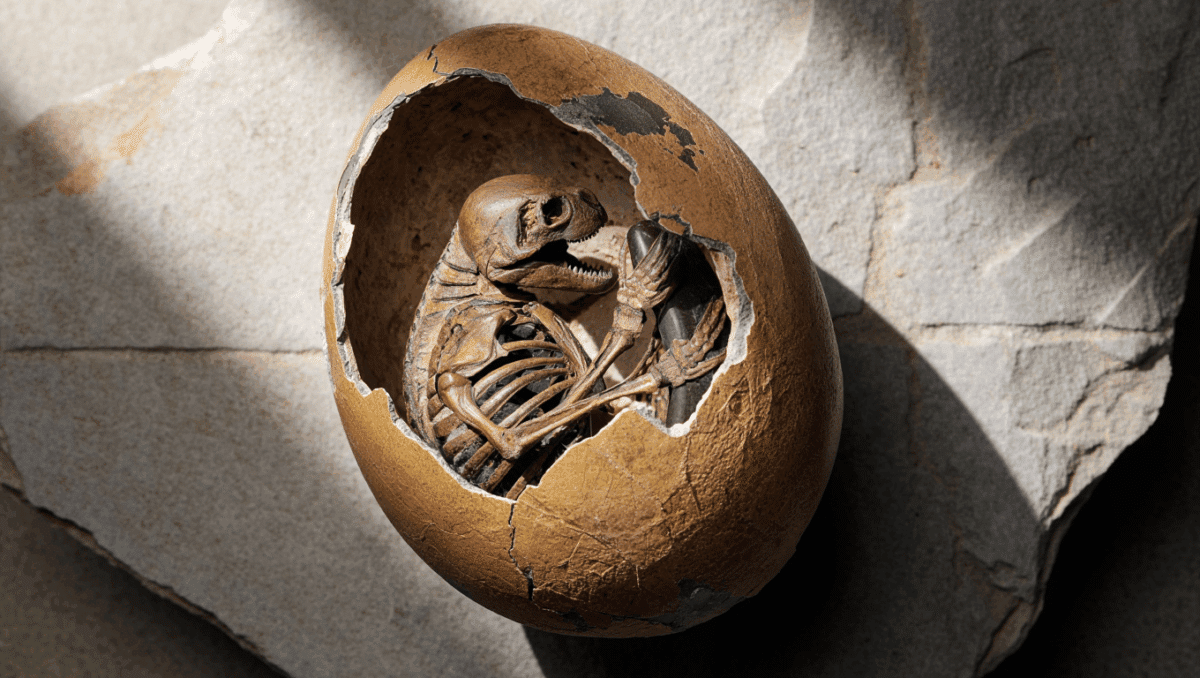
A fossil that sat in a nodule for millions of years has rewritten a chapter of vertebrate history. Scientists have identified an egg containing an embryo of Lystrosaurus—an iconic, pig-sized survivor of the planet’s worst extinction—offering the first direct proof that some distant mammal relatives reproduced by laying eggs.
The discovery adds a biological key to a long-standing mystery about therapsid reproduction and helps explain how Lystrosaurus dominated ecosystems after the End-Permian collapse. Advanced imaging, international collaboration, and a lucky field find combined to reveal anatomy so delicate that only modern technology could expose it.
Why this egg matters: proof that mammal ancestors laid eggs
The Growing Demand for Data-Driven Decision Making in Silicon Valley
He quit, ran out of money, and begged to come back — here’s how his boss reacted
Researchers publishing in PLoS ONE report that the fossilized egg is roughly 250 million years old and contains a curled embryo of Lystrosaurus, a stout, herbivorous synapsid often described as a mammal ancestor. For decades, paleontologists debated whether early therapsids gave birth to live young, like modern mammals, or laid eggs. This specimen settles that debate for at least some lineages.
The egg appears to have had a soft shell, which helps explain why such fossils are so rare; unlike the mineralized eggshells of many dinosaurs, soft-shelled eggs seldom survive fossilization. That scarcity means this fossil is not only the oldest clear evidence of egg-laying among mammal ancestors, but also extraordinarily unusual in the fossil record.
From field nodule to three-dimensional scan: how the embryo was revealed
The specimen was originally found in South Africa during a 2008 field trip. A skilled fossil hunter noticed a small concretion that, when prepared, revealed tiny fragments of bone. The object sat in collections until modern imaging methods made a non-destructive peek inside possible.
Cutting-edge imaging unlocked the details
Scientists used synchrotron x-ray computed tomography at the European Synchrotron Radiation Facility (ESRF) in France to scan the nodule. The technique produces extremely bright X-rays and ultra-high-resolution 3D images, allowing researchers to visualize minute, fragile bones without removing them from matrix.
The scans exposed a curled hatchling with skeletal features that signaled its developmental stage. In particular, the lower jaw showed an unfused mandibular symphysis—the two halves of the jaw had not yet fused—which indicates the embryo could not have fed on its own at the time it died. That anatomy supports the interpretation that the animal was still inside an egg when it died.
What the egg reveals about Lystrosaurus life history and survival strategy
Analysis of the egg and embryo gives a clearer picture of how Lystrosaurus reproduced and why it thrived in the difficult world after the End-Permian extinction.
- Large, yolk-rich eggs: The eggs were relatively large for the adult’s body size, suggesting ample yolk that could sustain development without post-hatching parental feeding.
- Precocial young: Hatchlings were likely well-developed at birth—able to move, feed, and evade danger much sooner than altricial species that require extensive parental care.
- Adaptation to arid conditions: Bigger, yolk-rich eggs are less prone to desiccation, an advantage in the hot, drought-ridden environments that followed the mass extinction.
- No evidence of lactation: The reproductive strategy inferred from the egg implies Lystrosaurus did not depend on milk to nourish young, unlike later true mammals.
Taken together, these traits suggest a life-history strategy of rapid maturity and early independence—traits that would be highly advantageous in unstable, resource-poor ecosystems and help explain Lystrosaurus’s ecological success.
Scientific reactions: a milestone in paleontology and evolutionary biology
Scientists involved in the study described the find as a major breakthrough. The ability to visualize and interpret delicate embryonic bones provides direct evidence for reproductive modes in deep time, answering a question that had persisted for generations.
This is the first time a fossil egg has been confidently linked to a therapsid in South African collections, and it represents the earliest clear case of egg-laying behavior among the lineage that eventually led to mammals. That makes the discovery a landmark for both regional paleontology and the broader study of vertebrate evolution.
Broader implications for climate resilience and biology
Beyond the evolutionary novelty, researchers argue the fossil offers lessons about survival under rapid environmental change. By examining how a species adapted its reproductive strategy to extreme post-extinction conditions, scientists can better understand the range of biological responses to climate stress—insights that feed into models of modern biodiversity resilience.
Methods, dating, and what comes next for embryonic fossils
The team combined field stratigraphy with high-resolution synchrotron imaging to place the egg in time and context. Radiometric constraints and the fossil’s geological setting align it with the recovery phase after the End-Permian event, about a quarter-billion years ago.
Because soft-shelled eggs seldom fossilize, researchers expect such finds to remain rare, but the successful use of non-destructive imaging opens new opportunities. Planned next steps include:
- Re-examining museum collections for other nodules with ambiguous bone fragments.
- Applying similar synchrotron CT methods to promising specimens worldwide.
- Comparative studies to track the evolution of reproductive traits across therapsids and early mammals.
As teams revisit historical finds with modern tools, the fossil record may yield more surprises about how ancient animals bred, grew, and adapted—details that until now have been locked inside stone. This Lystrosaurus egg provides a rare, intimate glimpse into embryonic life at a turning point in Earth’s history and sets the stage for additional discoveries that could reshape our understanding of early vertebrate reproduction
You might also like:
- Gobi Desert fossil discovery upends timeline of mammal evolution
- 289-million-year-old fossil reveals earliest known lung function, mummified skin, scales, proteins
- Prehistoric fish fossil rewrites evolution, reveals origins of catfish and carp
- Marsupials discovered after 6,000 years presumed extinct
- Platypus fossil reveals it swam with dolphins 25 million years ago

Michael Thompson is an experienced journalist covering U.S. and global news. With ten years on the front lines, he breaks down political and economic stories that matter. His precise writing and keen attention to detail help you grasp the real‑world impact of every event.


Man, finding out that mammal ancestors laid eggs is mind-blowing! Imagine the drama in the prehistoric bird family when they found out! Natures full of surprises, aint it?
Man, talk about a blast from the past! Finding an embryo fossil that hints at mammal ancestors laying eggs? Thats like rewinding the history tape and discovering a whole new chapter. Natures full of surprises, aint it?
Man, finding out that mammal ancestors used to lay eggs is mind-blowing! Imagine a world where wed be collecting mammal eggs for breakfast… Wait, that sounds kinda weird now that I say it out loud. Nature is wild, yall.
Yo, imagine waking up to a plate of mammal eggs every morning! Natures got some funky surprises up its sleeve, huh? But yo, collecting mammal eggs for breakfast? Thats a bit too Jurassic Park for my liking. Who knows what other wild secrets Mother Natures hiding, right?
I remember when Uncle Bob wouldnt stop yapping about mammals laying eggs. Everyone thought he was cookoo. Now, look at this fossil! Whos laughing now, Uncle Bob? Science rocks!
I never knew mammal ancestors laid eggs, wild! Imagine a furry egg, ha! This discoverys like finding out your grandpa had a secret rock band. Science keeps dropping plot twists, love it!
Man, this discoverys like a plot twist in a sci-fi movie! Mammal ancestors laying eggs? Mind blown! Can you imagine the chaos if our furry friends still popped eggs like chickens? Natures full of surprises, huh?
Man, this discovery about mammal ancestors laying eggs really shakes up the family tree, huh? Imagine finding out your great-great-grandpappy was an egg-layer! Nature sure loves to keep us on our toes with these twists and turns.
Man, talk about surprises in the fossil game! Who knew mammal ancestors were egg-droppers? Natures full of curveballs, aint it? Cant wait to see what other secrets those ancient rocks are hiding.
Man, who wouldve thunk it? Mammal ancestors laying eggs like birds? Natures full of surprises, aint it? Bet they had their own reality show back then: Lystrosaurus, The Original Eggheads.
Man, this finds like a plot twist in a B-rated sci-fi flick! Mammal ancestors laying eggs? Mind blown! Natures full of surprises, aint it? Cant wait for the next scoop from the prehistoric gossip mill!
Ugh, this makes me rethink my whole biology class back in school. Imagine if we hatched from eggs like Lystrosaurus? Id have cracked mine way too early, thats for sure! Natures full of surprises, aint it?
Man, imagine being an early mammal ancestor popping out an egg! This discoverys like rewinding the tape on evolution, catching our ancient peeps in egg-laying action. Natures full of surprises, aint it?
I mean, who wouldve thought, right? Mammal ancestors popping out eggs like its no big deal. Next thing you know, well find out T-Rexes were actually herbivores. Science, man, always keeping us on our toes!
Dude, its like were in some sci-fi flick where the plot twists keep coming! First, mammals laying eggs, now T-Rexes on a salad diet? Whats next, pigs flying? Science really be playing 4D chess with us!
I remember when I found a dino toy buried in my backyard – thought I hit the jackpot! But this? A real embryo fossil revealing mammal ancestors laid eggs? Mind blown. Natures full of surprises, aint it?
Man, this fossil find is mind-blowing! Who knew our mammal ancestors were egg layers? Natures full of surprises, innit? Makes you wonder what other cool secrets are still buried out there.
I remember when folks used to argue if mammals laid eggs or not. Well, guess what? This embryo fossil just dropped the mic, showing our ancestors did the egg dance way back. Natures surprises, huh?
Man, who woulda thought, right? Mammals layin eggs! Natures full of surprises. Cant wait to see what other mind-blowin discoveries are lurkin out there. Science keeps us on our toes, for real.
Man, this discovery about mammal ancestors laying eggs is mind-blowing! Imagine the drama back then: To lay or not to lay, that is the evolutionary question. Cant wait for the next fossil soap opera episode!
Man, talk about a blast from the past! Who knew mammal ancestors were egg layers? Natures full of surprises. Makes you wonder what other secrets are hidden out there, huh?
Dude, mind-blowing, right? Natures like a box of chocolates – you never know what youre gonna get! Who knows what other wild secrets Mother Earths hiding from us? Maybe next well find out aliens are real or Bigfoots just a really hairy dude on holiday. Lifes full of surprises, man!