
Show summary Hide summary
- Where the fossil came from: Richards Spur’s extraordinary preservation
- A “mummified” reptile with three-dimensional skin and cartilage
- Modern imaging revealed hidden anatomy without damage
- Evidence for early rib-driven breathing in an amniote
- Molecular traces: the oldest protein remnants yet identified
- Researchers, museums and the road ahead
- How this find changes our view of early land vertebrates
A tiny reptile that perished in an Oklahoma cave almost 289 million years ago is rewriting the story of how early land animals breathed and how soft tissues can survive through deep time. Researchers say the specimen, preserved in remarkable three-dimensional detail, offers a rare window into the anatomy and biochemistry of early amniotes from the Permian period.
More than just bones, the fossil retains scaly skin, calcified cartilage and molecular traces that push back the age of recovered protein remnants by tens of millions of years. The discovery helps scientists connect anatomical features to the physiological shift that let vertebrates become more active on land.
Where the fossil came from: Richards Spur’s extraordinary preservation
The Growing Demand for Data-Driven Decision Making in Silicon Valley
He quit, ran out of money, and begged to come back — here’s how his boss reacted
The specimen was excavated from the Richards Spur locality in Oklahoma, a fossil site famous for its exceptional record of terrestrial vertebrates from the late Paleozoic. Unique local conditions—anoxic muds and petroleum-rich seepage—created an environment that inhibited decay and preserved delicate tissues that rarely survive the fossilization process.
- Location: Richards Spur cave systems, Oklahoma.
- Geological age: Early Permian, roughly 289 million years old.
- Preservation factors: Oxygen-poor sediments and hydrocarbon seepage limited microbial activity and stabilized soft tissues.
A “mummified” reptile with three-dimensional skin and cartilage
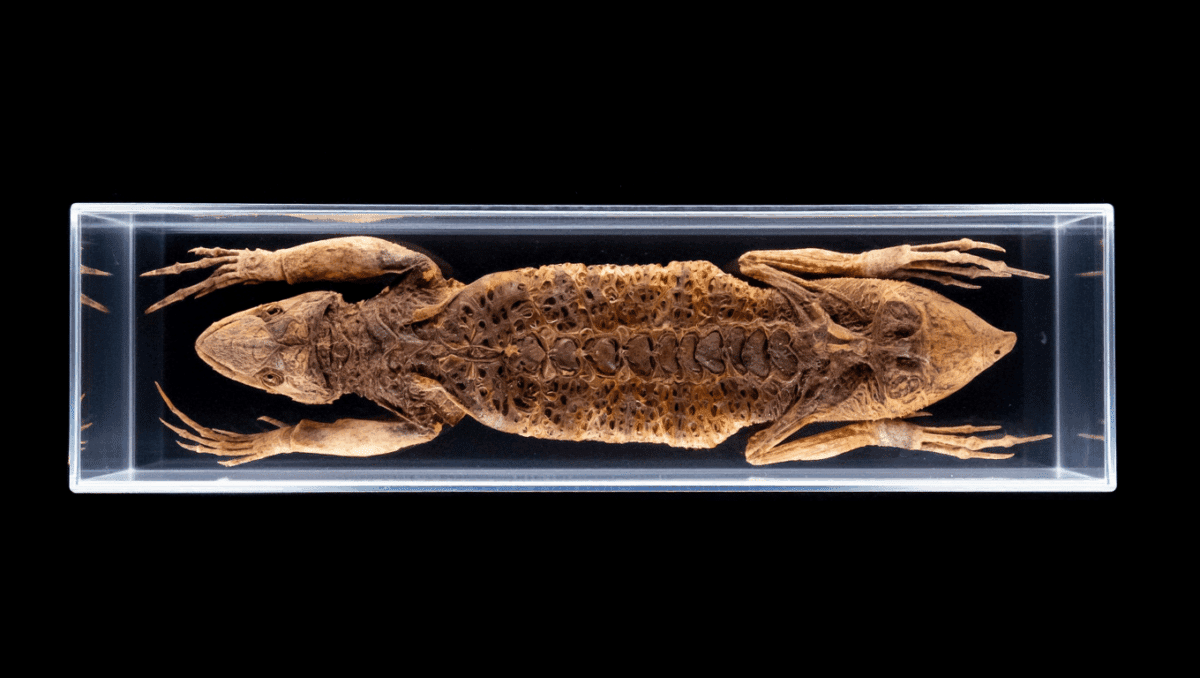
The animal, identified as Captorhinus aguti, is small—only a few inches long—but extraordinarily well-preserved. Rather than a flattened impression, the specimen retains a near-life-position layout, with limbs and torso preserved in three dimensions. Researchers describe the skin as scaly and textured, wrapping the body with an accordion-like pattern similar to scales in some modern burrowing reptiles.
What was preserved
- Three-dimensional epidermal scales covering the torso and neck
- Calcified cartilage and segmented sternal elements
- Connective structures linking the ribcage to the shoulder girdle
Such fidelity of soft-tissue preservation is exceptionally rare for fossils of this age, allowing paleontologists to examine anatomical features normally lost in older specimens.
Modern imaging revealed hidden anatomy without damage
To study internal details without destroying the fossil, the team used advanced imaging techniques. Neutron computed tomography (nCT) provided high-resolution, noninvasive scans that penetrated the surrounding matrix, revealing thin sheets and tissues wrapped around bones. In addition, synchrotron-based infrared spectroscopy was applied to detect chemical signatures preserved inside the fossil material.
- Neutron computed tomography (nCT): mapped internal structures in 3-D.
- Synchrotron infrared spectroscopy: identified molecular residues consistent with protein remnants.
Evidence for early rib-driven breathing in an amniote
Among the most consequential discoveries was a detailed arrangement of ribs, a segmented sternum, and rib-to-shoulder connections that together form a functional respiratory apparatus. These elements indicate that Captorhinus used costal aspiration—the expansion and contraction of the ribcage by intercostal muscles—to ventilate its lungs, a breathing strategy common in most modern reptiles, birds and mammals.
Before the evolution of costal aspiration, many amphibian-like vertebrates relied on cutaneous respiration (breathing through the skin) and buccal pumping, which uses throat and mouth movements to move air. Those methods limit oxygen intake and reduce sustained activity. The rib-driven system evident in Captorhinus would have allowed deeper, more efficient breathing and greater endurance.
Why this matters
- Physiological advantage: Improved oxygen delivery supports higher activity levels.
- Ecological impact: Enhanced respiration likely facilitated wider terrestrial dispersal and diversification of early amniotes.
- Evolutionary implication: The anatomy suggests rib-assisted breathing was already established early in amniote history, potentially ancestral for reptiles and their descendants.
Molecular traces: the oldest protein remnants yet identified
Beyond anatomy, the team detected chemical signatures in bone, cartilage and skin consistent with original proteinaceous material. These molecular remnants are significantly older—by nearly 100 million years—than previously confirmed protein detections in the fossil record, making this one of the most ancient cases of soft-tissue chemistry preservation reported to date.
The presence of preserved protein fragments pushes the limits of what scientists thought possible for molecular preservation and opens new possibilities for studying the biology of very ancient animals using both anatomical and biochemical lines of evidence.
Researchers, museums and the road ahead
The study was led by a team that included Ethan Mooney, who helped drive analysis while a student at the University of Toronto, working with veteran paleontologist Robert R. Reisz. Imaging work was carried out at specialized international facilities, and the analyzed specimens are now curated at the Royal Ontario Museum in Toronto for ongoing and future research.
- Key contributors: University of Toronto researchers, collaborators at Harvard and international imaging centers.
- Specimen repository: Royal Ontario Museum, Toronto.
- Next steps: Further molecular analyses and comparative studies to place the breathing apparatus more precisely in the amniote family tree.
How this find changes our view of early land vertebrates
This fossil provides both anatomical and chemical evidence that a major respiratory innovation—costal aspiration—was present in early amniotes, offering a mechanism for increased activity and ecological success on land. Coupled with exceptional soft-tissue preservation, the specimen gives paleontologists a rare chance to reconstruct not only shape and posture, but also functional biology and molecular composition in a Permian-era reptile.
You might also like:
- Prehistoric fish fossil rewrites evolution, reveals origins of catfish and carp
- Ancient snake found in London museum: what we know
- Triceratops huge nose helped regulate body temperature, study suggests
- 90-million-year-old missing link fossil of tiny bird-like dinosaur discovered
- Pachycephalosaur skull upends understanding of dome-headed dinosaurs

Michael Thompson is an experienced journalist covering U.S. and global news. With ten years on the front lines, he breaks down political and economic stories that matter. His precise writing and keen attention to detail help you grasp the real‑world impact of every event.


Man, this fossils like a time machine! Imagine rocking those scales and proteins 289 million years ago. Crazy how modern tech unveils hidden details without wrecking it. Natures secrets, yall!
Whoooa, hold up! A 289-million-year-old fossil spillin the tea on its lung game? Thats some next-level history right there! Can you imagine the stories that reptile could tell if it could talk? Time-traveling lizard goals!
Man, this fossil discoverys like a time machine to the past! Imagine the secrets those 289-million-year-old scales hold. Its wild how modern tech can unveil ancient mysteries without breaking a sweat. Natures time capsule, right?
No way, dude, a 289-million-year-old fossil spillin all the tea on ancient lungs, skin, scales, and proteins? Thats some next-level T-rex drama right there! Mother Natures original reality show, am I right?
Man, finding a 289-million-year-old fossil with mummified skin and lung function? Thats like unearthing a time capsule from Mother Nature herself! Can you imagine the stories this ancient reptile could tell us? Just wow.
Man, finding a fossil thats been chilling for 289 million years? Thats like winning the jackpot of time capsules! Imagine the stories that old boy could tell. Bet its got some real tea to spill on the dino drama back in the day!
I remember my grandpa talking bout fossils, but this? A 289-million-year-old lung! Crazy, right? Like time travel! Makes you wonder what else is hidden out there in the rocks. Natures own time capsule!
Dang, that 289-million-year-old fossil is like a time machine to prehistoric days! Mummified skin, lung function, scales… Its like Jurassic Park, but real! Natures own blockbuster movie, right in our hands.
Whoa! Imagine finding a 289-million-year-old fossil with mummified skin and lung function. Thats like a time capsule from the past! Its mind-blowing how modern tech can unveil hidden secrets without wrecking the find.
Man, finding a 289-million-year-old fossil with mummified skin and protein still intact, its like straight out of a sci-fi flick! Imagine the stories that ancient reptile could tell. Natures mysteries never fail to amaze.
Man, finding a 289-million-year-old fossil with mummified skin and lung function? Thats like hitting the jackpot in the paleontology world! Makes you wonder what other ancient secrets are still buried out there, waiting to be discovered.
Whoa, this fossils like a time machine to the prehistoric spa! Mummified skin, scales, and lung function, talk about being well-preserved. Makes you wonder what ancient beauty routines were like, huh?
Whoa, talk about a blast from the past, right? Its like stumbling upon a cavemans skincare secrets. I bet they were all about that natural glow way before it was trendy. Wonder if they had a DIY mud mask recipe or if they simply rubbed dino droppings on their faces for that prehistoric glow!
Whoa, imagine finding a 289-million-year-old fossil with mummified skin and lung function! I mean, talk about a blast from the past. Nature sure knows how to keep secrets, huh? Wonder what other surprises are hidden out there.
Whoa, talk about a blast from the past! This ancient fossil is like a time machine. Imagine peeking into the world 289 million years ago… Gives me goosebumps! Cant wait for more mind-blowing discoveries.