
Show summary Hide summary
- Where the specimen came from and why museums matter for discoveries
- What makes this ancient snake “bizarre” — unusual anatomy explained
- How modern methods reshaped the interpretation
- Implications for our understanding of snake origins and evolution
- What remains uncertain and the next steps scientists are taking
- Why this discovery resonates beyond paleontology
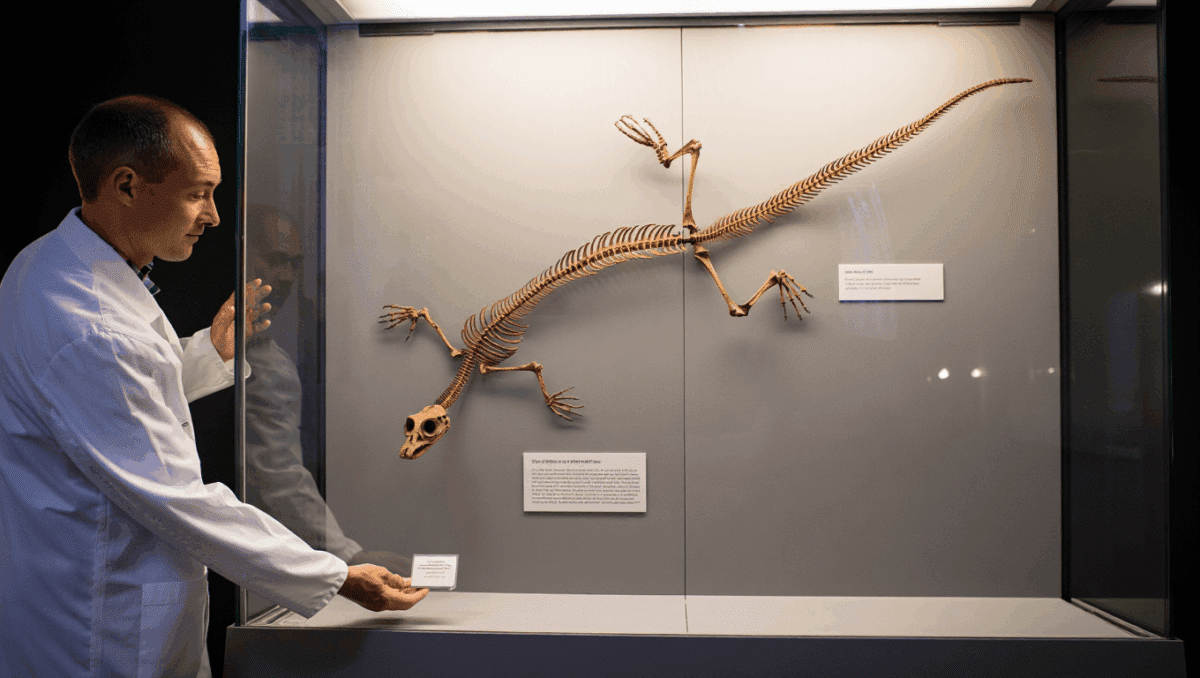
A forgotten fossil tucked away in a London museum drawer has scientists rethinking what an ancient snake might have looked like. Once cataloged as an odd reptile from a bygone excavation, the specimen has now been reexamined with modern imaging and fresh eyes — revealing a creature whose mix of features appears to straddle the line between lizard and snake, and raising new questions about early snake evolution.
Researchers say the fossil’s combination of unusual vertebrae, unexpected limb remnants, and other skeletal oddities make it one of the more puzzling reptile remains to surface from museum collections in recent years. As paleontologists apply CT scanning and comparative anatomy, the specimen is being reinterpreted not as a simple curiosity but as a key piece in the puzzle of how snakes emerged and diversified.
Where the specimen came from and why museums matter for discoveries
The fossil was part of a long-standing collection housed at a major London natural history institution. Many such museums contain thousands of labeled items that were cataloged decades — even centuries — ago. Over time, shifts in research priorities and storage practices mean some specimens are rarely revisited.
The Growing Demand for Data-Driven Decision Making in Silicon Valley
He quit, ran out of money, and begged to come back — here’s how his boss reacted
- Rediscovery: A routine audit or a researcher’s curiosity often brings forgotten fossils back into the spotlight.
- Technology gap: Older specimens were identified before modern imaging; CT scanning and 3D modeling can reveal internal details unseen by earlier researchers.
- Context recovered: Newer comparative collections and databases let scientists place odd fossils into updated evolutionary frameworks.
Because this specimen had been misfiled or overlooked, it effectively became a time capsule: the bones themselves were old, but the questions being asked about them are new.
What makes this ancient snake “bizarre” — unusual anatomy explained
The fossil drew attention for a handful of striking anatomical traits. Rather than fitting neatly into modern snake anatomy, the bones show a mosaic of features that suggest a transitional form.
Key skeletal oddities
- Vertebrae shape: The spinal bones are elongated and display peculiar articulations, suggesting a body plan adapted for sinuous movement but not identical to today’s snakes.
- Possible limb remnants: Tiny pelvic elements or limb-associated bones appear present in places where modern snakes lack them entirely, hinting at retained ancestral traits.
- Cranial fragments: Partial skull pieces indicate a skull structure that is neither fully lizard-like nor fully snake-like, with jaw and palate features that complicate classification.
Scientists refer to such a combination as a “mosaic” because the animal appears to have retained some primitive lizard traits while evolving snake-like characteristics in other parts of its skeleton.
How modern methods reshaped the interpretation
When the fossil last received detailed attention, researchers relied largely on surface examination and basic radiography. The recent study incorporated modern tools that allowed a much deeper look.
- CT scanning: High-resolution computed tomography provided a three-dimensional view of internal structures, revealing hidden bone fragments and the arrangement of the vertebrae.
- 3D reconstruction: Digital modeling let scientists manipulate and compare the specimen to living and extinct reptiles without risking damage to the original fossil.
- Comparative analysis: Access to extensive digital libraries of snake and lizard anatomy enabled more precise comparisons across a wide evolutionary span.
These methods helped clarify which features were anatomical and which could be the result of fossil distortion or post-burial deformation, strengthening the argument that the oddities are biological rather than taphonomic.
Implications for our understanding of snake origins and evolution
If the specimen represents an intermediate stage, it has potentially important implications for several long-debated questions in paleontology and evolutionary biology.
- Timing of limb loss: The presence of limb-like bones suggests that limb reduction in early snakes may have been a gradual process, occurring in different ways across lineages.
- Habitat transitions: Features of the vertebrae and skull can suggest whether early snakes were moving toward a burrowing, aquatic, or surface-active lifestyle.
- Multiple origins? Mosaic anatomy supports the idea that modern snakes may have evolved diverse body plans from several lizard-like ancestors rather than from a single, uniform transformation.
Researchers caution that a single specimen cannot settle big debates. Still, every new data point reshapes the tree of relationships and invites fresh hypotheses about ecological pressures that drove early snake diversification.
What remains uncertain and the next steps scientists are taking
Several important questions about the fossil remain open, and researchers have outlined follow-up work to resolve them.
- Precise dating: Establishing the rock layer or the original excavation context will help pin down how old the specimen is and link it to global evolutionary events.
- Further imaging: Additional scans at different resolutions can reveal microstructures, such as growth lines, that indicate age and development.
- Comparative fieldwork: Searching museum holdings and field sites for additional material could yield more complete skeletons or associated fauna that clarify lifestyle.
Scientists also plan to publish detailed morphometric datasets so other researchers can test competing interpretations. Open data and collaborative reanalysis are central to confirming whether this fossil truly changes prevailing views.
Why this discovery resonates beyond paleontology
Finds like this capture public imagination because they narrate the messy, stepwise process of evolution. The specimen illustrates how traits can appear, persist, and fade across long spans of time — and how a single bone reexamined with new tools can pivot scientific thinking.
- Museum science: The case highlights the ongoing value of natural history collections for fresh discoveries.
- Public engagement: Strange, intermediate fossils are accessible stories that help non-specialists grasp evolutionary concepts.
- Interdisciplinary work: Combining paleontology, imaging technology, biomechanics, and comparative anatomy shows how modern science operates across fields.
As researchers continue to study the specimen, they emphasize that reinterpreting museum material is a powerful, cost-effective way to expand our knowledge of ancient life and the deep history of familiar animal groups like snakes.
You might also like:
- Prehistoric fish fossil rewrites evolution, reveals origins of catfish and carp
- 90-million-year-old missing link fossil of tiny bird-like dinosaur discovered
- Pachycephalosaur skull upends understanding of dome-headed dinosaurs
- Gobi Desert fossil discovery upends timeline of mammal evolution
- 289-million-year-old fossil reveals earliest known lung function, mummified skin, scales, proteins

William Anderson is a multimedia producer specializing in videos, podcasts, and interactive galleries. With five years of immersive content creation, he turns information into a rich audio‑visual experience. His storytelling skills draw you directly into the heart of every story, on any platform.


A conspiracy nut: A snake in a museum? Sounds suspicious. Theyre hiding something, mark my words. Ancient snake or not, the real question is: what else are they keeping from us, huh?
I remember visiting that museum once, tripped on a rug, almost knocked over some ancient vase. But this snake, man, thats wild. Bet it has some tales to tell. Wonder what other creatures are hiding in those dusty old drawers.
Man, can you believe they found an ancient snake in a London museum? Wild stuff. Makes you wonder what other crazy relics are chillin in those dusty old cabinets. Who knew history could be this cool, right?
Mate, imagine finding a fossilized snake in a London museum! Reminds me of that time I found an old sock under my bed, but way cooler. Museums really hold some wild stuff, eh?
I remember seein a massive snake skeleton in a museum once, thought it was fake til I got up close. Fascinatin stuff, mate. Cant imagine what folks back in the day thought when they stumbled upon these beasts!
Man, I swear, that snake skeleton had me shook too when I saw it up close! Crazy how those ancient folks mustve felt stumbling upon those massive beasts. Imagine the mix of fear and wonder, right? Natures wild, mate.
I remember watchin a documentary bout ancient civilizations, and they mentioned some wild creatures. This snake find in Londons museum is somethin else! Makes ya wonder what else is hidden in those dusty old shelves.
Mate, didnt know snakes had VIP access to museums! Imagine if this ancient fella could spill tea on its adventures. Museum mysteries, innit? Wonder if its got any cool snake bling hidden in there!
Dang, that ancient snake discovery in Londons museum got me thinking – imagine stumbling upon that beast back in the day? Bet those folks had a wild time explainin that one to their pals!
I remember hearin bout this ancient snake found in a London museum! Crazy how these discoveries pop up, innit? Makes me wonder what else is lurkin in museums around the world. Excitin stuff, mate!
Who knew London museums were hiding ancient snakes? Imagine stumbling upon that during a school trip! Makes you wonder what other creepy crawlies are lurking in those dusty corners, eh?
A quirky conspiracy nut: I always knew those museums had secrets! Ancient snakes in London? Whats next, a mummys curse? Keep your eyes peeled, folks, the truth is out there!
Mate, imagine finding an ancient snake in a museum! Thats like a plot twist in a B-grade horror flick. But hey, props to museums for preserving this bizarre piece of history. Who knows what other creepy crawlies are lurking in there?
Yo, aint it wild how this ancient snake popped up in a London museum? Like, imagine strolling through artifacts and bam, a prehistoric reptile. Museum game strong, keepin history alive, man.
Mate, Im telling ya, finding an ancient snake in a London museum is like stumbling upon a relic from another world. Makes you wonder what else is lurking in those dusty old shelves, eh? Cheers to museums for keeping these weird wonders alive!