
Show summary Hide summary
- From Donegal Bay to Boston: A Rare Ocean Trek
- How Scientists Matched the Whale Across Oceans
- What This Movement Indicates About the Species
- Other Notable Voyages: Recent Examples of Long-Distance Travel
- Why Tracking Individuals Matters for Conservation
- About North Atlantic Right Whales: Size, Numbers, and Distinctive Traits
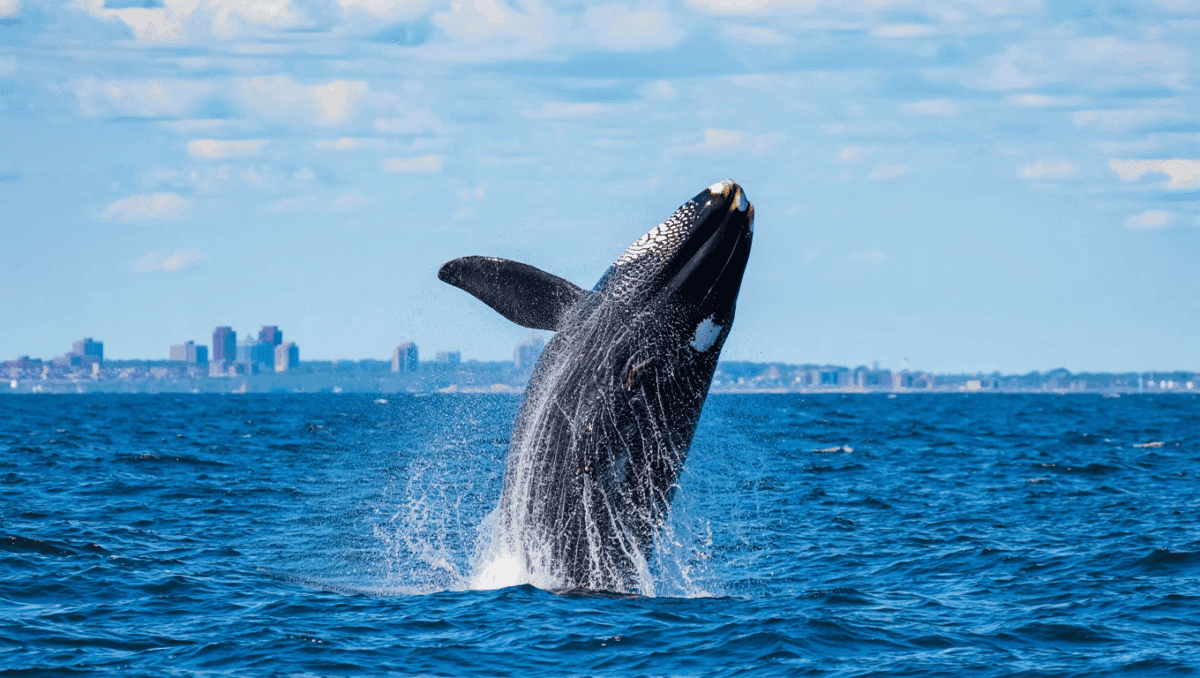
The sighting of a North Atlantic right whale off Ireland in July 2024 stunned marine researchers—and months later that same individual turned up near Boston, creating one of the most surprising migration stories of the year. What began as a rare European sighting became an international detective story, as scientists pieced together photo IDs and catalog records to confirm that a single adult whale had crossed thousands of miles of ocean to reappear in New England waters.
The animal’s journey is more than a curiosity; it provides a fresh glimpse into how this critically endangered species is moving across the Atlantic as populations attempt to recover. Researchers say the episode raises as many questions as it answers about habitat use, travel routes, and the long-term survival of North Atlantic right whales.
From Donegal Bay to Boston: A Rare Ocean Trek
When observers first recorded the right whale in Donegal Bay, Ireland, they knew they were seeing something unusual—right whales are seldom reported in those waters. Then, on November 19, a scarred adult surfaced about 23 miles off the coast of Massachusetts. Specialists at the New England Aquarium and the Center for Coastal Studies independently reviewed photographs and determined it was the same whale seen months earlier in Irish waters.
The Growing Demand for Data-Driven Decision Making in Silicon Valley
He quit, ran out of money, and begged to come back — here’s how his boss reacted
This transatlantic connection—an individual identified in Europe and then in New England—has not been documented in living memory and may be the first verified example in a century. While historical whaling records hint that the species once ranged widely along both sides of the Atlantic, modern documentation of such movements has been virtually nonexistent until recently.
How Scientists Matched the Whale Across Oceans
Identification relied on careful photographic comparison and established cataloging practices used by whale researchers worldwide.
- Field teams photographed unique scarring and callosity patterns on the whale’s head and body.
- Those images were checked against the New England Aquarium’s right whale catalog, which includes known individuals and their distinguishing marks.
- Catalog analysts linked the November sighting to the July images from Ireland based on matching scar patterns and other features.
According to the surveyor who first recorded the New England sighting, the encounter felt routine at the moment—just the season’s first right whale—but the catalog match later revealed its extraordinary significance. Scientists emphasize the importance of photographic IDs for tracking movements of a population numbering only a few hundred animals.
What This Movement Indicates About the Species
Marine biologists are interpreting the event as part of a broader pattern of unexpected movements among right whales. In recent years, several individuals have shown atypical travel behavior, suggesting the species may be expanding its search for suitable feeding and breeding habitat as environmental conditions shift.
Key points researchers are considering:
- Changes in ocean temperatures and prey distribution may push whales into new areas.
- Small population size increases the visibility of rare vagrant events—each unusual trip gets noticed.
- Documented crossings could signal a slow return toward historical ranges, but also highlight new risks as whales enter unfamiliar waters.
With roughly 380 North Atlantic right whales left, each sighting carries conservation implications. Scientists are monitoring whether these journeys represent individual anomalies or the start of new migratory habits.
Other Notable Voyages: Recent Examples of Long-Distance Travel
This Irish-to-Boston case is not the only recent story of surprising right-whale movement. Earlier in the year, two whales named Curlew and Koala migrated from the Mid-Atlantic down into the Caribbean and were later spotted in Bahamian waters—a route described by experts as exceedingly rare for the species.
Highlights from recent unusual sightings
- May: Curlew and Koala travel from temperate Mid-Atlantic waters into tropical islands—an uncommon southern route for right whales.
- July: An adult right whale appears in Donegal Bay, Ireland—the first such Irish sighting in roughly a century.
- November: The same adult is photographed off the coast of Massachusetts and matched to the Irish images.
These movements show that right whales are appearing in places where they historically were scarce or absent, underscoring the need for broad international monitoring.
Why Tracking Individuals Matters for Conservation
Monitoring individual whales helps scientists and policymakers make informed decisions about protections and human activities that affect whale survival.
- Identification allows researchers to map life histories, reproduction, and health for specific animals.
- Knowing where whales travel helps managers target ship-speed restrictions and fishing gear changes to reduce collisions and entanglements.
- Long-distance records help reveal how environmental change influences whale distribution over time.
Every confirmed sighting becomes a data point in the fragile story of a species recovering from centuries of exploitation and modern threats.
About North Atlantic Right Whales: Size, Numbers, and Distinctive Traits
Right whales are among the ocean’s largest baleen whales, reaching lengths of roughly 43 to 52 feet and weighing tens of tons. They possess distinctive rough patches of skin, called callosities, on their heads that help researchers identify individuals.
A few notable biological details:
- Adults typically measure between 43 and 52 feet in length.
- Weight estimates range up to around 100 tons for the largest individuals.
- They have conspicuous callosities—unique patterns used like fingerprints for identification.
One striking anatomical fact often mentioned in natural-history accounts: right whales have unusually large reproductive organs compared with most other species—an attention-grabbing detail that underscores how distinctive these animals are biologically.
Researchers continue to watch these whales closely as they navigate changing oceans, hopeful that each new record will deepen understanding and inform efforts to prevent further decline.
You might also like:
- North Atlantic right whale population slowly increasing, scientists say
- Blue and fin whale sightings increase, offering new hope for survival
- World’s largest whale graveyard teems with deep-sea life including species unknown to science
- Dangerous virus detected in Arctic whales by drones
- Macronesia marine sanctuary protects waters around 4 Atlantic islands and critical whale habitat

Michael Thompson is an experienced journalist covering U.S. and global news. With ten years on the front lines, he breaks down political and economic stories that matter. His precise writing and keen attention to detail help you grasp the real‑world impact of every event.


I remember when I saw a whale breach off the coast of Maine. It was epic! Hearing about this whales journey from Ireland to the US makes me wonder what other secrets the ocean holds. Nature is wild, man!
Yo, did you see that whales epic journey from Ireland to the US? Thats one adventurous marine mammal! Scientists must be scratching their heads like, Whale, whats your secret navigation app? Nature never ceases to amaze, man.
Yo, did you catch that whales journey from Ireland to the US? Talk about a real-life adventure movie plot twist! Nature always keeps us on our toes, man. Guess those scientists are scratching their heads now!
Man, that whale be on some next-level adventure vibe, like straight outta a fantasy novel! From Ireland to the US? Thats one determined traveler. Scientists must be scratching their heads harder than a cat stuck in a sweater.
I mean, whales be living their best lives, huh? From Ireland to the US, talk about a vacation! Scientists out there scratching their heads, like, Yo, howd you get here, buddy? Whales, man, the original jet-setters.
Man, that whale is living its best life, going on a transatlantic adventure like its on a whale world tour! Guess even marine animals get restless in quarantine. But seriously, natures mysteries never fail to amaze.
Man, that whales like the ultimate globetrotter! From chilling in Ireland to cruising to the US, its living its best life. Like, imagine the stories it could tell if it could talk! Natures full of surprises, aint it?
Man, whales out here pulling off surprise moves like theyre in a spy movie! From Ireland to the US? Thats some next-level migration game. Scientists must be scratching their heads like, Whale, what are you up to? Nature never fails to amaze.
Bro, whales on some top-secret missions? Plot twist! Theyre like the James Bonds of the sea. Imagine the marine biologists like, Seriously, whales, spill the tea! Natures playing 4D chess while were stuck in checkers. Gotta love the unpredictability, right?
Man, talk about a whale with the travel bug! Mustve had one too many pints in Ireland and decided to swim across the pond to the States. Cant blame the fella for wanting a change of scenery!
Man, that whale is on a wild journey! Reminds me of that time I got lost in a new city and ended up in a completely different state. Nature always keeps us on our toes, huh?
Man, that whales on a mission! Reminds me of that time I got lost in the city and ended up in a whole different neighborhood. Except, you know, with more fins and less Google Maps. Natures GPS, I guess!
Dude, that whales got some serious wanderlust! I feel ya on the lost-in-the-city vibe. Natures GPS indeed, straight up. Who needs Google Maps when youve got fins and a sense of adventure, right? Next time I get lost, Im calling on my inner whale for some guidance!
I always knew whales were onto something, mate! From Donegal Bay to Boston, talk about a grand adventure. Maybe theyre just looking for a good ol fish and chips tour, who knows? Natures full of surprises, innit?