
Show summary Hide summary
- Half a million years ago: a bone hammer from Boxgrove, England
- Europe’s oldest wooden tools found at a Greek lakeshore
- How these discoveries reshape our view of early European technology
- Why preservation matters: the role of environment and chance
- Methods researchers used to verify tool use and age
- What archaeologists will focus on next
Archaeologists have pushed back the timeline of toolmaking in Europe after two striking finds: a half‑million‑year‑old bone hammer in southern England and the oldest known wooden implements ever recovered from a former lakeshore in Greece. Together, these discoveries paint a different picture of early hominin ingenuity — one in which bone and wood were shaped and reused long before Homo sapiens set foot on the continent.
Half a million years ago: a bone hammer from Boxgrove, England
At the famed Boxgrove site in West Sussex, researchers have identified a heavy hammer fashioned from an elephant or mammoth bone that dates to roughly 500,000 years ago. Far from a random fragment, the object carries a pattern of wear and trapped flint shards that point to repeated, purposeful use when striking stone.
The Growing Demand for Data-Driven Decision Making in Silicon Valley
He quit, ran out of money, and begged to come back — here’s how his boss reacted
Clues hidden in microscopic damage
Microscopic analysis revealed tiny scarring and embedded flint fragments that are consistent with knapping — the controlled striking of stone to flake off pieces and produce cutting edges. Those patterns suggest the bone was not merely an ad hoc breaker but a tool selected and used for a specific craft.
- Material: Long bone from a large proboscidean (elephant or mammoth).
- Function: Likely used as a hammer to shape flint and other stones.
- Evidence: Repeated impact marks, micro‑fractures and stone residues preserved in crevices.
Boxgrove has long produced important Paleolithic finds, but this bone hammer adds a new dimension: early European toolmakers regularly incorporated organic materials into their technological repertoire, even though bone and wood rarely survive in the archaeological record.
Europe’s oldest wooden tools found at a Greek lakeshore
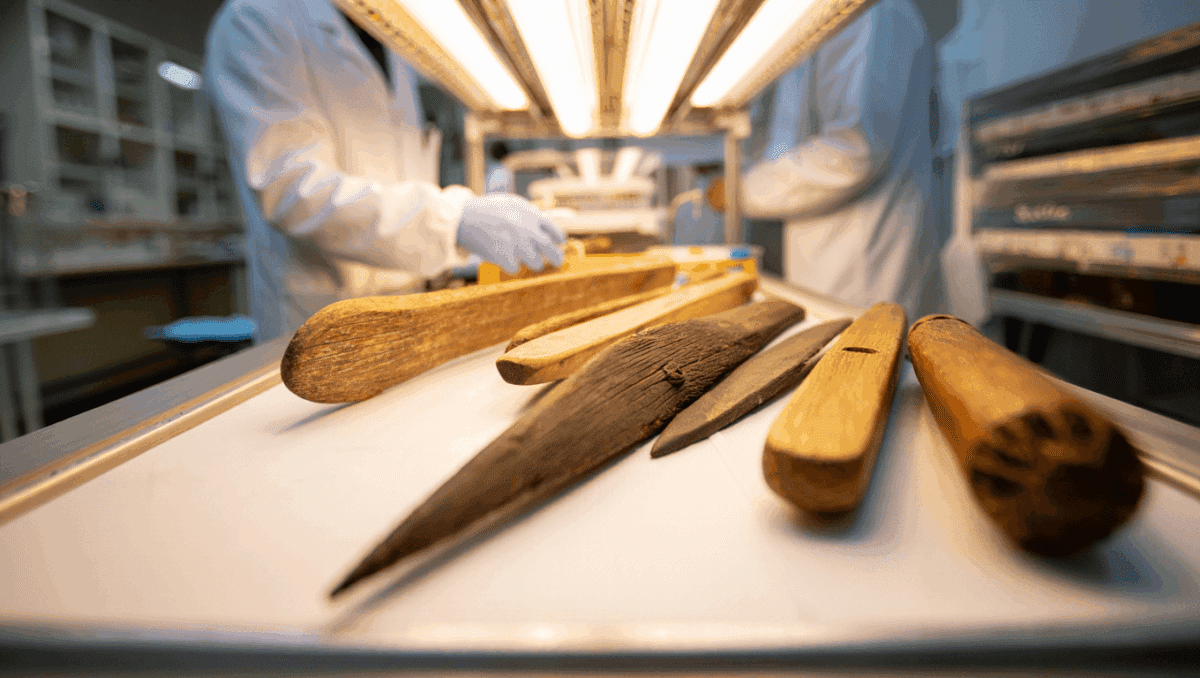
Further southeast, in southern Greece, archaeologists recovered wooden implements dated to around 430,000 years old — the oldest wooden artifacts yet documented. Among the items were a digging stick and a shaped twig, both showing deliberate chopping and shaping marks.
What the wooden tools reveal
At first glance a carved twig and a stick might seem humble, but the cut marks, polished surfaces and patterned removals all signal intentional manufacture. Those traits distinguish naturally broken wood from objects altered by hominins for specific tasks like digging, food processing or plant work.
- Age: About 430,000 years old, predating modern humans’ arrival in Europe by hundreds of thousands of years.
- Likely makers: Not Homo sapiens — most likely early Neanderthals or their ancestors (such as Homo heidelbergensis).
- Preservation context: A former lakeshore environment that created conditions favorable to preserving organic tools.
Because wood typically decays quickly, these finds required exceptional burial conditions. Their survival provides rare, direct evidence that early European hominins were shaping woody materials intentionally, expanding our view of their technological skills.
How these discoveries reshape our view of early European technology
Until now, the surviving record of early European technology has been dominated by stone tools simply because rock preserves far better than bone or wood. These new organics force a rethink of how complex and varied prehistoric toolkits may have been.
- Broader material use: Hominins were adept at exploiting bone and wood alongside stone.
- Longstanding traditions: Knowledge of shaping organic tools may have been passed across generations long before modern humans arrived.
- Behavioral complexity: Use of specialized organic tools indicates planning, selection of raw materials, and task‑specific techniques.
Why preservation matters: the role of environment and chance
Organic artifacts survive only in particular contexts — waterlogged sediments, anaerobic muds, or mineral‑rich deposits that inhibit decay. The Greek lakeshore and certain deposits at Boxgrove provided the rare conditions needed to slow microbial breakdown and allow wood and bone to persist for hundreds of thousands of years.
Factors that aid preservation
- Anaerobic (oxygen‑poor) sediments that block bacteria and fungi.
- Rapid burial that isolates remains from weathering and scavengers.
- Mineralization or chemical environments that stabilize organic tissues.
Methods researchers used to verify tool use and age
Scientists combined macroscopic observation with microscopic and chemical analyses to separate natural damage from deliberate modification. Dating relied on stratigraphic context and established geochronological techniques appropriate to the sites, while residue and wear studies helped reconstruct how each object was used.
- Microwear analysis: Reveals patterns of abrasion and polish consistent with specific tasks.
- Residue testing: Detects trapped particles like flint fragments or plant residues.
- Contextual dating: Associates artifacts with dated layers to estimate age.
What archaeologists will focus on next
These finds open several lines of inquiry: searching for more organic tools under waterlogged or special preservation conditions; reexamining old collections for overlooked bone or wood artifacts; and refining methods to detect subtle traces of use. Each new discovery could further rewrite timelines and deepen our understanding of premodern ingenuity in Europe.
You might also like:
- 1,500-year-old reindeer trap and hunting gear uncovered in Norway’s mountain ice
- Oldest poisoned arrowheads date back 60,000 years, show hunters’ knowledge of toxins
- 2,000-year-old shipwreck artifacts found in Swiss lake include Roman chariot parts
- Lost land bridge found by female archaeologists may rewrite European history
- Poisoned weapons older than previously thought, new study shows

William Anderson is a multimedia producer specializing in videos, podcasts, and interactive galleries. With five years of immersive content creation, he turns information into a rich audio‑visual experience. His storytelling skills draw you directly into the heart of every story, on any platform.


Ah, wooden tools from 500,000 years ago? Imagine the stories they could tell, if only trees could talk, right? Bet theyve seen some wild things back in the day. Makes you wonder what our modern tools will reveal about us in the future.
Man, half a million years ago, our ancestors were out there crafting wooden tools in Boxgrove, England. Imagine the patience and skills they had! Microscopic damage clues reveal so much about their lives. Its mind-blowing to think about our ancient roots.
Dang, can you picture the OG handymen in Boxgrove, England, half a mil years back? Chillin, craftin wooden gear like its no biggie. Bet they were like, Look at me, Im the original DIY champ! Micro-damage spillin the tea on their lives? Thats some next-level CSI stuff, man. Its wild to think were all just a bunch of upgraded cavemen, deep down.
Oh, snap! Wooden tools from way back? Thats like time-travel stuff, man. Makes you wonder how they managed to craft those babies half a million years ago. Bet those ancient folks had some serious skills!
Whoa, hold up! 500,000-year-old wooden tools? Thats some serious ancient DIY action right there. Can you imagine the stories these tools could tell if they could talk? I bet theyve seen some wild stuff over the years!
Dude, totally wild, right? Imagine if those old wooden tools could drop some serious tea about the Stone Age drama theyve witnessed. Bet theyd have some legendary tales to spill! Just picturing a tool gossiping like, You wont believe what I saw the cavemen doin with those mammoth bones last night! *laughs*
Man, can you imagine the stories these wooden tools could tell? Half a million years old, thats wild! Bet theyve seen some things. Makes you wonder what else is hiding out there in the dirt, waiting to be discovered.
Oh man, can you imagine the stories those 500,000-year-old wooden tools could tell? Bet theyve seen some crazy stuff. Makes you wonder how advanced our ancestors really were back then, yknow?
Oh, wooden tools from 500,000 years ago? Thats older than my grandmas recipes! Can you imagine the stories these tools could tell if they could talk? Bet theyve seen some real Stone Age drama!
A history buff here, imagining those ancient folks crafting those wooden tools like its yesterday. Half a million years ago in Boxgrove, England—imagine the tales those tools could tell! Makes me wonder what else well uncover next.
Yo, imagine using wooden tools half a million years ago! The ancestors were really out there grindin. Bet theyd laugh at our fancy gadgets today. Time to step up our game!
Dude, imagine the OG humans rockin wooden tools like its the new iPhone! They were the real MVPs, for real. Bet theyd get a kick outta seeing us struggle with our tech sometimes, yknow? Maybe we should take a page from their book and simplify things a bit. Who needs all these fancy gizmos anyway?
Whoa, imagine the stories these ancient wooden tools could tell! Half a million years ago, our ancestors were already crafting tools in England? Thats some serious time travel material right there. Wonder what else well dig up next!
Imagine the banter those old wooden tools could spin, mate! Half a mil years back, our ancestors were already handcrafting in England? Proper time-travel vibes, innit? Cant wait to see what else pops up from the ground next!
Oh man, half a mil years ago, can you imagine? Wooden tools in England, gotta love history, right? Makes you wonder what else is hidden out there in the world. Time to go digging!
Half a mil years ago, mate? Wooden tools in England? Sounds like a proper throwback! Historys a treasure trove, innit? Makes ya think what other ancient goodies are lurking out there. Time to grab a shovel and start diggin!