
Show summary Hide summary
- Evidence from Ayvalık: artifacts that hint at a vanished land bridge
- What the tools reveal about technology and behavior
- The archaeologists: a female-led excavation making waves
- Rethinking migration routes into Europe
- Research gaps and the next phases of investigation
- Why submerged coasts are crucial to human prehistory
A team of archaeologists working along Turkey’s northeastern Aegean coast has uncovered stone tools that point to a previously unrecognized route humans may have taken into Europe. The finds, recovered from sites around Ayvalık, suggest stretches of land now submerged by the sea once formed a connected corridor between Anatolia and the European mainland during Ice Age lowstands.
Published in a peer-reviewed archaeology journal, the research brings new attention to a part of the Aegean that has received little Paleolithic fieldwork. By combining surface surveys across dozens of locations, investigators recovered artifacts that could challenge long-held ideas about how early humans dispersed into Europe.
Evidence from Ayvalık: artifacts that hint at a vanished land bridge
The Growing Demand for Data-Driven Decision Making in Silicon Valley
He quit, ran out of money, and begged to come back — here’s how his boss reacted
Researchers documented a collection of stone implements scattered across roughly 200 square kilometers near present-day Ayvalık. In total, the team reported 138 stone tools from 10 distinct localities—an inventory that includes flakes, chopping implements, and larger cutting tools whose forms link them to broad Paleolithic traditions.
These discoveries support the idea that, during Pleistocene glacial periods when global sea levels fell by as much as 300 feet, the modern islands and promontories around Ayvalık were once part of an extensive coastal plain. That exposed terrain would have connected Anatolia to islands and peninsulas that are now isolated by water, creating a practical passageway for people and animals moving between continents.
What the tools reveal about technology and behavior
The recovered artifacts display a mixture of simple and more refined manufacturing techniques that archaeologists associate with Middle and Lower Paleolithic toolkits. While the number of items is modest—partly because active coastal processes and deep sedimentation have blurred or buried much of the record—the types of tools are revealing.
- Levallois-style flakes: Several flakes show preparation methods linked to Levallois reduction strategies, a hallmark of advanced stone-working used by Neanderthals and some early Homo sapiens groups.
- Large cutting implements: Handaxes and cleavers point to tasks like butchery and heavy-duty processing that would have been essential for survival in Pleistocene environments.
- Surface scatter patterning: Finds are concentrated along ancient shoreline zones, suggesting repeated use of the coastal corridor rather than isolated or accidental presence.
Why Levallois artifacts matter
Levallois technology reflects planned core preparation and the production of predictably shaped flakes. Its presence in Ayvalık ties the area into a wider technological network spanning Africa, Asia, and Europe and lends weight to the idea that people moving through the Aegean carried shared know-how across regions.
The archaeologists: a female-led excavation making waves
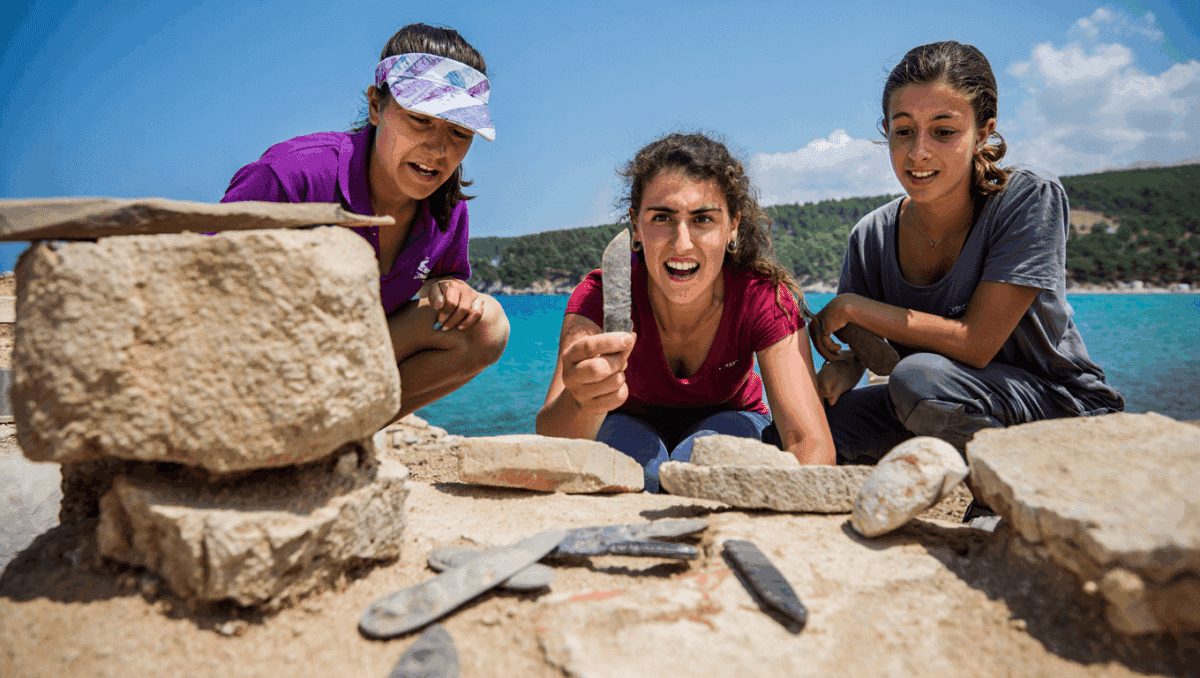
The fieldwork was carried out by a Turkish research team led by archaeologists from Hacettepe University and Ankara University. Team members described the moment of discovery as emotionally powerful, noting that holding the first recovered implements underscored how little was previously known about Paleolithic occupations along this stretch of coast.
Lead researchers emphasized that these finds place Ayvalık on the map as more than a picturesque seaside region: they read the artifacts as tangible traces of itinerant human groups moving through a landscape dramatically altered by Pleistocene sea-level change.
Rethinking migration routes into Europe
For decades, models of early human expansion into Europe have favored corridors through the Balkans and Levant. The Ayvalık discoveries do not negate those pathways, but they add a plausible alternative—an Aegean coastal corridor—through which populations could have traveled.
During glacial maxima the exposed Aegean shelf would have simplified coastal travel and offered resource-rich plains, changing the calculus of movement and settlement. If further work confirms the chronological placement of the artifacts, the Ayvalık area could represent a significant geographic route linking Anatolia with the European interior.
Research gaps and the next phases of investigation
The authors call for expanded, multidisciplinary work to determine when these tools were made and how the landscape changed over time. Key next steps include:
- Targeted stratigraphic excavations to recover undisturbed contexts.
- Absolute dating techniques such as radiocarbon (where organic material exists), optically stimulated luminescence (OSL) for sediments, and other chronometric methods.
- Paleoenvironmental reconstructions using cores and microfossil analysis to rebuild former shorelines and habitat zones.
- Underwater survey and geoarchaeological mapping of the submerged Aegean shelf to locate buried sites and landscape features.
Researchers argue that combining these approaches will clarify whether Ayvalık functioned as a transient corridor or a locus of repeated occupation, and how it fits into wider patterns of Paleolithic interaction and innovation across Eurasia.
Why submerged coasts are crucial to human prehistory
Coastal shelves that were exposed during Ice Age lowstands preserve chapters of human history now hidden beneath the waves. As sea levels rose, many Paleolithic sites were drowned or reworked by marine processes, making reconnaissance along modern shorelines and offshore mapping especially important for reconstructing migration networks.
By recovering artifacts from the Ayvalık coast and pointing to the existence of a temporary land bridge, the research highlights how much of the human past remains to be discovered in submerged landscapes and marginal coastal zones—areas that may reshape our understanding of early human movement across continents.
You might also like:
- 500,000-year-old wooden tools are the oldest ever discovered
- Britannic bell, other artifacts recovered by deep-sea divers from Titanic’s sunken sister ship
- Roman stone-lined basin discovered predates concrete, reveals advanced engineering
- 1715 treasure fleet shipwreck: $1 million in gold and silver coins recovered
- 600-year-old Peruvian tomb declared discovery of the decade after first unsealing

Michael Thompson is an experienced journalist covering U.S. and global news. With ten years on the front lines, he breaks down political and economic stories that matter. His precise writing and keen attention to detail help you grasp the real‑world impact of every event.


So, female archaeologists are out there rewriting history now? Imagine finding a lost land bridge, thats some serious Indiana Jones stuff! Cant wait to see what other hidden gems they dig up next.
Oh, snap! Here comes the plot twist! Female archaeologists flipping the script and rewriting history? Thats the kind of empowerment Im here for. Lets see those textbooks get a makeover now!
Remember when everyone thought they had Europes history all figured out? Well, looks like these archaeologists are here to shake things up! Cant wait to see how this discovery flips the script on what we thought we knew.
You know, these archaeologists really be out there changing the game! Finding a lost land bridge? Thats some Indiana Jones level stuff right there. Cant wait to see how this discovery shakes up the history books!
So, these archaeologists found a lost land bridge? Reminds me of that time I found my missing sock under the couch. Maybe this discovery will shake things up in the history books. Wonder what else is hiding under our noses!
Oh man, that sock-under-the-couch moment is the story of my life. Who knew lost things could have such epic comebacks? Maybe well uncover more mind-blowing secrets like this lost land bridge. Time to grab a flashlight and start digging under those couch cushions – who knows what other gems are hiding in plain sight!
I once read this sci-fi book about lost civilizations and boom! Now we have this real-life discovery of a lost land bridge reshaping history. Its like reality catching up with fiction, wild stuff!
Imagine the plot twist! Female archaeologists out there rewriting history like its no biggie. Who knew a lost land bridge could shake things up? Guess were all in for a wild ride with these artifacts spillin the tea.
Oh snap, aint that a whirlwind of a discovery! Female archaeologists flippin the script and rewriting history like its a Tuesday errand. Lost land bridge causin a stir? You bet were in for a ride! These artifacts spillin the tea got me wonderin what other secrets theyre holdin. Who knew ancient relics could be so chatty, huh?
Man, these archaeologists are really shaking things up! Female-led excavation? Thats the kind of change I like to see. Lets rewrite some history books and give credit where its due. Time to update those textbooks, folks!
Whoa, a land bridge rewrites history? Thats like a plot twist in a blockbuster movie! Female archaeologists leading the charge? Talk about breaking stereotypes and shaking things up. Cant wait to see how this discovery unfolds!
Man, archaeology never gets old! Female team finding a lost land bridge? Thats epic! Cant wait for the history books to get a rewrite. Go, ladies! Excavate those mysteries!