
Show summary Hide summary
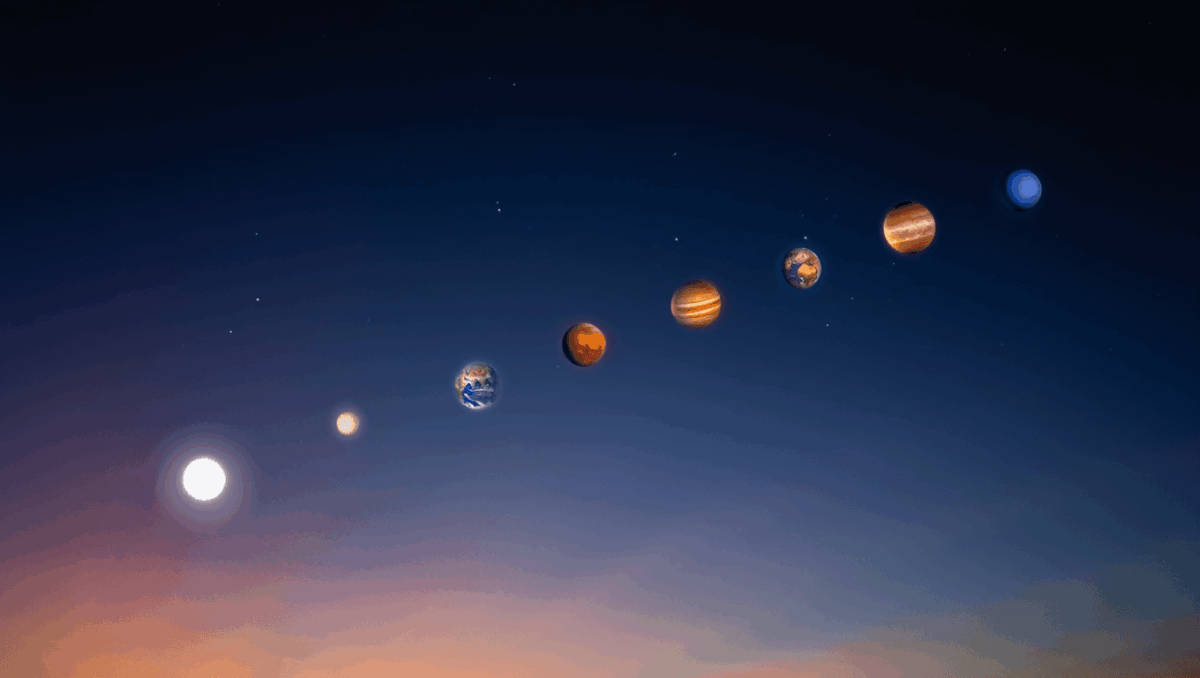
Next Saturday, Feb. 28, 2026, skywatchers around the globe have a rare chance to see a string of planets gathered along the same slice of sky. From bright Venus to distant Neptune, six planets will appear close together after sunset — a quiet, celestial parade that rewards anyone willing to step outside and look westward as twilight fades.
Astronomers call this kind of grouping a planetary alignment, and while bits of it happen from time to time, seeing this many worlds clustered where they’re easy to identify is notable. With a little planning — and a pair of binoculars for the faintest members — you can trace a line through our solar system that spans worlds both familiar and remote.
Why planets line up: the science behind a planetary alignment
A planetary alignment happens when multiple planets cross the same plane of the solar system — the ecliptic — and from Earth they seem to occupy nearly the same stretch of sky. This is a perspective effect: each planet keeps its own orbit, but when their orbital paths intersect our line of sight at the right time, they appear to march close together.
The Growing Demand for Data-Driven Decision Making in Silicon Valley
He quit, ran out of money, and begged to come back — here’s how his boss reacted
- Not a literal straight line: The planets are still millions of miles apart; they just project near one another from Earth’s viewpoint.
- Chance and timing: The more planets that appear together, the rarer the event. Specific alignments like this one won’t exactly repeat for many years.
- Recent and future parallels: A similar multi-planet grouping happened around late February last year, while an identical configuration won’t occur again until approximately 2040.
Which planets you’ll see and what equipment helps
On the evening of Feb. 28 you can expect to find Mercury, Venus, Jupiter, Saturn, Uranus and Neptune positioned along the western sky. How easily you spot each depends on brightness and distance.
Naked eye vs. binoculars or telescope
- Naked eye: Mercury, Venus, Jupiter and Saturn are bright enough to be seen without magnification. Venus will be especially prominent — often the first “star” people notice after sunset.
- Binoculars or telescope: Uranus and Neptune are much dimmer and will require optical aid. A modest pair of binoculars or a small telescope makes them visible as tiny disks or faint points of light.
Where to look and the best viewing strategy
Timing and a clear western horizon are the keys to a good view. Here’s how to optimize your chances:
- Time it: Start looking about 30 minutes after local sunset. That’s when the sky will be dark enough for contrast but the planets will still sit low above the horizon.
- Direction: Face west from wherever you are. The lineup will be low in the sky, so pick a spot with an unobstructed view—no tall buildings, trees or hills between you and the horizon.
- Find a reference: Locate Venus first — it will be the brightest, often with a slight reddish tint. From Venus, Mercury sits up and to the right, Saturn will be up and to the left, and Neptune appears very close to Saturn’s position.
- Look leftward for the rest: Uranus will be roughly 40 degrees to the left of that cluster, while Jupiter will sit farther left at about a 90-degree separation from the Venus/Saturn grouping.
- Bring optics and patience: Binoculars help pick out Neptune and Uranus and can make the grouping feel more dramatic. Allow your eyes a few minutes to adapt to the dark for better contrast.
Practical tips for photographers and families
- Use a tripod for long-exposure photos; a wide-angle lens will capture multiple planets at once.
- Apps and star charts can overlay planetary positions on your phone’s camera to guide your search.
- Dress for the weather and pick a comfortable viewing spot—astronomical shows are best enjoyed slowly.
You might also like:
- 2025’s Final Planet Parade Approaches: Learn How to Witness This Celestial Event!
- Taureans, Scorpios, Pisces: this rare cosmic event is about to upend your life
- Exoplanet magnetospheres detected for first time, opening new window on planets
- Saturn mystery solved by astronomers
- NASA’s new telescope to hunt exoplanets and search for signs of life

Michael Thompson is an experienced journalist covering U.S. and global news. With ten years on the front lines, he breaks down political and economic stories that matter. His precise writing and keen attention to detail help you grasp the real‑world impact of every event.


Man, I remember last time I tried to spot planets, ended up staring at a streetlamp thinking it was Jupiter. Time to redeem myself this week and actually catch this planet parade in the night sky!
I remember tryin to spot those planets alignin with my old telescope… Never quite got the hang of it. Maybe this time Ill give it another shot. Who knows, maybe the stars are on my side this week!
Man, I remember last time I tried spotting planets in the sky, it was a total mess. But this article got me curious about the planet parade. Maybe Ill give it another shot and hope the stars align for me this time!
Man, I remember watching a planetary alignment with my ex. It was so romantic until she started talking about her horoscope. Anyways, I might grab my binoculars and check out the planet parade this week. Who knows, maybe Ill find a new stargazing buddy!
I remember watchin the planets align with my grandpa. Hed point up at the sky, tellin me tales about each one. Cant wait to grab my binoculars and share the magic with my own kiddos this time.
Man, I remember stargazing with my grandpa, talking about planets lining up like some cosmic dance. Cant wait to grab my old binoculars and catch this planet parade. Skys the limit!
Man, planetary alignments like a celestial party! I remember spotting Jupiter last year, felt like finding a hidden treasure. Cant wait to catch this weeks parade, gonna grab my binoculars and geek out. Skys the limit!
Oh, man, I remember my grandpa rambling about these planetary parades. Hed drag us outside with his old binoculars. Guess Ill give it a shot this week, see if I can spot those planets doin their cosmic dance.
I remember last time I tried to spot a planet parade, I got so excited, but ended up seeing just a bunch of blinking lights in the sky. Maybe this time with better equipment I can actually distinguish Uranus from Venus!
Man, last time I tried spotting planets, got lost staring at a blinking airplane! Maybe this time with some actual guidance, Ill catch the cosmic party. Time to dust off my old binoculars and join the planet parade!