
Show summary Hide summary
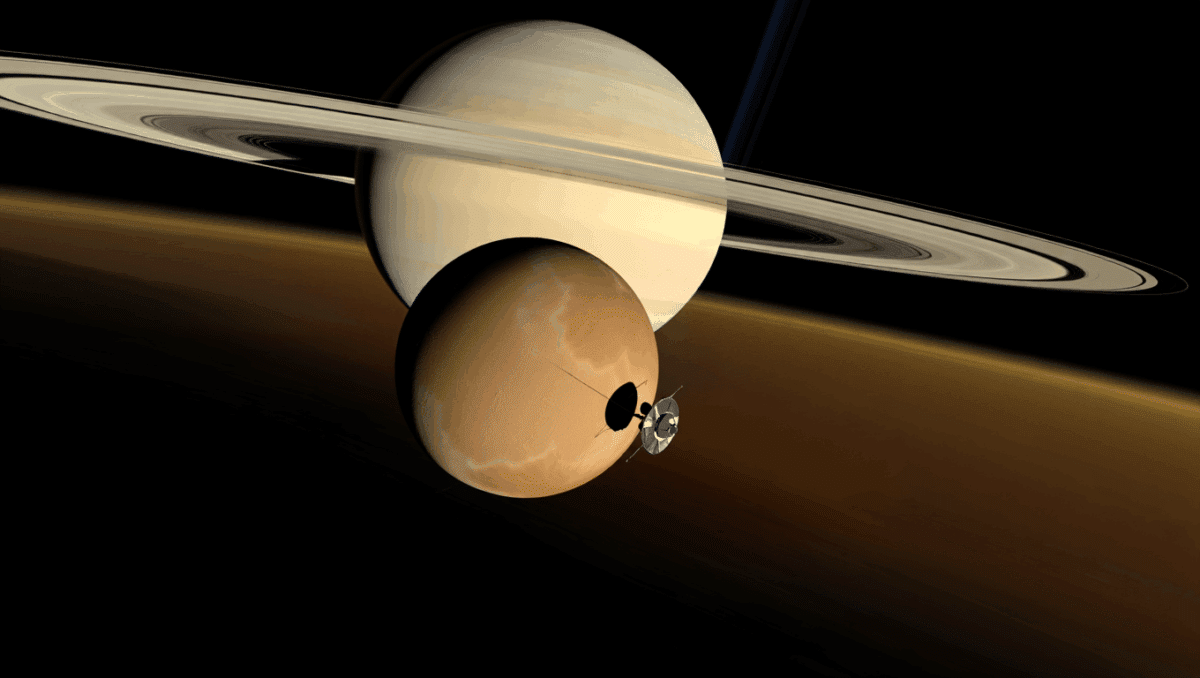
Saturn’s largest moon, Titan, has long been an outlier in our solar system: bigger than Mercury and wrapped in a thick, hazy atmosphere, yet its origin story has remained mysterious. New analysis combining spacecraft measurements and computer simulations offers a single, elegant explanation that could resolve several of Saturn’s biggest puzzles at once.
Research led by Matija Ćuk of the SETI Institute reexamines data from NASA’s Cassini mission and proposes that a dramatic collision in Saturn’s past may have reshaped the system. The scenario — an extra moon slamming into Titan and then setting off a cascade of orbital changes — could account for Titan’s surprising mass, Saturn’s tilt and wobble, and even the planet’s iconic rings.
An impact that made Titan unusually massive
The Growing Demand for Data-Driven Decision Making in Silicon Valley
He quit, ran out of money, and begged to come back — here’s how his boss reacted
Titan stands out not only for its size and dense nitrogen atmosphere but also because its mass seems too large to be explained by standard moon-formation models for Saturn. Ćuk’s team suggests that Titan grew significantly when another satellite merged with it hundreds of millions of years ago. That added material would have boosted Titan’s gravitational pull and altered the dynamics of nearby moons.
Where the extra moon may have come from
- Ćuk points to a likely candidate related to Hyperion, one of Saturn’s many smaller, irregular moons — a body that may once have been far larger before the system evolved.
- The hypothesized colliding moon would have been roughly about 1,000 times the mass of Hyperion, large enough to produce measurable consequences across the Saturnian system.
- This merger would explain why Titan appears oversized compared with expectations from simple accretion models.
How Cassini’s measurements and simulations line up
Cassini’s long-term observations of Saturn provided precise readings of the planet’s internal tilt and the slow wobble of its rotation axis. Earlier explanations leaned on gravitational resonance with Neptune to produce Saturn’s peculiar tilt, but the numbers didn’t quite add up. Ćuk’s approach was to run the clock backward, adjusting the system until the pieces fit.
Key elements of the new model
- Backward orbital calculations show Saturn’s current wobble is too rapid to be explained solely by Neptune’s influence.
- When the system is rewound to the estimated age of Saturn’s rings, the wobble aligns with Neptune’s resonance — but only if an extra moon had been present earlier.
- Introducing a moon that later merged with Titan restores the resonance to a near-perfect match, reconciling the Cassini data with dynamical theory.
From a moon collision to rings and chaos among satellites
Ćuk’s scenario sets off a domino effect. A collision that enlarged Titan would not have occurred in isolation; the new mass and altered orbit of Titan could have destabilized inner satellites. Those disturbances could have led to additional collisions, scattering debris and eventually forming the thin, bright rings we see today.
- Timing matters: The research places the Titan-impact event at roughly 500 million years ago, with ring formation occurring perhaps around 100 million years ago.
- Such an internal chain reaction explains multiple anomalies — Titan’s size, the timing and youth of the rings, and Saturn’s obliquity — with a single causal sequence.
- Computer simulations show that this kind of cascade is dynamically plausible and consistent with the current distribution and character of Saturn’s moons.
How this idea compares to previous hypotheses
Earlier proposals tried to explain Saturn’s tilt and rings by invoking a lost moon called Chrysalis that wandered too close to the planet and disintegrated. Ćuk’s work refines that line of thinking by emphasizing an earlier merger that changes the timing and dynamics of resonance with Neptune.
Independent experts who reviewed the concept told reporters that the model fits the available evidence better than some earlier alternatives. William B. Hubbard, professor emeritus of planetary sciences at the University of Arizona, and Carl Murray, an emeritus professor and former Cassini team member, both described the idea as convincing and plausible based on current datasets.
Why astronomers are paying attention now
The combination of long-baseline spacecraft data from Cassini and modern computational power makes it possible to explore complex, multi-step histories for planetary systems. Ćuk’s paper, accepted by The Planetary Science Journal, uses this toolkit to knit together observations that previously seemed contradictory.
The broader implication is that violent, relatively recent events — on geological timescales — can reshape planetary satellite systems in ways we can still detect. As telescopes such as James Webb expand what we can observe in exoplanetary systems, models like this one help scientists interpret how unusual features may arise from dramatic collisions and cascading orbital effects.
Evidence still being tested and questions that remain
- Additional simulations and more detailed modeling of tidal forces and orbital resonances are needed to confirm the timeline precisely.
- Observational searches for compositional signatures in Saturn’s rings and small moons could help verify whether they’re remnants of disrupted satellites.
- Future missions or refined analysis of Cassini data may tighten constraints on when the rings formed and how Titan’s mass changed.
You might also like:
- Titan alien life: could Saturn’s moon harbor signs of life?
- Mysterious “Second Moon” Revealed: Hidden for 60 Years, Now Uncovered!
- Asteroid could hit the moon in 2032: what we know
- 2025’s Final Planet Parade Approaches: Learn How to Witness This Celestial Event!
- Planets align this week: how to see the planet parade in the night sky

Michael Thompson is an experienced journalist covering U.S. and global news. With ten years on the front lines, he breaks down political and economic stories that matter. His precise writing and keen attention to detail help you grasp the real‑world impact of every event.


Wait, so astronomers cracked the Saturn mystery? About time! I always wondered about that extra moon hanging around Titan. Cant wait to delve into the juicy details of how they unraveled this cosmic puzzle. Science is wild, man!
Oh man, Ive been waiting for this Saturn saga to unfold! Those astronomers mustve been pulling all-nighters to crack that cosmic code. Cant wait to dig into the nitty-gritty deets of how they peeled back the layers of this space onion. Science truly is a wild rollercoaster ride, dude!
I always knew Saturn had some secrets up its sleeve. Astronomers finally cracked the code, huh? Bet those stargazers are feeling pretty smug right about now. What else are they hiding up there in the cosmos?
Whoa, Saturn out here playing cosmic hide and seek! Imagine an impact so wild it beefs up Titan, creating a mystery moon. Science fiction writers, take notes! Our universe is full of surprises.
I mean, who wouldve thought Saturns moon Titan had this whole mysterious mass problem? Astronomers out here cracking the case like its a cosmic mystery novel. Props to the science squad for solving this interstellar puzzle!
Yo, did yall hear about this Saturn mystery gettin cracked by astronomers? Wild stuff, man. Like, they really out here solvin space puzzles and whatnot. Science be blowin my mind sometimes, for real.
Yo, I know, right? Those astronomers out here playing cosmic detective cracking Saturns secrets. Science be like, Hold my microscope! Its mind-blowing how they unravel these space enigmas. Makes you wonder what else is hiding out there in the galaxy, huh?
I always knew those astronomers were onto something with Saturn! Their new model is like solving a cosmic puzzle. Wonder what other surprises are lurking out there in the universe? Time for a telescope upgrade!
Man, I always knew those astronomers were onto something big! Bet they were over the moon when they cracked the Saturn mystery. Cant wait to see what they uncover next in that universe of secrets!
Oh, totally! Those stargazers mustve been over the moon when they cracked that Saturn mystery. The universe is like a treasure chest, always hiding some new gem for them to discover. Cant wait to see what cosmic secrets they unravel next! How do they even keep track of all that starry stuff up there?
Dude, the universe keeps throwing surprises! Saturns moon Titan, its got some secrets. An impact made it extra chunky? Thats wild, man. Space, youre full of drama!
Man, astronomy keeps droppin bombs! The way they cracked the Saturn mystery is mind-blowing. Like, an extra moon just casually hangin around Titan? Big brain energy right there. Science never fails to amaze.
Aint it wild how them astronomers cracked the Saturn mystery? Like, talk about cosmic brainpower! Maybe I should stargaze more often instead of binge-watching sci-fi shows. Hats off to those space detectives!
Man, those astronomers are like the Sherlock Holmes of space, cracking the Saturn mystery! Stargazings the real deal – who needs sci-fi when youve got the cosmos putting on a show? Big props to those cosmic detectives, man!
I always knew those astronomers had some tricks up their sleeves! Solving the Saturn mystery like its no big deal. Makes you wonder what other secrets those planets are hiding, huh? Cant wait for the next cosmic reveal!
I remember when them astronomers had us all puzzled bout Saturns moons. Now they say they cracked the case! Like a space detective story, innit? Science, youre full of surprises!
Oh mate, I totally get ya! Remember those days when Saturns moons were giving us all a headache? Now theyre out there solving mysteries like cosmic Sherlock Holmes! Science never fails to keep us on our toes, eh? Who wouldve thought space could be this entertaining?
Ive always been fascinated by space mysteries, man. Its wild how astronomers cracked the case on Saturn! Feels like a real-life cosmic detective story. Science is the ultimate sleuth, aint it?