
Show summary Hide summary
- How embedding radioisotopes stops horn smuggling
- From idea to field trials: building the Rhisotope Project
- Safety checks and what field testing revealed
- Private land and huge stakes for owners
- Market pressure, ethics and broader conservation context
- What law enforcement and customs gain from this approach
A new, controversial tool in the fight against rhino poaching is moving from concept to countryside in South Africa: harmless radioactive markers embedded in rhino horn that make the horns traceable by existing radiation scanners at ports and airports. Conservationists and scientists say the approach could shut down a major route used by traffickers, while critics worry about ethics and long-term consequences.
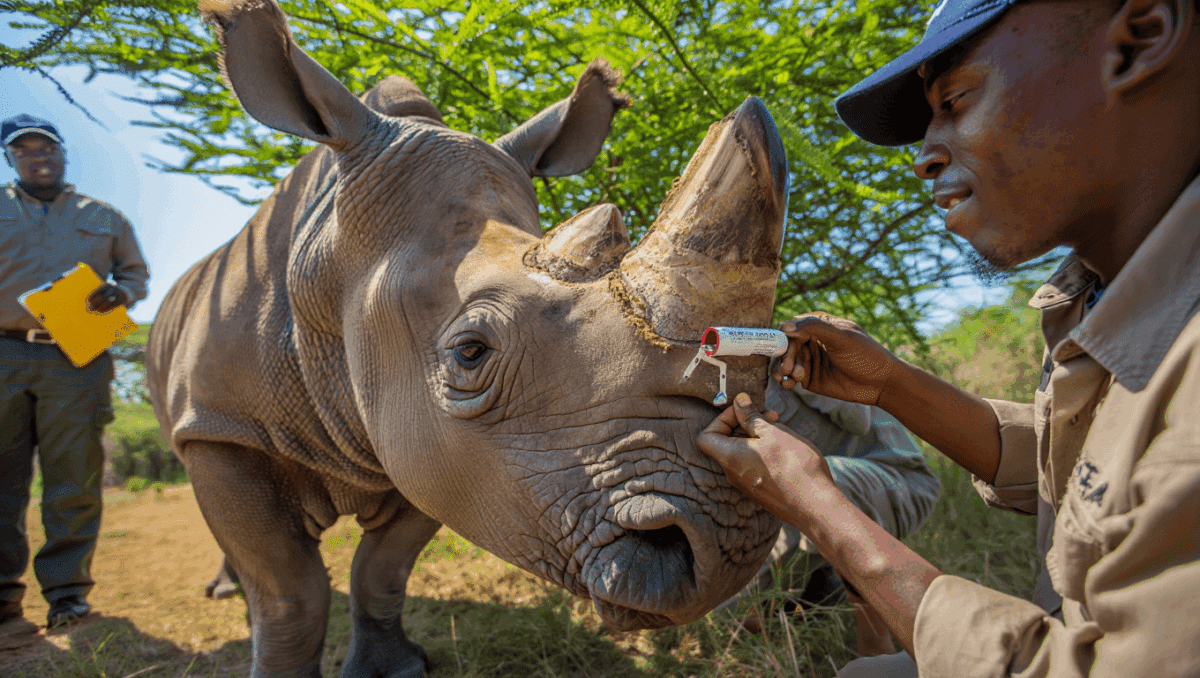
The program, known as the Rhisotope Project, is being rolled out after years of research and field trials led by the University of the Witwatersrand (Wits) and partners. Proponents describe it as a way to “flag” horns so they trigger the same detection systems already used globally to prevent nuclear smuggling, making illicit exports difficult or impossible to move undetected.
How embedding radioisotopes stops horn smuggling
The Growing Demand for Data-Driven Decision Making in Silicon Valley
He quit, ran out of money, and begged to come back — here’s how his boss reacted
The basic idea is straightforward: put a tiny, biologically safe radioactive marker inside a rhino’s horn so that any attempt to export it will set off radiation detectors at international entry points. Those instruments are widespread and designed to be easy to operate, giving officials a ready-made way to spot trafficked horns without requiring new, specialized equipment for wildlife products.
- Detection infrastructure: There are roughly 11,000 radiation-detection units deployed at ports and border crossings across the world’s roughly 200 countries.
- Concealment defeats: Tests show the marked horn registers even when hidden inside a standard 40-foot steel shipping container, and residue on removed material can betray its origin.
- Tracking rather than poisoning: The markers are designed to devalue horns and make them easily traceable, not to harm animals or “poison” the horn.
From idea to field trials: building the Rhisotope Project
The technology did not appear overnight. Early attempts nearly a decade ago tried different nuclear approaches but were judged impractical for field conditions. The current method — developed by radiology experts at Wits and supported by South Africa’s Nuclear Energy Corporation and the International Atomic Energy Agency (IAEA) — uses radioisotope “seeds” placed within the horn.
Key collaborators and milestones
- University of the Witwatersrand (Wits): scientific lead and developer of the technique.
- Nuclear Energy Corporation of South Africa (NECSA): technical partner in isotope handling.
- International Atomic Energy Agency (IAEA): provided oversight and international collaboration for safety and detection protocols.
One of the project’s chief scientists described the original motivation as exploring whether radioactivity could be applied to reduce the market value of horn and to provide law enforcement with a practical method of interception. That idea evolved into a plan that prioritizes animal safety and uses minute, well-controlled sources to render the horn traceable.
Safety checks and what field testing revealed
Before any wider deployment, the program underwent controlled trials in a rhino nursery inside a UNESCO biosphere reserve in Limpopo province. Researchers kept close watch on the treated animals for months and ran cellular-level tests on blood samples to check for biological effects.
Testing methods and findings
- Animals monitored continuously for health and behavior over a six-month period.
- Biological dosimetry performed: scientists cultured blood cells and checked for micronuclei, a standard indicator of cellular damage.
- Results showed no detectable cellular harm in the animals tested, supporting claims that the procedure is safe when correctly applied.
Project scientists now say they have demonstrated the technique is both safe for rhinos and effective at making horns detectable through routine customs nuclear-security systems. Conservation advocates who were initially skeptical have called the method promising, even “magical,” for its potential to close off trafficking routes without resorting to lethal or invasive measures.
Private land and huge stakes for owners
South Africa’s rhino population is notable for being heavily concentrated on private land as well as in national parks. That reality changes how anti-poaching tools scale and who pays for them.
- Private caretakers: A large share of the country’s rhinos live on privately owned reserves and farms.
- Cost pressures: Owners often spend significant sums on armed patrols, technology, and routine dehorning — a common but imperfect deterrent that must be repeated every 18 to 24 months.
- Potential savings: The isotope approach would let rhinos keep their horns and require a maintenance “top-up” only about once every five years, proponents say — a model that could be more cost-effective over time.
For many private stewards, the ability to protect animals without frequent dehorning or constant security spending is a major selling point. Advocates are actively courting partnerships and funding to offer the technology more widely to owners and reserves.
Market pressure, ethics and broader conservation context
Rhino horn remains highly valuable on the black market — commonly cited figures place its price near $65,000 per kilogram, which translates to a large payout for traffickers who kill a rhino for its horns. Yet horn composition is keratin, the same protein found in human hair and nails, and it has no scientifically proven medicinal properties despite demand driven by tradition and myth.
Anti-poaching responses have ranged across strategies:
- Heavy investment in armed anti-poaching units and surveillance.
- Periodic dehorning to make animals less attractive targets.
- Market-focused ideas such as farmed horn to flood supply and lower black-market prices.
- Scientific and technological solutions like the Rhisotope Project to disrupt trafficking channels.
Those exploring the radioisotope option emphasize that it’s one tool among many and argue it could reduce reliance on lethal or stress-inducing interventions. Some scientists involved said they feel pride and hope that a workable method has been developed that may help rhinos survive for future generations.
What law enforcement and customs gain from this approach
One practical advantage is leveraging an existing global detection network: radiation scanners are already widespread and straightforward to operate, unlike most wildlife-forensics equipment. That means customs and port officials could spot illicit horn shipments without special wildlife training or new hardware purchases.
- Practical detection: Marked horns set off nuclear-security alarms at ports, air cargo hubs and border crossings.
- Residual tracing: Even if traffickers remove marked material, trace residue and handling can reveal the horn’s prior contamination.
- Scale potential: With international collaboration, the method could create a deterrent effect by increasing the risk that trafficked horns will be intercepted.

You might also like:
- Virginia Tech guard gives free mini statues at events, becomes a campus celebrity
- How Chernobyl mutated stray dogs
- Fusion Reactor Breakthrough: Chinese Scientists Create ‘Impossible’ Steel!
- Zoo elephants rewilded in Africa: how well they cope in the wild
- Nuclear plant worker falls into reactor pool and survives

Michael Thompson is an experienced journalist covering U.S. and global news. With ten years on the front lines, he breaks down political and economic stories that matter. His precise writing and keen attention to detail help you grasp the real‑world impact of every event.


Man, talk about next-level conservation! Using radioactive isotopes in rhino horns to combat smuggling is like a sci-fi movie plot. Cant wait to see if this high-tech approach really kicks poachers where it hurts!
I once heard about this wild idea to use radioactive isotopes in rhino horns to stop poaching. Crazy, right? But hey, if it helps those majestic creatures survive, Im all for it. Anything to protect these beauties from the greedy hands of poachers.
Ive seen some wild things in my time, but using radioactive isotopes in rhino horns? Thats next-level! Gotta admit, if it helps stop those poachers, Im all for it. Lets hope this Rhisotope Project makes a real difference.
Man, embedding radioisotopes in rhino horns to stop smuggling? Thats some next-level spy stuff! Finally using science for good, huh? Hope those poachers are shaking in their boots now.
I once heard that rhino horns are worth more than gold. Crazy, right? But now theyre using radioactive isotopes to track those precious horns and stop the poachers. Science meets poaching in the ultimate showdown!
Man, I remember seeing those poor rhinos butchered for their horns. If this radioactive isotopes trick helps stop those poachers, count me in! Lets give those majestic creatures a fighting chance, right?
Man, the Rhisotope Project is like something out of a sci-fi flick! Who wouldve thought radioactive isotopes could help save rhinos? Pretty rad, but also kinda wild, right? Nature and technology teaming up to protect these majestic creatures.
I mean, who knew rhinos could get a radioactive makeover, right? Turning their horns into some kind of high-tech tracking device against poachers? Thats like sci-fi meets wildlife conservation, sign me up for that!
Man, using radioactive isotopes in rhino horns to track em and fight poaching? Thats some next-level tech meets conservation! Cant believe were sci-fi-ing our way to save these majestic beasts. Hope it works out!
Man, using radioactive isotopes in rhino horns to fight poaching? That’s some sci-fi stuff right there. Cant believe were at a point where we need nuclear science to protect these majestic creatures. Nature, you crazy!
I remember when conservation was all about boots on the ground, not isotopes in horns. Times change, huh? Hope it works, but cant help but feel a bit uneasy about rhino horns with a side of radioactivity!
A wildlife enthusiast here, and I gotta say, using radioactive isotopes in rhino horns to fight poaching? Thats some next-level thinking! Its like science and conservation teaming up for a real-life superhero mission. Kudos to the brilliant minds behind this innovative approach!
I remember reading about this Rhisotope Project a while back. Its wild how theyre using radioactive isotopes in rhino horns to fight poaching. Cant wait to see if this actually makes a difference in the long run.
Dang, this Rhisotope Project is like science fiction coming to life! Using radioactive isotopes to protect rhinos? Thats some next-level stuff right there. Cant wait to see if this tech can really make a difference.
Man, this rhino horn smuggling mess? Glad theyre using science now, with those radioactive isotopes. About time we fight these poachers with brains, not just brawns. Lets see if it works, huh?
Ya know, using radioactive isotopes in rhino horns for anti-poaching sounds like sci-fi gone wild! Cant decide if its genius or just plain crazy. Wonder what the rhinos think about all this high-tech stuff in their horns?
Dude, totally feel you on that! Its like rhinos are getting upgrades straight from a sci-fi flick. Wonder if they strut around with their new high-tech horns like Check me out, Im the future of anti-poaching! Maybe theyre secretly plotting to take over the world with their radioactive powers. Watch out, humans, the rhinos might just outsmart us all!
I remember reading about this Rhisotope Project a while back. Cant believe theyre using radioactive isotopes to track rhino horns now. Hope this helps combat poaching and protect these majestic creatures.
I remember watching those wildlife documentaries, seeing the brutal poaching of rhinos for their horns. Now, using radioactive isotopes to track them? Thats some next-level conservation innovation right there. Hope it helps save those magnificent creatures.