
Show summary Hide summary
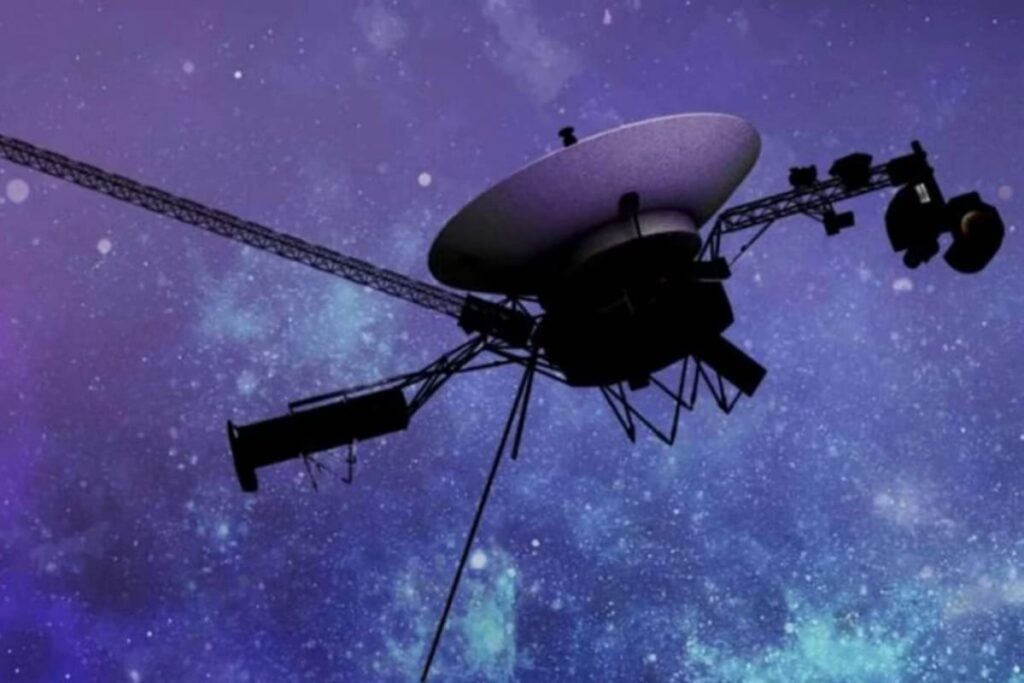
Launched nearly half a century ago, Voyager 1 has travelled farther than any other human-made object — and it’s still sending back surprises. Now more than 15 billion miles from Earth, the spacecraft has detected something extraordinary at the edge of our solar system: a blistering region so intense that it may force scientists to rethink what they know about our cosmic boundaries.
A fiery frontier at the edge of the solar system
When Voyager 1 lifted off in 1977, its main goal was to capture close-up images of Jupiter and Saturn. But its most groundbreaking discovery has come much later, as it crossed into the solar system’s outermost border — the heliopause.
The Growing Demand for Data-Driven Decision Making in Silicon Valley
He quit, ran out of money, and begged to come back — here’s how his boss reacted
This invisible boundary is where the solar wind — streams of charged particles ejected by the Sun — meets the interstellar medium, the space between stars filled with particles and radiation. For years, astronomers believed this region would be cold and sparse. Instead, Voyager’s sensors picked up a dramatic rise in both particle density and temperature, creating what researchers now call a “wall of fire.”
We’re talking about plasma temperatures reaching nearly 30,000°C (54,000°F). Not flames as we know them, but particles moving so fast that their collisions generate astonishing heat.
What exactly is the heliopause?
Think of the heliopause as the bubble wrap around our solar system. Inside, we’re protected by the Sun’s magnetic influence and solar wind. Beyond it lies interstellar space, where radiation from distant stars flows freely.
Voyager 1’s data revealed that the Sun’s magnetic field lines are stretched and compressed at this boundary, creating magnetic reconnection — a process where magnetic fields snap and realign, releasing massive bursts of energy. It’s this cosmic traffic jam of charged particles that produces the so-called wall of fire.
For spacecraft, though, it’s not as dangerous as it sounds. In this super-thin plasma, collisions are rare. Voyager sails through it unaffected, even as its instruments detect some of the hottest plasma ever measured.
Surprising magnetic similarities
One of Voyager’s most intriguing discoveries is that the magnetic fields inside the heliopause look surprisingly similar to those outside in interstellar space. Scientists once expected stark differences, but this continuity suggests our solar system is more seamlessly linked with the wider galaxy than we thought.
This has big implications for how we understand stellar winds, magnetism, and plasma flows — not only in our system, but around other stars too.
A legend still transmitting after 48 years
The fact that Voyager 1 is still working is a marvel in itself. Each of its instruments runs on less power than a household light bulb, and yet it continues to transmit data across billions of miles. Its tiny plutonium power source is fading, but NASA engineers carefully manage the spacecraft’s systems to keep it alive.
Catching those faint signals is no small feat. On Earth, 230-foot radio antennas and highly sensitive receivers are needed to pick up the spacecraft’s whispers from interstellar space.
What lies beyond the wall of fire?
Voyager 1 isn’t stopping here. It will keep moving deeper into interstellar space, measuring particle density and magnetic fields far beyond the reach of any other mission. Its findings could reshape how we understand the heliosphere — the protective bubble shielding Earth and the other planets from galactic radiation.
For future astronauts who may one day venture beyond Pluto, this information could prove vital.
Nearly five decades after its launch, Voyager 1 continues to remind us of humanity’s persistence and curiosity. With each signal it beams home, it brings us one step closer to understanding our place in the galaxy.
The question is: what else is waiting for us beyond this fiery frontier? If Voyager’s journey has taught us anything, it’s that the universe always has another surprise in store.
You might also like:
- Solar radiation storm, biggest in 23 years, sparks northern lights worldwide
- Sun’s highest-resolution images reveal breaking waves and magnetic mysteries
- Exoplanet magnetospheres detected for first time, opening new window on planets
- Space debris plasma collector could remove orbital trash
- 3I/ATLAS comet’s unusual tail points toward the sun

David Miller is an entertainment expert with a passion for film, music, and series. With eight years in cultural criticism, he takes you behind the scenes of productions and studios. His energetic style guides you to the next big releases and trending sensations.


Man, Voyager 1 still out here making waves after all these years? That lil spacecraft got some serious staying power. Who knew itd still be throwin surprises our way from the edge of the solar system?
Man, Voyager 1s still buzzing after all these years? That lil spacecrafts like the Energizer Bunny of space, aint it? Sending signals that could flip our cosmic script? Wild, man, real wild.
Man, Voyager 1 still out here shakin things up after all these years? That lil spacecraft got more stamina than most of us! Just when you think you know it all, space be like, Hold my cosmic beer!
Yo, for real though! Voyager 1 is out there flexin like its on some interstellar Red Bull or somethin! That lil dudes been breaking records longer than most of us been alive. Space really be on some Hold my cosmic beer vibe, huh? Who knew the universe had so much sass!
Man, Voyager 1 is like that wise grandparent who keeps surprising you with stories from back in the day. Just when you think you know it all, bam! It hits you with something that could rewrite the whole science book.
Dude, Voyager 1 just wont quit, huh? Like that old rockstar who never stops touring. Its out there, chillin at the heliopause, sending signals back like, Hey Earth, remember me? Legendary stuff, man.
Hey, remember when Voyager 1 was just a lil spacecraft on a big journey? Now its out there signalin from the edge of the solar system like a boss. Talk about glow-up goals!
Man, Voyager 1 is like that old-school grandparent who surprises you with a witty comeback at Thanksgiving. Just when you thought it was chillin, it drops a bombshell signal thats about to shake up science class. Time to update those textbooks, kiddos!