
Show summary Hide summary
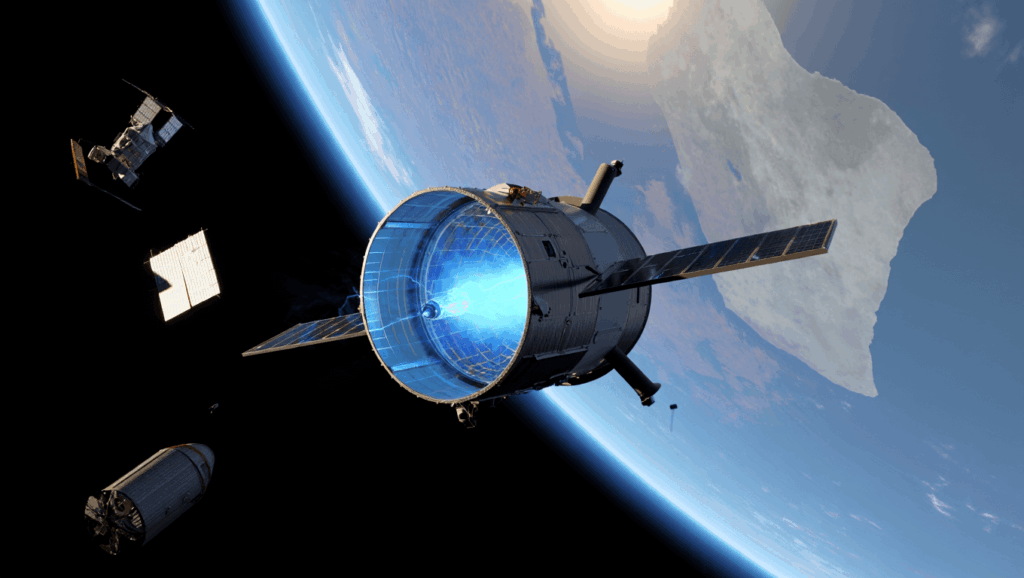
Earth’s orbit is filling up with discarded rocket stages, defunct satellites and fragments from collisions — a growing hazard that could one day make space travel far more dangerous. Engineers and scientists are experimenting with many concepts to remove orbital debris; one of the newest ideas comes from a Japanese research team that wants to use plasma engines to gently tug junk out of orbit without ever grabbing it.
Rather than catching debris with nets or harpoons, the proposed system would rely on a specially shaped plasma beam to slow objects down so they fall back into the atmosphere. The approach is still experimental, but recent lab results suggest a practical path forward to reduce the risk of cascading collisions known as Kessler Syndrome.
How a bi-directional plasma thruster aims to clean up space debris
The Growing Demand for Data-Driven Decision Making in Silicon Valley
He quit, ran out of money, and begged to come back — here’s how his boss reacted
Kazunori Takahashi and colleagues at Tohoku University have been developing a bi-directional plasma thruster that emits charged particles in opposite directions. One exhaust stream provides the thrust to steer the cleanup vehicle, while the counter-directed beam interacts with nearby debris to slow it down.
This method avoids physical contact: the plasma beam transfers momentum through electromagnetic interaction, reducing the chances of breaking fragile objects into thousands more hazardous fragments. That noncontact characteristic is what makes the concept attractive for dealing with a wide range of orbital junk, from small paint flecks to larger dead satellites.
Key features of the design
- Dual exhaust streams: One for vehicle control, one for deceleration of target debris.
- Electromagnetic coupling: Momentum exchange without grappling or docking.
- Scalable architecture: Intended to work on many object sizes by adjusting power and field geometry.
What changed since the 2018 prototype
Takahashi first revealed a primitive prototype in 2018 that could affect very small bits of debris but lacked the oomph for heavier targets. The team’s latest upgrade borrows ideas from fusion research — specifically, a magnetic configuration known as a cusp magnetic field — to better confine and shape the plasma.
By guiding the plasma with that cusp field, the thruster keeps a denser, more directed beam, improving the efficiency of momentum transfer. In vacuum tests mimicking low-Earth orbit conditions, this modification produced roughly three times the deceleration force compared with the earlier iteration.
Laboratory performance and technical numbers
During bench tests the enhanced thruster delivered measurable deceleration while consuming electrical power comparable to mid-sized satellite systems. Important figures from the experiments include:
- Output force: about 25 millinewtons at a driving power of 5 kilowatts.
- Performance gain: roughly a threefold increase in deceleration capability versus the 2018 model.
- Projected goal: reach the energy-to-force ratio needed to de-orbit a ~1-ton satellite in on the order of 100 days.
That last target remains just out of reach with current tests: the system came close but did not yet meet the power-to-pull requirement for de-orbiting very large objects within the 100-day benchmark.
Advantages, limits and operational challenges
The plasma-drag approach offers several potential benefits over nets, robotic arms or explosive disposal:
- Lower risk of creating additional debris because it doesn’t physically contact fragile objects.
- Ability to operate at a safe standoff distance, reducing collision risk for the cleanup craft.
- Modularity — the same basic thruster could be scaled or combined with other systems.
However, the concept faces practical hurdles. Power requirements are substantial, and delivering kilowatts of electrical energy in orbit pushes current spacecraft power systems unless nuclear or advanced solar arrays are employed. Precision station-keeping and targeting are also essential so the plasma beam affects only the intended object and not nearby functioning satellites.
Where this idea sits within broader debris-removal efforts
Space junk removal is a crowded field of ideas: service spacecraft that dock and tug, nets and harpoons, lasers that nudge objects, and even proposals to induce controlled reentry by changing surface properties. The plasma thruster is one of several noncontact strategies worth exploring because it could complement other techniques rather than replace them.
Researchers emphasize that multiple approaches will likely be necessary to address the diversity of orbital debris. While the plasma-drag concept is promising in laboratory environments, it still needs more testing in realistic orbital conditions and development of supporting systems, such as high-density power sources and precise guidance controls
You might also like:
- Astronauts stranded in orbit after space junk hits capsule
- Mysterious “Second Moon” Revealed: Hidden for 60 Years, Now Uncovered!
- NASA may nuke an asteroid to save the moon
- Meteorites mined for precious metals on the International Space Station
- Saturn mystery solved by astronomers

William Anderson is a multimedia producer specializing in videos, podcasts, and interactive galleries. With five years of immersive content creation, he turns information into a rich audio‑visual experience. His storytelling skills draw you directly into the heart of every story, on any platform.


I knew wed get to this point! Space cleanup crew in action, yall! No more dodging space junk like its a game of cosmic dodgeball. Lets hope this plasma collector gizmo can zap away all that orbital mess for good.
Man, space is starting to look like my room after a gaming marathon – cluttered with junk! This plasma collector thing sounds like the futuristic Roomba we need up there. Lets clean up our cosmic mess, folks!
Man, space junks like those crumbs you cant vacuum up. This plasma collectors like a fancy Roomba for space! Hope it actually works, cause our orbits starting to look like a hoarders living room.
Man, space trash is no joke! Love the idea of this plasma collector, though. Imagine if we could Marie Kondo our orbit, sparking joy and less collision risk. Lets declutter space, people!
Man, space trash is like my room – cluttered and messy! This plasma collector sounds like a sci-fi dream come true. Lets hope it cleans up space better than I tidy up my place!
Man, space junks like that messy roommate who never cleans up after themselves! This plasma collector sounds like a game-changer for tidying up our cosmic backyard. Lets hope it lives up to the hype!
Man, space trash? Were turning the galaxy into a junkyard! This plasma collector better be the real deal. Imagine if aliens visit and see all our debris floating around, talk about embarrassing!
Man, space junks a real mess. Finally, a plasma collector that might clean it up. Hope its not just hype like the 2018 prototype. Lets see if its more than just fancy lab numbers this time.
Man, space is getting crowded these days, right? But this plasma collector thing sounds like a solid plan, yo. Gotta clean up our cosmic backyard before it turns into a junkyard! Hope it works out, for real.
Man, space trash is a real issue, aint it? This plasma collector sounds like a solid idea to tackle the mess up there. Hope they get this tech out ASAP. Lets clean up our cosmic backyard, folks!
Oh man, space trash aint no joke, huh? That cosmic garbage dump is getting outta hand! But hey, this plasma collector? Sounds like a slick move to tidy up the celestial hood. Lets hope they hurry up and roll out this tech, cause our cosmic backyard needs a serious cleanup, yknow?
Man, space is like a cosmic junkyard nowadays. But this plasma collector? Thats some sci-fi stuff! If it can really clean up our orbital mess, sign me up! Lets hope its not just another flashy prototype.
Man, thinkin’ ‘bout all that space junk up there, it’s like a cosmic mess we gotta clean up, you know? This new plasma collector sounds like a wild ride! Can’t wait to see if it’s the real deal or just another sci-fi daydream.
Man, space debris is like that annoying roommate who never cleans up. Glad someones finally stepping up to tidy it all. Plasma collector sounds like the space janitor we desperately need! Hope it works out, fingers crossed.