
Show summary Hide summary
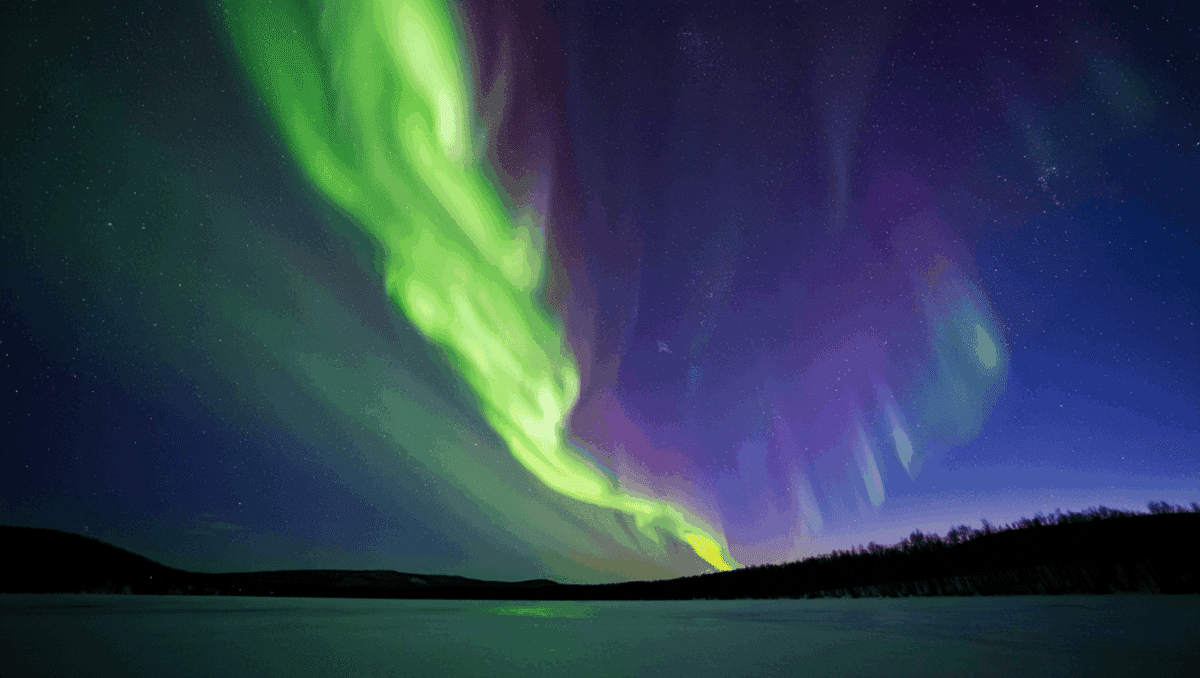
The night sky lit up far beyond the Arctic circle as an intense burst of charged particles from the Sun sent auroras cascading across skies normally too far south to see them. Scientists and space-weather forecasters called the event the most powerful solar radiation storm seen in roughly 23 years, prompting advisories for satellite operators, airlines, and utility managers worldwide.
Across the globe, observers reported vivid green and red curtains of light, while agencies tracked elevated radiation levels and a fast-moving coronal mass ejection (CME). Experts say the storm offers a vivid reminder that space weather can disrupt modern technology as easily as it can create show-stopping natural displays.
What happened: the solar eruption behind the storm
Scientists say a large solar active region unleashed a series of eruptions that culminated in a major solar flare and a fast-moving coronal mass ejection. Satellites detected a surge of energetic protons and electrons — the particles that define a radiation storm — that arrived at Earth after the CME and associated shock wave raced through interplanetary space.
The Growing Demand for Data-Driven Decision Making in Silicon Valley
He quit, ran out of money, and begged to come back — here’s how his boss reacted
Key elements of the event
- Strong solar flare: Instruments recorded a high-class X- or M-class flare that signaled intense magnetic reconfiguration on the Sun.
- Coronal mass ejection (CME): A massive plasma cloud hurled toward Earth with a high speed, enhancing the storm’s impact.
- Solar energetic particles (SEPs): A stream of charged particles increased radiation levels in near-Earth space, triggering alerts from space-weather centers.
Auroras far from the poles: where they were visible
The geomagnetic disturbances that accompanied the radiation storm expanded the auroral oval, making the northern and southern lights visible in regions that rarely see them. Social media filled with photos and videos from cities typically too far south for auroras, offering an unusual spectacle for residents and photographers.
- Urban sightings were reported at mid-latitudes in Europe, the northern United States, and parts of East Asia.
- In the Southern Hemisphere, higher-than-usual auroral activity lit the skies over parts of New Zealand and southern Australia.
- Observatory webcams and amateur astronomers captured long-exposure images showing intense green bands and deep crimson edges.
Practical impacts: satellites, aviation, and critical systems
Beyond the scenic vistas, this level of solar activity carries practical risks. Space- and ground-based systems can experience degraded performance or temporary outages when a solar radiation storm and associated geomagnetic storm arrive.
Satellite and spacecraft effects
- Increased radiation can damage sensitive electronics and solar panels, prompting operators to put satellites into safe modes.
- Low-Earth-orbit satellites may experience increased atmospheric drag, causing orbital decay and requiring tracking adjustments.
- Communications and scientific instruments that rely on precision timing or particle measurements can register anomalous readings.
Aviation and human exposure
- Airlines flying polar routes may reroute flights or limit operations to reduce crew and passenger exposure to elevated radiation levels.
- High-frequency radio communication used on polar routes can degrade or fail during strong storms, affecting backup communication paths.
- Spaceflight participants and astronauts on the International Space Station face increased radiation exposure and may be advised to shelter in more shielded sections.
Ground systems and infrastructure
- Geomagnetically induced currents (GICs) can stress power grid transformers and require utility operators to implement protective measures.
- GPS accuracy and timing services can degrade temporarily, affecting navigation and financial networks that depend on precise timing.
- Pipeline and rail systems that rely on sensitive electronics may need monitoring for anomalies linked to magnetic disturbances.
How agencies and operators reacted in real time
Official space-weather centers worldwide issued alerts and briefings as the event unfolded. Operators followed standard mitigation procedures to protect assets and maintain public safety.
- Space agencies and NOAA/NWS centers elevated watch levels, issued radiation storm statements, and communicated potential impacts to stakeholders.
- Satellite operators adjusted spacecraft orientations, powered down vulnerable subsystems, and increased telemetry sampling.
- Airlines monitored crew exposure and communications quality, with some rerouting or altering flight plans on polar tracks.
- Utilities reviewed transformer loading and GIC mitigation measures, standing ready to take reactive steps if grid disturbances developed.
What you might notice and practical advice
For most people, the storm’s most noticeable effect was the aurora display. For others, minor interruptions to radio and navigation services could have been noticeable. Here are practical points for different audiences.
For general public and aurora seekers
- Travel to dark locations away from city lights to improve aurora visibility.
- Bring a tripod and long-exposure camera settings for the best photos; the lights can shift rapidly.
- Stay informed via official space-weather feeds to learn about any ongoing alerts.
For pilots, airlines, and passengers
- Expect possible route changes for flights that normally use high-latitude tracks.
- Crew and passengers on polar routes might see different flight paths or experience minor communication delays.
For satellite operators and infrastructure managers
- Continue monitoring telemetry and space-weather bulletins; implement contingency plans for prolonged disturbances.
- Consider short-term protective measures such as switching off nonessential systems and recalibrating sensors after the event.
What scientists are continuing to watch
Researchers are tracking the CME’s structure, the evolving particle environment, and the recovery of Earth’s magnetosphere. Data from this storm will help improve models that forecast space weather and its effects on technology and human activities.
- Model refinement: Scientists will use observations to refine predictions of CME arrival times and particle flux levels.
- Radiation dose studies: Post-event analysis will quantify exposure levels for different altitudes and flight profiles.
- Longer-term impacts: Engineers will assess whether elevated radiation caused cumulative damage to satellites or ground-based systems.
You might also like:
- Voyager 1 just sent a signal that could rewrite everything we know
- NASA: Earth is getting darker and what it means for the future
- Sun’s highest-resolution images reveal breaking waves and magnetic mysteries
- Space debris plasma collector could remove orbital trash
- Hurricane Melissa forces hurricane hunter planes to turn back

William Anderson is a multimedia producer specializing in videos, podcasts, and interactive galleries. With five years of immersive content creation, he turns information into a rich audio‑visual experience. His storytelling skills draw you directly into the heart of every story, on any platform.


Whoa, did the sun just decide to throw a massive party or what? I mean, talk about a sparkly show with those northern lights popping up everywhere! Mother Nature teaming up with the sun for a dazzling spectacle, I dig it.
Man, that solar radiation storm was like nature putting on its own rave party! Northern lights everywhere? I bet even the aliens were peeking out from behind the moon for that show. Sign me up for the next solar shindig!
I used to think solar flares were just sci-fi stuff, yknow, like in those old movies. But this storms real, making auroras dance all over! Natures putting on quite the show, aint it?
Oh man, I remember back in 98 when the sky went all disco with those northern lights. Like, the whole town was out staring up like we were at a free light show. Wild times. Glad the skys still throwing parties!
I mean, Mother Natures light show is cool, but a solar radiation storm? Thats next level! Makes you wonder what else is lurking out there. Maybe aliens are just throwing a rave we cant see!
I mean, imagine aliens throwing a rave in space! Theyd probably have some out-of-this-world beats! Who knows, maybe theyre just waiting for the perfect moment to drop the bass down here. Could be the ultimate intergalactic party were missing out on!
Man, I was just chillin, and suddenly the skys like, BAM! Heres a solar radiation storm! Next thing you know, northern lights everywhere, like a celestial disco party. Natures way of throwing a light show, huh?
Whoa, hold the phone! Northern lights going global? Thats like Mother Nature throwing a rave and everyones invited! Next time the Suns in the mood to party, count me in for some cosmic disco vibes!
Man, I remember the last time I saw such a stunning solar storm! Its like Mother Nature is putting on her own light show for us. Makes you appreciate the beauty and power of the universe, yknow?
Man, that solar radiation storm was like Mother Natures own fireworks show! The fact that it sparked northern lights all over is just mind-blowing. Makes you appreciate the universes little surprises, right?
Man, did you catch that solar radiation storm? Its like Mother Nature dialed up the Northern Lights to a whole new level! Seeing those auroras dance even in places they dont usually show up was mind-blowing!
Man, I remember the last time I saw the northern lights dance like that! It was like the sky was throwing a party, and we were all just lucky guests. Natures light show sure knows how to leave us in awe.
Man, that solar radiation storm had me feeling like I was in a sci-fi flick! The northern lights putting on a show everywhere, its like Mother Natures disco party. Wonder if well get any cool superpowers out of this…
Man, I remember when I was a kid and saw those northern lights dancing in the sky. It was like magic, you know? Now that theres this solar storm, I bet there are some epic light shows happening all over. Natures own rave party!
Aint no disco ball like Mother Natures, am I right? This solar storms like the Earth throwing a rave party with those northern lights. Who needs glow sticks when you got the sky showing off like that?