
Show summary Hide summary
- Why a tail that points to the Sun is unusual
- How astronomers spotted the odd tail
- Possible causes: what could push dust toward the Sun?
- What this tells us about 3I/ATLAS and other interstellar visitors
- How scientists are testing the theories right now
- Why astronomers are excited about unusual comet tails
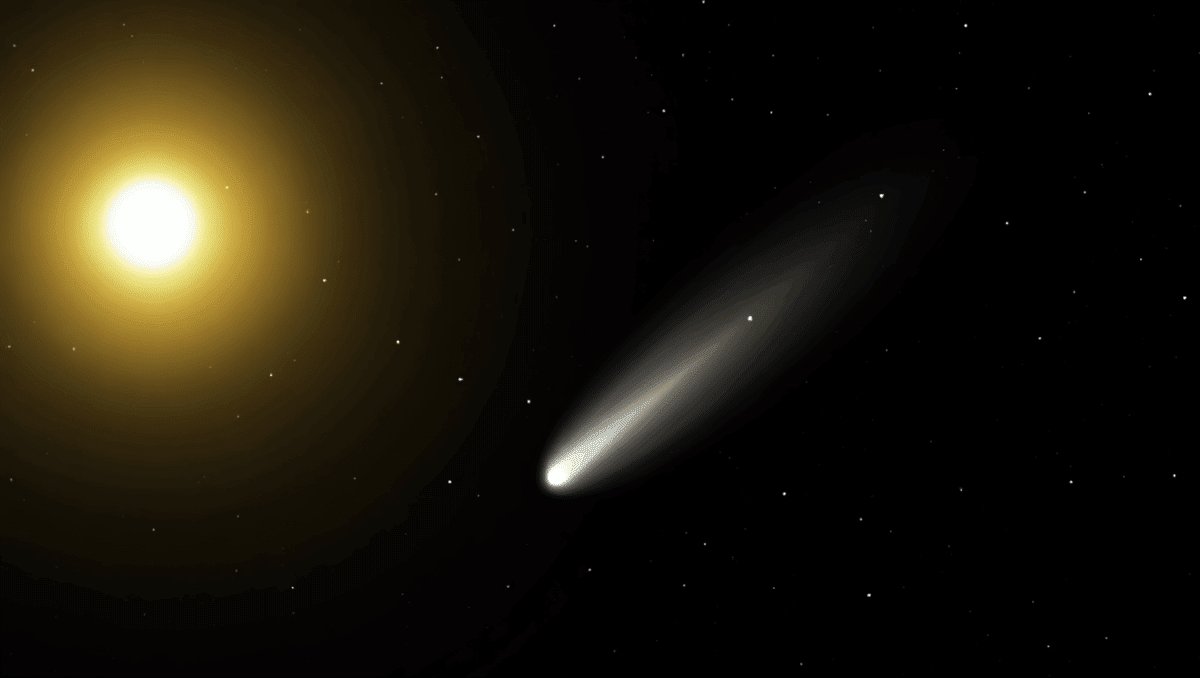
The bizarre visitor known as 3I/ATLAS has surprised astronomers again: instead of the familiar streaming tail that trails away from the Sun, this object developed a plume that points back toward the star. The odd orientation has sparked fresh debate among comet experts, who say the phenomenon challenges simple models of dust and gas behavior in the near-Sun environment.
Observations from multiple observatories show a sudden change in the comet’s appearance that doesn’t fit the usual pattern of a comet brightening and shedding material as it warms. The sunward-facing tail — sometimes called a “anti-tail” or simply a sunward plume — is rare and often short-lived, but when it appears it can reveal unusual physical processes at work on the nucleus.
Why a tail that points to the Sun is unusual
Comets typically display two tails: a diffuse dust tail blown outward by sunlight and a straight ion tail sculpted by the solar wind. Both mechanisms push material away from the Sun, so tails almost always point anti-sunward. When debris streams toward the Sun instead, it forces a rethink about the drivers shaping the coma and tail.
The Growing Demand for Data-Driven Decision Making in Silicon Valley
He quit, ran out of money, and begged to come back — here’s how his boss reacted
- Normal behavior: dust and gas sublimate from the nucleus and are accelerated away from the Sun by radiation pressure and the solar wind.
- Sunward tails: occur when larger particles or specific viewing geometries make material appear to lie on the sunward side, or when short-lived jets or fragmentation events temporarily alter the flow.
In the case of 3I/ATLAS, the sunward feature is pronounced and persistent enough that astronomers are treating it as more than a mere perspective trick. That makes the object an intriguing case study for particle dynamics under variable solar forces.
How astronomers spotted the odd tail
Multiple teams began reporting an atypical morphology in images taken over successive nights. Survey telescopes flagged the change; follow-up photometry and higher-resolution imaging tracked the evolution.
- Wide-field surveys first detected the brightening and structural change.
- Follow-up imaging resolved the sunward plume and measured its length and brightness over time.
- Spectroscopy looked for gas signatures that might indicate volatile-driven jets or fragmentation products.
Coordinated observations are crucial because the sunward tails can form and fade on timescales of days. Rapid-response observations allow researchers to correlate structural changes with increases in brightness or shifts in outgassing rates.
Possible causes: what could push dust toward the Sun?
There are several plausible scenarios that could explain why 3I/ATLAS developed a sunward-pointing tail. Each involves different physical mechanisms and implies different properties for the nucleus and its grains.
1. Large grain dynamics and low radiation pressure
If the coma contains relatively massive dust grains, solar radiation pressure has less leverage to push them away. Under some viewing geometries, these grains can linger near the comet and form a sunward-skewed structure.
- Large grains respond slowly to solar radiation, producing a tail more aligned with orbital motion than with sunlight.
- This scenario implies a higher fraction of millimeter- to centimeter-sized particles in the coma.
2. Recent fragmentation or outbursts
A sudden breakup of the nucleus or an explosive jet can eject material with an initial velocity component directed sunward. If material is launched with the right speed and direction, it may form a temporary plume pointing toward the Sun.
- Fragmentation releases both dust and volatile-rich debris that can light up the coma.
- Outbursts can create transient features that migrate and dissipate over days to weeks.
3. Electrostatic forces and interaction with the solar wind
Microphysical forces — like differential charging of dust grains under intense solar ultraviolet radiation — can cause particles to move in unexpected ways. Charged grains interacting with magnetic fields in the solar wind may produce unusual tail orientations.
- Small charged particles can follow magnetic field lines rather than purely ballistic trajectories.
- Electrostatic lofting from the surface could inject grains into trajectories that temporarily point inward.
4. Projection effects and viewing geometry
Sometimes the sunward tail is partly an optical illusion. When Earth, the comet, and the Sun align in certain ways, material that is actually in the comet’s orbital plane can appear projected toward the Sun.
- Viewing angle can compress the apparent structure of the coma into a sunward-facing spike.
- Careful modeling of the geometry is required to separate projection artifacts from real physical flows.
What this tells us about 3I/ATLAS and other interstellar visitors
If 3I/ATLAS is indeed interstellar or an unusual solar-system object, its atypical tail behavior offers a rare window into composition and structure. The presence of large grains or frequent fragmentation, for instance, could indicate a history of thermal or collisional processing unlike typical comets.
- Composition clues: spectroscopy of the plume can reveal the mix of ices and refractory material.
- Surface properties: repeated outbursts or an abundance of large grains suggest a loosely bound, possibly porous surface.
- Orbital history: comparing its behavior to other visitors helps place 3I/ATLAS in context of dynamical origin theories.
Researchers emphasize that one anomalous feature is rarely decisive, but it can guide follow-up priorities. For example, if large grains dominate, radar and thermal infrared observations become key; if fragmentation is active, monitoring for secondary fragments and changing photometry becomes essential.
How scientists are testing the theories right now
Teams are combining imagery, spectroscopy, and modeling to pin down the mechanisms behind the sunward tail. The approach is multidisciplinary and iterative.
- Time-series imaging tracks morphological changes and helps estimate particle speeds.
- Spectral observations search for volatile emissions that would indicate fresh ice exposure.
- Numerical simulations model grain dynamics under radiation pressure, gravity, and electromagnetic forces.
- Comparative studies examine whether similar features appeared in past comets and interstellar encounters.
Real-time coordination matters: fast-moving or transient phenomena require flexible telescope scheduling and rapid data sharing. Citizen scientists and amateur astronomers often contribute valuable early detections that prompt professional follow-up.
Why astronomers are excited about unusual comet tails
Anomalous tails like the one on 3I/ATLAS are more than curiosities. They expose physical processes that are otherwise hidden and can refine models used to interpret cometary behavior across the solar system and beyond.
- They help constrain dust size distributions and ejection velocities.
- They reveal how small bodies respond to extreme heating and space weathering.
- They provide real-world tests for particle interaction models under solar influence.
As observations continue, each new image and spectrum will narrow the list of viable explanations. For now, 3I/ATLAS stands as a reminder that small bodies can still surprise us, and that careful, rapid observation remains the best tool for turning mysteries into understanding.
You might also like:
- Comet 3I/ATLAS moving strangely: scientists explain why
- Comet spins backward near sun, leaving scientists baffled
- Bizarre comet stumps world’s most powerful telescopes
- asteroid collision observed: astronomers see debris cloud and brightness changes
- 3I/ATLAS alien search: scientists find no signs of alien life

William Anderson is a multimedia producer specializing in videos, podcasts, and interactive galleries. With five years of immersive content creation, he turns information into a rich audio‑visual experience. His storytelling skills draw you directly into the heart of every story, on any platform.


Ya know, that comets tail actin like a sunflower twistin towards the sun got me thinkin. Natures full of surprises, aint it? Keeps us astronomers on our toes, huh? Gotta love the cosmic dance!
Man, I remember the time I spotted a comet in the night sky with my old telescope. This whole tail pointing towards the sun thing is mind-bending! Can you imagine the kind of forces at play out there? Space is wild, dude.
Man, that comets tail is doing its own thing, huh? Pointing towards the sun like its got a secret crush or something. Maybe its trying to get a tan out there in the vastness of space. Who knows? Space is wild, man.
Man, this comets tail actin all rebellious, pointin towards the sun like, I aint like other tails, I do my own thing. Gotta give props to them astronomers for catchin this cosmic drama goin on up there.
Yo, aint that the truth! This comet out here bein all sassy, showin off its rebellious side. Like, I aint followin the rules, Imma do my own thing! Gotta hand it to them astronomers for catchin this cosmic soap opera in action. Its like the drama up there is more entertainin than some reality TV shows down here on Earth!
Man, that comets tail be acting like a compass pointing straight to the sun! Its like the universe forgot about basic physics or something. Maybe its just lost and needs some space GPS to find its way back.
I remember this one time I tried to take a selfie with the sunset, but ended up looking like a potato. So, seeing a comet with a tail pointin towards the sun feels like a cosmic plot twist. Natures got its own selfie game, huh?
Man, that comets tail be acting like its lost, pointing towards the sun and all. Like, does it need directions or something? Maybe its just trying to catch some rays, who knows? Space is weird, man.
Man, this comets tail actin all rebellious, pointin towards the sun like its tryna break the rules. Reminds me of that one time I defied gravity… until I fell flat on my face.
Dang, that comets got some attitude, huh? Pointin where it shouldnt be, rebel without a cause! Gravitys a harsh mistress, aint it? One minute youre defying it, next thing you know, face plant! Maybe that comet needs a lesson in gravity, too!
Man, that comets tail is acting sus, pointing towards the sun like its looking for a tan or something! Astronomers got their work cut out figuring whats pushing dust that way. Space mysteries, man!
Man, this comets tail pointing towards the sun got me thinking! Like, whats up with that? Maybe its just trying to get a tan or something. Space is full of surprises, aint it?
Man, talk about a comet with a rebellious streak! This ATLAS dudes tail be like, Nah, I aint followin the rules, Imma point straight at the Sun! Who knew space rocks could be so sassy?
Dang, that ATLAS comets got some attitude, huh? Straight-up defying the laws of space and physics like its nobo- comets business! Who knew rocks could sass us from millions of miles away? Watch out, Sun, you got a rebel on your tail now!
Oh, look at that comet showing off its tail like a diva! Pointing towards the sun, huh? Must be trying to catch some cosmic rays or just playing hard to get. Space drama at its finest!
Oh, would you look at that flashy comet stealing the spotlight like its auditioning for a cosmic reality show! Bet its out there trying to outshine the sun with that tail drama. Who knew space could be so full of divas? *insert eye roll*
Man, this comets tail is acting like a rebellious teen trying to soak up all the suns attention. Like, Hey, look at me! Wonder whats causing this cosmic show-off behavior. Maybe its just a comet with a flare for the dramatic!
Man, comets are like the rockstars of space, always pulling some crazy stunts! This ones tail pointing at the Sun? Talk about a rebellious move! Cant wait to see what other surprises space has in store for us next!
Man, youre spot on! Comets be out there acting like cosmic rebels, flipping their tails at the Sun like its no biggie. Space truly be the ultimate reality show, always keeping us on our toes. Who needs Netflix when you got the galaxy throwing these plot twists our way, right? Wonder what other surprises are lurking in the cosmic corner store ready to pop up next!
Man, this comets tails acting like a rebellious kid dodging chores! Pointing towards the sun, really? Mustve skipped astronomy class. Maybe its just trying to get a tan. Who knew comets could be so sassy?
Man, this comets tail pointing at the Sun is like a cat chasing its own tail, but in space! Wonder whats pushing all that dust sunward. Someone get these astronomers a space detective to crack this cosmic case!
Man, this comets tail is like a rebellious teenager – going against the norm and pointing towards the Sun! Its like, Forget the rules, Ill shine where I want! Nature sure knows how to keep us on our toes.
Dude, totally get what you mean! That comets like the ultimate rebel without a cause, defying gravity and all that jazz. Natures out here throwing plot twists like its a soap opera marathon. Who knew space could be so sassy, right? Its like, Watch me break the rules, Earthlings! Too bad we cant all shine wherever we please, huh?